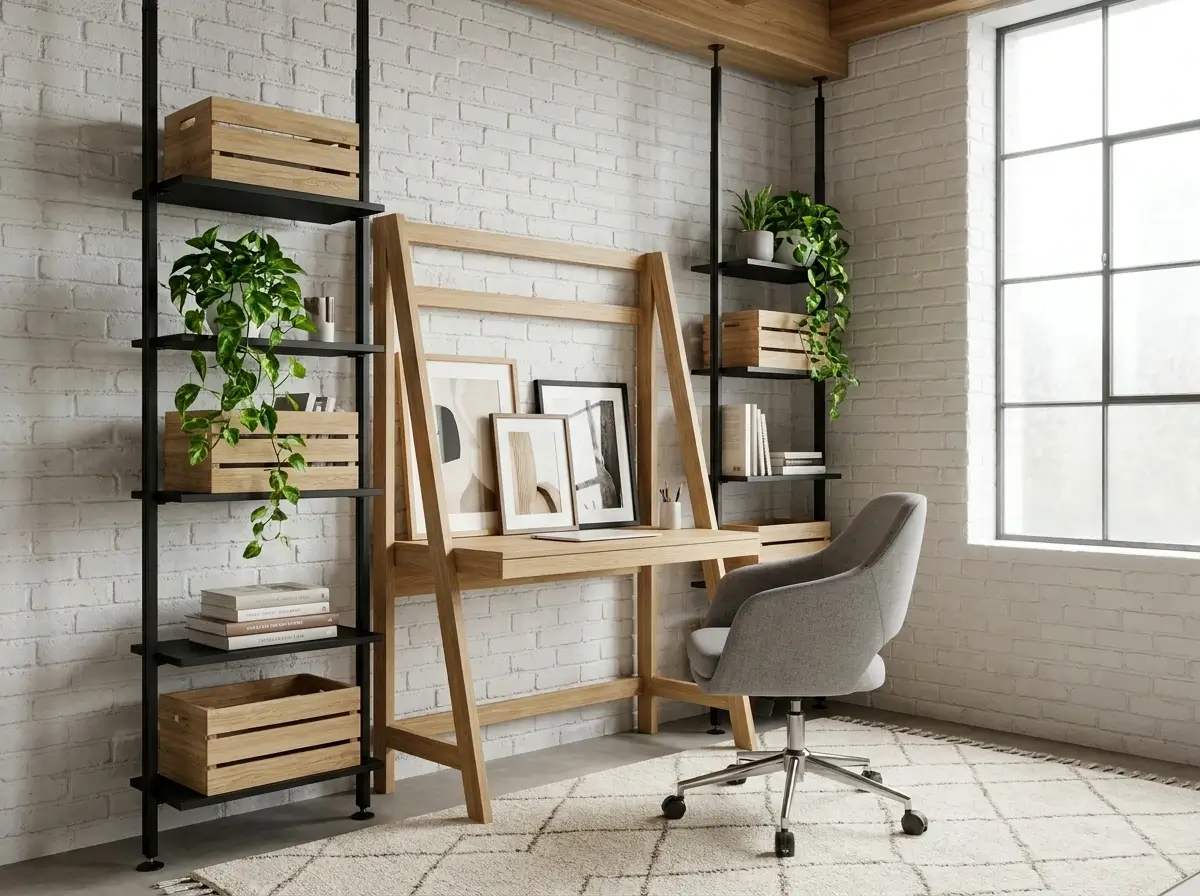
Setting up a workspace under an angled roof often feels like a balancing act between productivity and bumped heads. For renters, the challenge is even greater.
You need a functional home office, but permanent shelves and wall-mounted monitors are quick ways to lose a security deposit.
A common mistake is trying to force standard office furniture into a room with low knee walls and slanted ceilings, which instantly makes the room feel cramped.
Instead, the most successful small loft office ideas rely on flexibility, strategic desk placement, and damage-free organization.
By choosing the right freestanding pieces and optimizing your layout, you can carve out a professional background for video calls without ever picking up a drill.
Below, we will explore practical ways to manage cables, position your desk, and store paperwork so you can work comfortably in your tiny loft.
The Best Desk Types for Renter-Friendly Small Loft Office Ideas
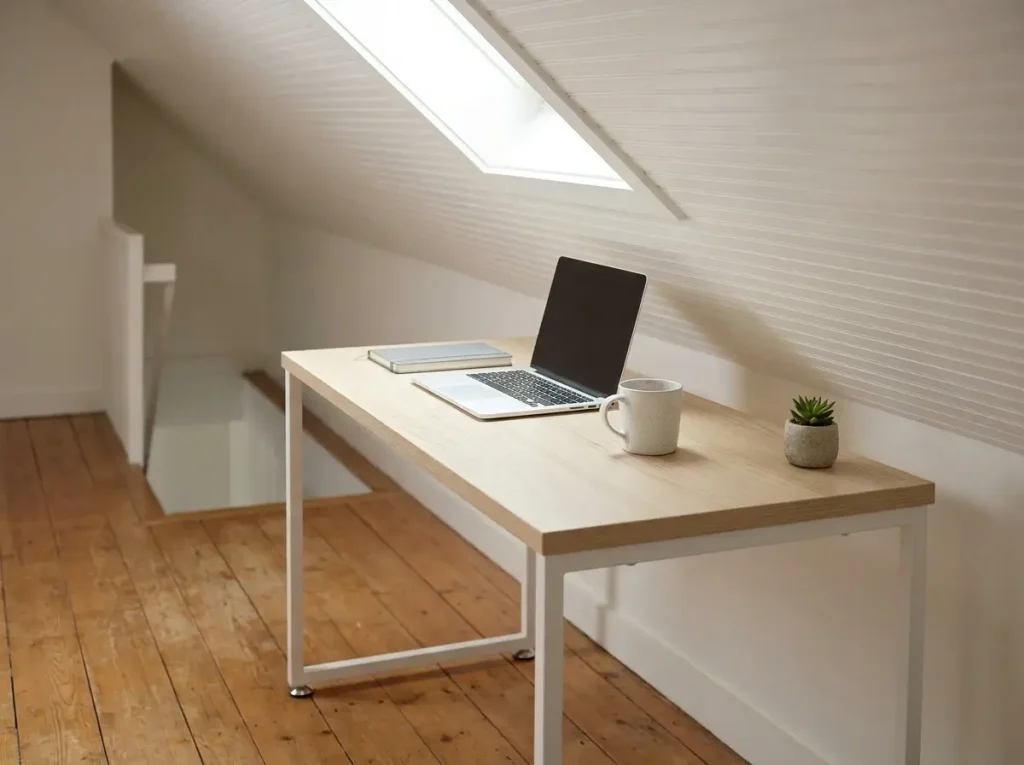
Finding the right desk is the foundation of all successful small loft office ideas. When you are establishing a remote work setup in an attic or upper-level bonus room, traditional office furniture rarely works in your favor.
A common mistake is purchasing a heavy, bulky executive desk under the assumption that professional WFH loft ideas require massive, solid wood furniture.
In reality, large desks are a nightmare for renters. Because loft layouts usually involve tricky access, you want to avoid the headache of carrying furniture up narrow stairs.
Heavy desks also eat up precious floor space and severely limit your layout options when trying to navigate around sloped ceilings. Instead, you need furniture that actively adapts to your temporary space.
Lightweight Folding Desks and Modular Options
When executing practical small loft office ideas, you should always prioritize lightweight, foldable, or modular desks. Renters need the flexibility to pack up and relocate easily at the end of a lease.
A lightweight folding desk can be collapsed in minutes. This prevents accidental damage to drywall during a move, helping keep your security deposit safe.
Modular desks offer similar benefits, allowing you to assemble and disassemble the frame repeatedly without worrying about stripped screws or weakened joints.
Another structural quirk of converted upper rooms is the flooring itself. You will often encounter uneven loft floors, particularly in older buildings where the floorboards have settled over the decades.
To combat this, look for furniture featuring adjustable desk legs or leveling feet. These simple screw-in footings allow you to perfectly level your workspace, ensuring your laptop and monitor do not wobble every time you type an email.
Narrow Profile Workstations
If your daily tasks only require a laptop and a notebook, there is no reason to sacrifice half of your room to a deep workstation. Some of the most effective small loft office ideas involve scaling down to a narrow console desk.
Standard desks are typically 24 to 30 inches deep, which can quickly block walkways in a tight open-concept layout. A narrow profile workstation usually sits right around 15 to 20 inches in depth.
This gives you plenty of room for your laptop and a cup of coffee while keeping the center of the room entirely clear.
When shopping for a renter-friendly desk, keep these criteria in mind:
- Maximum depth of 20 inches to preserve floor space in tight quarters.
- Adjustable leveling feet to instantly compensate for sloped or uneven flooring.
- Collapsible frames for a completely stress-free moving day.
- Total weight under 50 pounds so the desk can be safely maneuvered by one person.
Ultimately, the absolute best small loft office ideas rely on furniture that serves your professional needs without becoming a permanent, unmovable fixture in your apartment.
By selecting a smart, adaptable desk, you establish a functional foundation for the rest of your workspace.
Positioning Your Desk Under Slanted Ceilings and Eaves
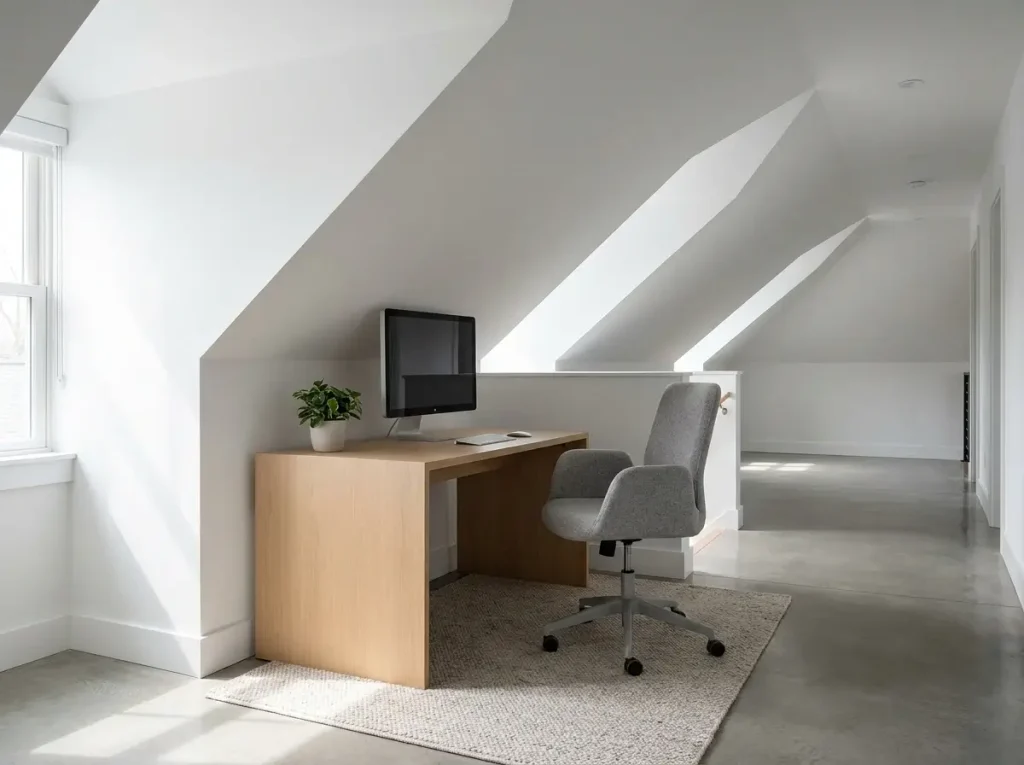
When mapping out your small loft office ideas, dealing with a steeply pitched roof is often the biggest puzzle you will face.
Awkward architecture can quickly turn what should be a productive workspace into a cramped, frustrating zone where you are constantly bumping your head.
A common mistake renters make is ignoring the natural flow of the ceiling height. Instead of forcing your setup into the center of the room and disrupting the walkway, the most successful small loft office ideas embrace the unique architecture by tucking the workstation directly into the eaves.
Because you cannot rely on custom-built, perfectly measured wall units, careful placement of your freestanding desk is everything.
Facing the Wall: Utilizing the Lowest Knee Walls
To maximize your usable floor space, the most effective strategy is to place the back of your desk against the lowest knee wall. This angled area of a loft is essentially dead space, simply because you cannot comfortably stand there.
By sliding your desk into this low-clearance zone, you keep the taller, central areas of the room completely open for daily foot traffic.
However, you must be extremely careful with your technology setup. Avoid positioning your monitor so far back that the slanted ceiling forces the screen to tilt downward awkwardly. You need your primary screen at eye level to prevent severe neck and shoulder strain.
If the roofline is too low, pull the desk forward just an inch or two to allow the monitor to stand perfectly straight.
Facing the Room: Maintaining Seating Clearance
Proper seating placement is another cornerstone of highly functional small loft office ideas. While your desk, cables, and monitors can comfortably live under the lowest part of the slope, your own body cannot.
You must ensure your office chair sits exactly where the ceiling returns to at least standard standing height. Tucking your chair under a low slope might feel cozy at first, but standing up quickly after a long conference call can result in a painful collision with the ceiling.
Additionally, always calculate your “roll-back” zone. Leave enough clearance behind the chair so you can safely push away from the desk without your head or the back of your chair hitting the sloped drywall.
Desk Placement Do’s and Don’ts
To quickly summarize how to execute these small loft office ideas without causing yourself daily frustration, keep these simple layout guidelines in mind:
- DO: Place the rear edge of your desk against the lowest knee wall to repurpose dead floor space.
- DON’T: Shove your monitor so far backward that the angled ceiling pushes it out of ergonomic alignment.
- DO: Ensure the center point of your office chair rests under a standard-height ceiling so you can stand up safely.
- DON’T: Forget to measure the rollback distance; you need a few feet of clearance behind your chair to stretch and move freely.
By carefully measuring your clearances and working actively with the roofline rather than against it, you can create an open, breathable work environment.
This simple shift in layout immediately makes the whole room feel larger, more intentional, and significantly more professional.
Drill-Free Cable Management to Keep Your Workspace Tidy
One of the most easily overlooked aspects of executing great small loft office ideas is dealing with the inevitable mess of electronics. When you are working in a tight footprint, running cables loosely across the floor creates a serious trip hazard.
In a small space, visual clutter immediately translates into mental stress, making it difficult to focus on your workday. Furthermore, when your office chair needs to roll freely in a confined area, loose wires often get tangled in the wheels.
This is not only frustrating but can actually damage your expensive electronics if a cord gets violently yanked from its port.
Renters face the unique challenge of needing damage-free cable management. You cannot simply drill holes into the drywall to hide wires, and you definitely should not drill a permanent grommet hole into a desk you might want to resell later. So, how do you manage the chaos?
The best small loft office ideas utilize smart, temporary solutions to keep cords invisible without leaving a trace behind.
Under-Desk Organization
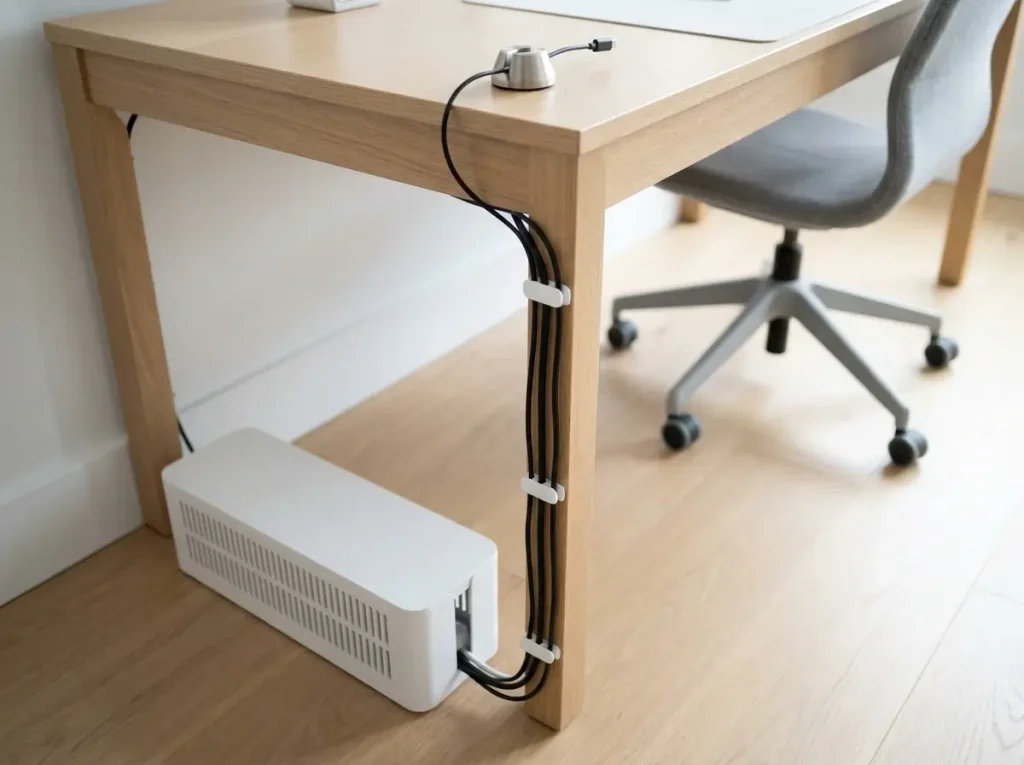
To route cables safely from the floor to your monitors without damaging furniture, heavy-duty adhesive cable clips are your best tool. These small, inexpensive clips stick directly to the back of your desk legs or along the rear edge of the tabletop.
Simply snap your monitor and power cords into the clips. This creates a clean, vertical line that hides the cords entirely from the front view of your desk.
When shopping for adhesive clips, look for brands that use stretch-release adhesive strips. These guarantee a completely damage-free removal, which is critical for protecting the veneer on lightweight folding desks or the paint if you choose to route a wire along the baseboard.
If you are researching top-tier small loft office ideas, routing cables vertically rather than letting them dangle freely is an absolute game-changer.
Hiding Floor Power Strips
Once your cables are successfully routed down the leg of your desk, you still have to deal with the bulky power strip on the floor. A floor full of tangled wires ruins even the most beautifully designed remote work setup.
Employing cable management boxes on the floor is the easiest way to hide power strips. These simple, vented boxes completely enclose the surge protector and all the bulky plugs.
They blend seamlessly against the baseboards, preventing dust buildup and keeping your workspace looking pristine.
For the cords you actually need to interact with daily, like your phone charger or laptop power supply, avoid letting them slip behind the desk.
Using weighted desktop cord holders will keep your charging cables easily accessible on top of your workstation without requiring permanent adhesive on the desktop.
To effectively implement these small loft office ideas for your wiring, follow this drill-free sequence:
- Consolidate at the source: Place a high-quality surge protector inside a cable management box directly below your desk.
- Route vertically: Use adhesive clips on the rear legs of your desk to guide the thickest monitor and power cables upward.
- Secure horizontally: Run another line of adhesive clips along the back edge of the desktop to keep cables off the floor.
- Manage the daily cords: Place a weighted cord holder near your keyboard to catch the charging cables you unplug frequently.
Brilliant Small Loft Office Ideas for Freestanding File Storage
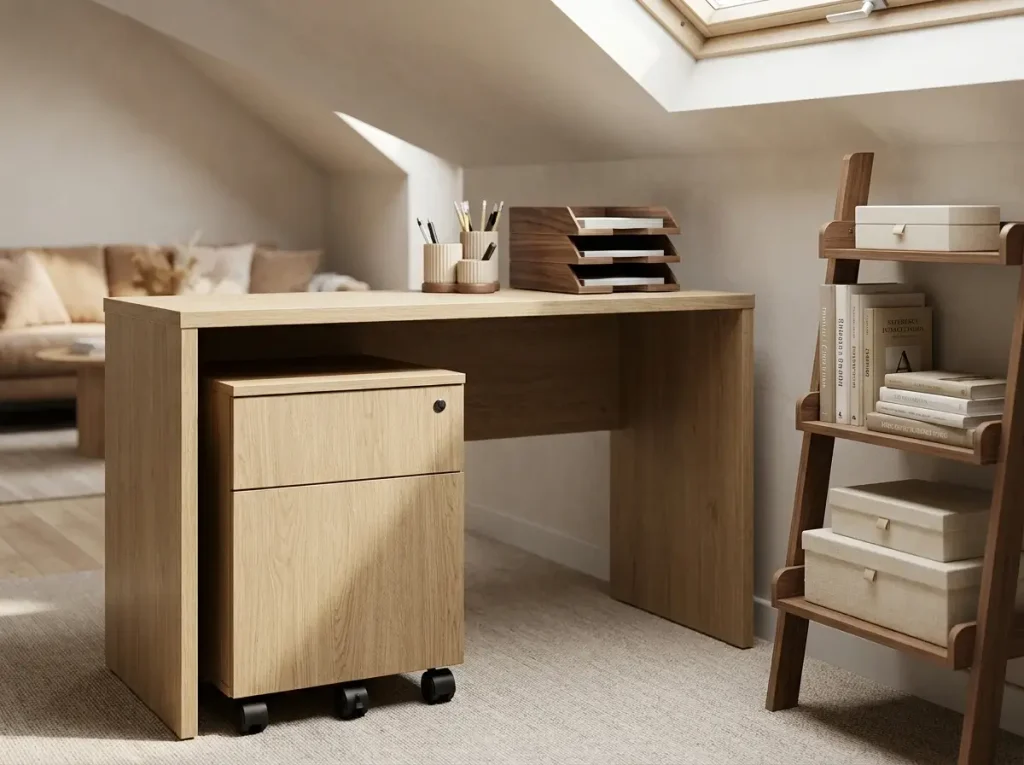
When you run a business or manage household paperwork from a tiny footprint, storage quickly becomes your biggest hurdle. Renters cannot simply drill heavy-duty shelves into the angled walls, which leaves many remote workers asking: where do I keep my physical files?
The most effective small loft office ideas focus entirely on portable, freestanding storage solutions. By avoiding built-in cabinetry, you protect your security deposit and ensure your entire workspace can easily move to your next apartment.
You do not have to sacrifice organization just because you lack a traditional home office closet.
Low-Profile Rolling Drawer Units
One of the smartest small loft office ideas is investing in low-profile, rolling filing cabinets that slide perfectly under your desk. This tactic instantly reclaims the vertical space beneath your workstation that would otherwise go entirely unused.
Standard metal filing cabinets are bulky, heavy, and notoriously difficult to maneuver up narrow staircases. Instead, seek out lightweight, mobile units equipped with durable casters.
The rolling feature is critical when navigating a tight loft. If you need extra legroom during a long conference call, you can quickly wheel the cabinet out of the way. Once the workday ends, you simply tuck it neatly out of sight to keep the floor clear.
Leaning Ladders and Freestanding Shelving
For items that do not need to be locked away in drawers, open vertical storage is essential. However, since you cannot mount floating shelves onto a slanted ceiling, you must rely on the room’s taller, straight knee walls.
Freestanding ladder shelves are an excellent addition to your small loft office ideas. They lean securely against standard-height walls, utilizing vertical height without requiring a single wall anchor or screw.
If you need a more comprehensive display or storage space, there are plenty of excellent freestanding shelving configurations designed specifically for renters who cannot drill. These units give you a sturdy place to stack reference books, printer paper, and binders safely.
Desktop Organizers and Decorative Boxes
Industrial plastic bins might work perfectly in a basement, but they will instantly ruin the cozy aesthetic of an open-concept loft. Because your workspace is likely visible from your bed or living area, you should swap standard plastic bins for decorative storage boxes.
Faux-leather or linen-wrapped boxes blend beautifully with residential decor. They are perfect for hiding ugly office supplies like staplers, extra ink cartridges, and messy charging cords.
Finally, complete your small loft office ideas by choosing modular desktop organizers. Consider adding these practical pieces to your daily setup:
- Tiered paper trays to separate incoming mail from urgent work documents.
- Segmented pen cups that keep your highlighters and stylus pens upright.
- Small desktop drawers that act as a monitor stand while storing sticky notes underneath.
Modular desktop pieces are perfect for frequent movers. When your lease is finally up, you simply pack the tray directly into a moving box, keeping your intricate sorting system perfectly intact for the next home.
Task Lighting Strategies for Video Calls in Dark Eaves
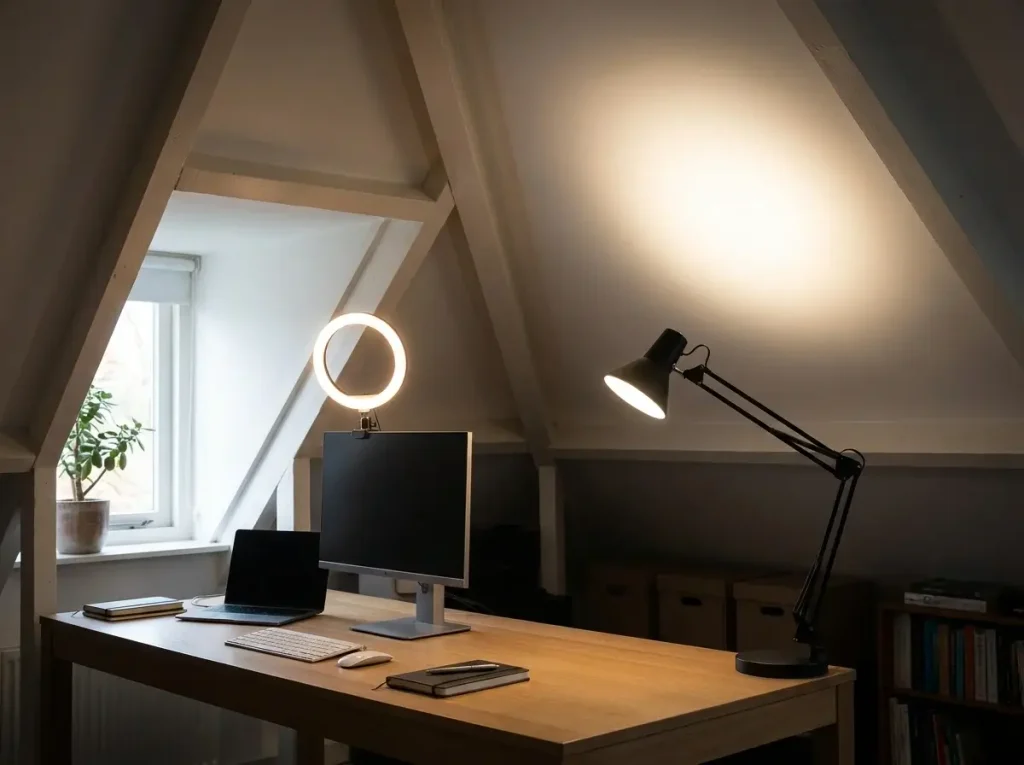
Converted attics and bonus rooms are notoriously dark, often relying on a single outdated overhead fixture or a tiny dormer window.
When you are putting together effective small loft office ideas, you will quickly realize that standard room lighting is rarely enough to make you look professional on a video call.
Shadows cast by steeply sloped ceilings can make your workspace feel gloomy and cramped. For renters, hardwiring new recessed lights or installing heavy track lighting is completely out of the question.
You need portable, drill-free solutions that instantly elevate your on-camera appearance.
The secret to a great remote work setup is layering your light sources to trick the webcam into seeing a bright, airy room.
Bouncing Light Off Slopes
Lofts typically lack sufficient hardwired overhead lighting, meaning you have to bring your own ambient light into the space. One of the most creative small loft office ideas is actually using the room’s awkward architecture to your advantage.
Instead of pointing a harsh desk lamp directly at your keyboard or straight at your face, use an adjustable LED desk lamp to bounce light off the slanted ceiling.
By aiming a bright beam upward against the white drywall of the slope, you diffuse the light across the room. This creates a softer, ambient glow that fills the dark eaves without causing a harsh glare on your monitor or straining your eyes during long shifts.
Eliminating Video Silhouettes
Ambient room lighting is important, but the placement of your desk relative to natural light will ultimately make or break your video presence. A common mistake when implementing small loft office ideas is placing the desk with a small dormer window directly behind the chair.
While looking out at the room might feel nice, the bright natural backlight pouring in from behind you will force your webcam to adjust improperly. This instantly turns you into a dark, featureless silhouette on Zoom or Teams calls.
To fix this, you should always try to face the window so the natural light illuminates your face evenly. However, if your layout makes this impossible, or if you frequently work after sunset, you must introduce dedicated front-facing illumination.
Utilizing Clamp-On Ring Lights
When natural light fails, a clamp-on ring light becomes an absolute staple for brilliant small loft office ideas. These lightweight, portable rings attach directly to the edge of your desk, the arm of your chair, or even the top of your monitor.
Because they clamp onto existing surfaces, they take up zero floor space and require no permanent mounting hardware. This makes them the ultimate renter-friendly lighting hack.
When positioning your ring light, set it slightly above eye level and tilt it downward to minimize screen glare, especially if you wear glasses. Look for models that offer adjustable color temperatures.
You can use cool white light to mimic daylight during morning meetings, and switch to a warm yellow glow for late-evening focus sessions.
By combining a ceiling-bounced desk lamp for ambient warmth and a dedicated clamp-on light for your face, you completely eliminate the dark attic vibe from your webcam feed.
Portable Acoustic Solutions for Small Loft Office Ideas
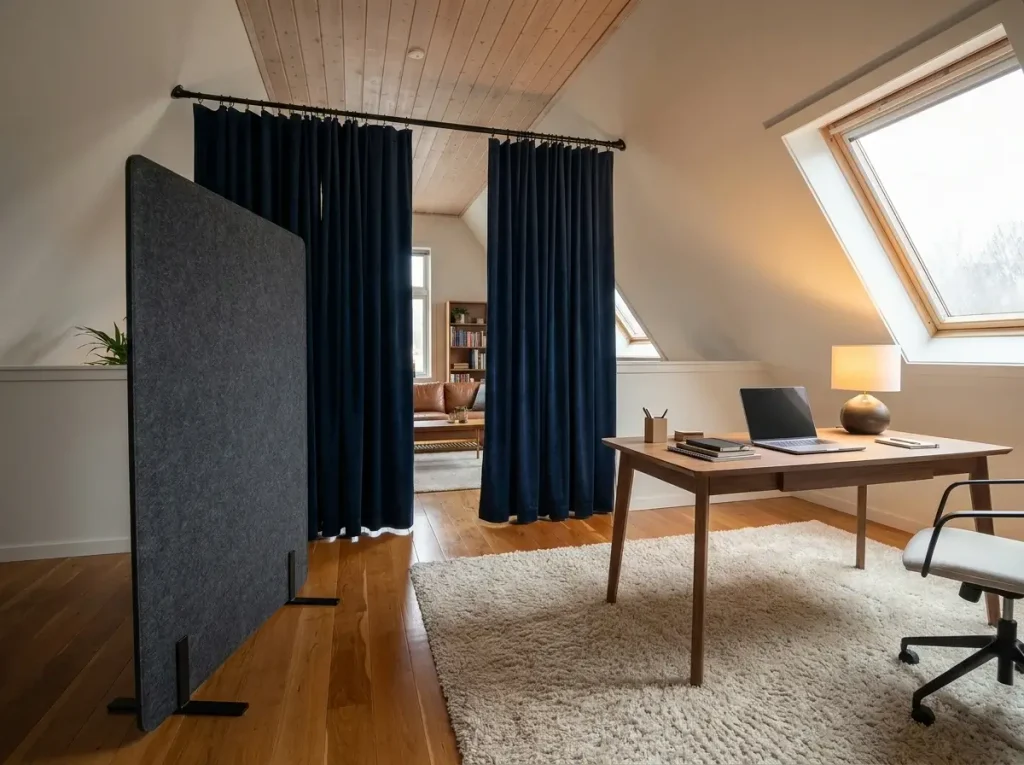
One of the most frustrating aspects of working in an open-concept layout is the constant echo. Open lofts naturally amplify every single keyboard click, pen tap, and conference call voice.
When you are brainstorming small loft office ideas, ignoring the room’s acoustics will quickly lead to daily headaches and annoyed coworkers on the other end of your microphone.
Because you are renting, you cannot staple traditional acoustic foam directly to the drywall. You also cannot permanently install a drop ceiling to catch those rogue sound waves. Instead, you need temporary, damage-free sound dampening.
The most effective small loft office ideas for noise control rely entirely on portable textiles and clever furniture placement. By introducing soft, thick materials, you can stop sound from bouncing off the hard angles of your ceiling.
Freestanding Panels and Floor Coverings
Hardwood or laminate floors are notorious for bouncing sound around an empty room. To instantly dampen the noise of your rolling chair and your voice, place a dense, high-pile rug directly under your workstation.
You will want to place a hard plastic chair mat over the rug so you can still roll your desk chair easily. However, the thick fabric underneath will immediately absorb excess echo before it travels across the floorboards.
If a rug is simply not enough, use thick, freestanding acoustic dividers to block sound waves. These portable partitions act as a physical barrier that catches your voice before it bounces off the slanted ceiling.
Integrating a stylish felt or fabric divider is one of those brilliant small loft office ideas that solves both an auditory problem and a visual one. It quiets the room while giving you a professional backdrop for meetings.
Tension Rod Curtains
Sometimes, the noise is not coming from your desk—it is coming from the rest of the apartment. If you share your loft with a partner or simply need to quiet the hum of a kitchen refrigerator down below, a textile barrier works wonders.
You can easily hang temporary sound-absorbing curtains using heavy-duty tension rods. Just secure a high-tension shower rod between two straight knee walls or across a narrow dormer opening.
These heavy velvet or thermal-lined curtains absorb a massive amount of ambient noise. Best of all, they can be taken down in seconds without leaving a single screw hole behind.
When comparing renter-friendly small loft office ideas for improving acoustics, consider these two main approaches:
- Freestanding Acoustic Panels: Excellent for absorbing high-frequency noises right at the source, such as aggressive typing or loud phone conversations. They require zero installation and can be folded away at the end of the day.
- Heavyweight Curtains on Tension Rods: Ideal for blocking out ambient background noise from other open areas of the loft. They provide incredible overall sound dampening, but you must have walls close enough together to support a tension rod safely.
By strategically placing heavy textiles around your desk, you can successfully transform a hollow, echoing attic into a quiet, professional command center.
Creating a Visual Boundary Between Work and Relaxation
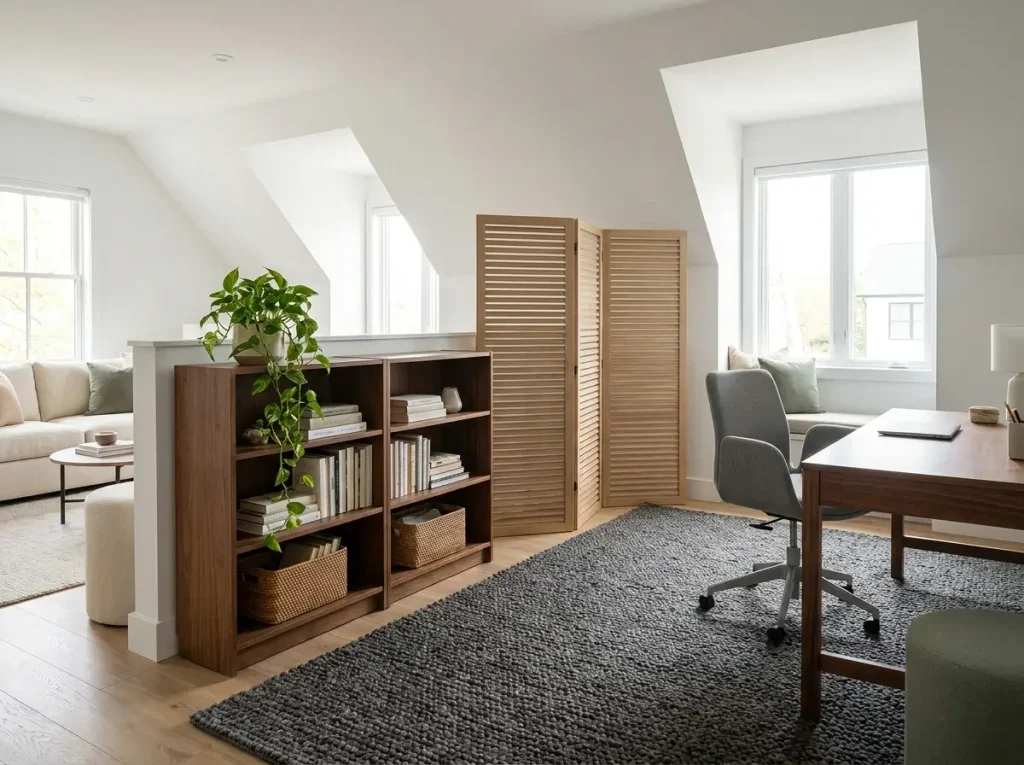
Working in an open-concept layout presents a unique psychological challenge: it becomes incredibly easy to let your professional life bleed into your personal time.
When your laptop is always visible from your bed or your living area couch, you never truly feel like you have left the office.
This is why the most crucial small loft office ideas go beyond just buying a desk; they focus heavily on creating a distinct mental and physical separation.
If you are struggling to transition out of work mode at the end of the day, you must establish a visual boundary.
Renters cannot frame and drywall a new room, but there are plenty of creative ways to section off your floor plan without making permanent alterations.
In fact, establishing this workspace boundary is just one essential step in mastering your overall tiny layout organization.
Furniture as Boundaries
One of the most effective small loft office ideas involves repurposing heavy furniture pieces you might already own.
Rather than standing a tall, open-backed bookcase upright against a wall, try laying it completely on its side horizontally. This instantly creates a low, renter-friendly boundary wall that visually separates your desk from the rest of the room.
Because the sideways bookcase stays relatively low to the ground, it does not block the flow of natural light coming from your small dormer windows.
However, when you are sitting down in your office chair, that low barrier is just high enough to hide the rest of your living space from your immediate field of view.
This simple trick allows you to physically step out of the “office” and genuinely log off at the end of the day, leaving your work behind a tangible barrier.
Temporary Screens and Floor Definition
If you prefer a taller visual block to hide your computer monitors entirely, employing a folding screen is one of the most classic small loft office ideas.
A lightweight canvas screen, a traditional shoji screen, or a slatted wood divider can be easily maneuvered to hide your workstation on the weekends or when guests visit.
These screens are completely freestanding, meaning they will never jeopardize your security deposit with wall anchors.
When it is time to move to a new apartment, they simply fold flat and slide right into a moving truck. If you want to explore even more partition options, there are numerous styles of non-permanent room dividers that work beautifully without touching the drywall.
Finally, you can define the exact office footprint cleanly with a distinct floor rug. While a rug obviously does not create a vertical wall, it acts as a powerful psychological anchor in an open room.
By placing your desk, chair, and portable file cabinets entirely within the borders of a specific area rug, you create a highly recognizable zone.
Make sure the rug is large enough to accommodate the full roll-back distance of your chair so you are not constantly catching the casters on the edge.
The sudden change in texture beneath your feet actively signals a transition in your day. When you step off that rug, you are officially off the clock.
Executing these careful small loft office ideas ensures that your functional command center never takes over the relaxing, cozy atmosphere of your beautiful upper-level retreat.
Conclusion
Carving out a dedicated workspace under a pitched roof doesn’t require tearing down drywall or sacrificing your security deposit. The most effective small loft office ideas are rooted in adaptability.
By choosing lightweight desks, utilizing portable file storage, and managing your cables with adhesive solutions, you can build a highly functional command center.
Positioning your setup carefully under the eaves ensures you stay comfortable, while strategic task lighting keeps you looking professional on every video call.
Ready to refine the rest of your layout? Review our comprehensive guide on managing small loft layouts to ensure every square foot of your upstairs retreat works perfectly for your lifestyle.