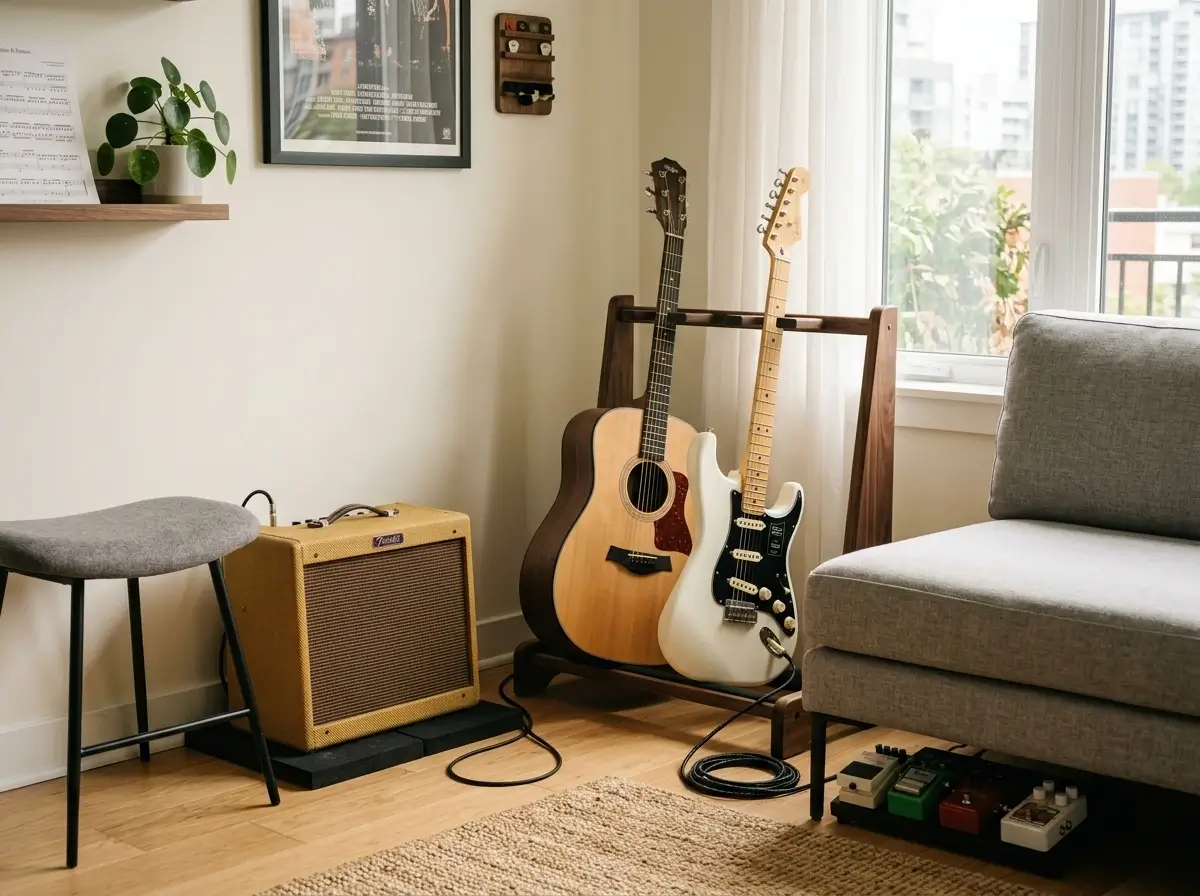
Creating a dedicated practice space in an apartment often feels like a puzzle. Between bulky amplifiers, sprawling pedalboards, and delicate instruments, gear can quickly take over your living area.
Worse, the constant fear of losing a security deposit keeps many musicians from mounting wall hangers or installing heavy shelves.
If you are tired of tripping over cables or keeping your favorite acoustic locked inside its case, you need a smarter layout. Implementing practical small guitar room ideas allows you to showcase your instruments safely and practice comfortably, without drilling a single hole.
This guide breaks down exactly how to build an inspiring, renter-friendly setup. We will cover freestanding storage racks, ways to manage structure-borne amp noise, and strategies for keeping your space organized so you can focus entirely on playing.
1. Freestanding Storage and Display for Small Guitar Room Ideas
When you live in an apartment, the dream of lining your walls with beautiful instruments often collides with the reality of strict lease agreements.
Most landlords strictly prohibit the heavy drywall anchors required to safely mount traditional wall hangers. Drilling multiple holes into the studs means risking your security deposit and dealing with tedious spackle repairs when you finally move out.
Fortunately, you do not have to keep your instruments locked away in dark closets. The foundation of the best small guitar room ideas begins with utilizing your floor space smartly through freestanding display solutions.
By choosing the right racks, you can keep your gear accessible and your walls perfectly intact.
Multi-Guitar Racks vs. Single Stands
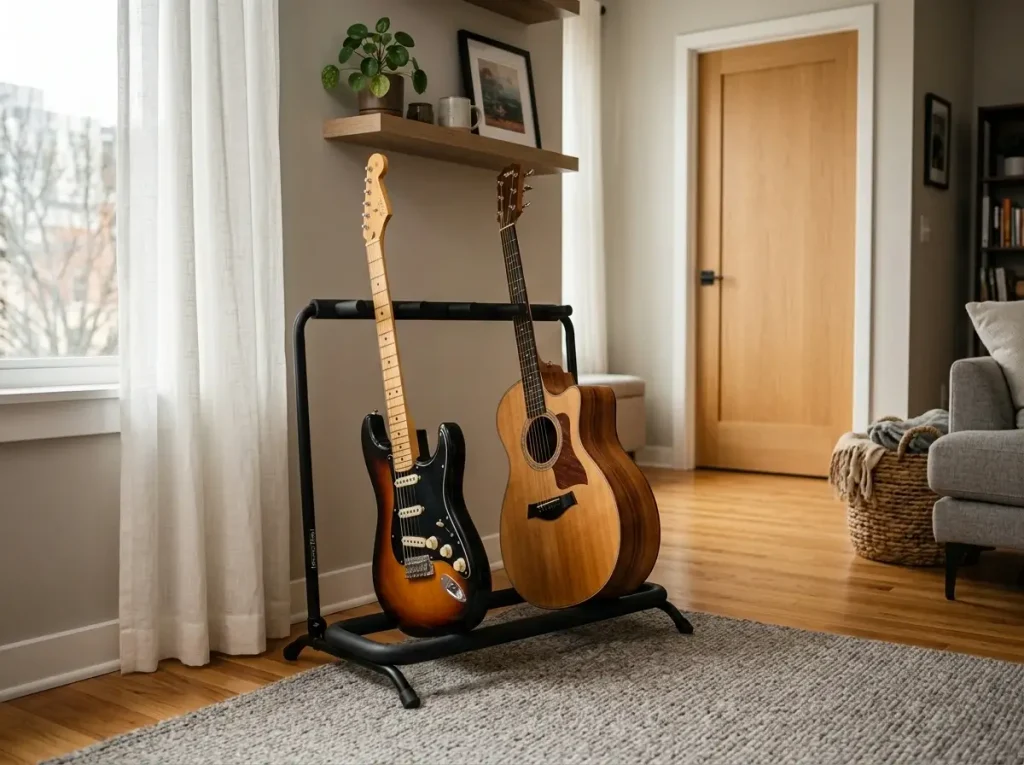
If you own more than one instrument, scattering single tripod stands around the room wastes precious square footage. Instead, a consolidated multi-instrument rack is a space-saving game-changer.
Tubular multi-guitar racks or folding A-frame racks allow you to securely store three, five, or even seven instruments in the footprint of a single side table.
For renters with slightly higher ceilings, tension-rod display systems are another fantastic option. These clever poles press firmly between the floor and ceiling using spring tension, allowing you to display guitars vertically without drilling a single screw.
When selecting any tubular rack, always ensure the padding is made from nitrocellulose-safe materials to prevent chemical reactions that can mar the finish on high-end or vintage guitars.
Grouping all your instruments and stands into one cohesive area is the critical first step in designating a dedicated hobby zone.
By concentrating your gear into one visual footprint, you keep the rest of your apartment feeling open and uncluttered. This focused approach is one of the most effective small guitar room ideas for maintaining a clean, intentional aesthetic.
Furthermore, keeping your instruments out of their hardshell cases means you are far more likely to pick them up and practice daily.
Preventing Accidental Tip-Overs
While freestanding racks protect your deposit, they must be loaded properly to protect your instruments. A fully loaded multi-guitar stand can become dangerously top-heavy, especially on plush apartment carpeting.
Always place the heaviest instruments, such as solid-body electrics or heavy basses, on the bottom slots or closest to the center of gravity.
Keep lighter hollow-bodies and acoustics near the top or the outer edges to maintain a stable balance.
If you are utilizing a tall vertical tension rack, it is vital to review the guidelines for anchoring heavy furniture to ensure it remains completely stable in your specific environment.
A common mistake is placing instrument racks in high-traffic walkways or right behind swinging doors. One accidental bump from a guest or a passing pet can easily snap a delicate mahogany neck. Instead, tuck your freestanding display into a low-traffic corner.
Always ensure there is at least a foot of clearance from baseboard heaters and avoid placing your racks near drafty windows. Keeping your gear safely out of the walking path is a cornerstone of practical small guitar room ideas.
Implementing these freestanding small guitar room ideas sets the stage for a highly organized, drill-free practice area that inspires creativity.
2. The Ergonomic Playing Station for Small Guitar Room Ideas
A beautiful guitar display means very little if you cannot comfortably sit down and play. Once your instruments are safely racked, creating an ergonomic playing station becomes your next priority.
This is often where renters struggle most, as limited square footage forces awkward compromises. However, prioritizing your physical comfort is one of the most critical small guitar room ideas you can implement for long-term playing health.
When space is incredibly tight, it is tempting to just use whatever living room chair or office chair is already nearby. Unfortunately, standard desk chairs with armrests will severely restrict your playing posture, technique, and overall enjoyment.
Choosing the Right Armless Seating
If you try to play a dreadnought acoustic guitar in a traditional office chair, the lower body of the instrument will inevitably collide with the armrests. To compensate, players end up twisting their spines, hunching their shoulders, or perching dangerously on the very edge of the seat.
Over time, this poor posture leads to back pain and repetitive strain injuries. Instead, you need seating that completely removes these physical barriers.
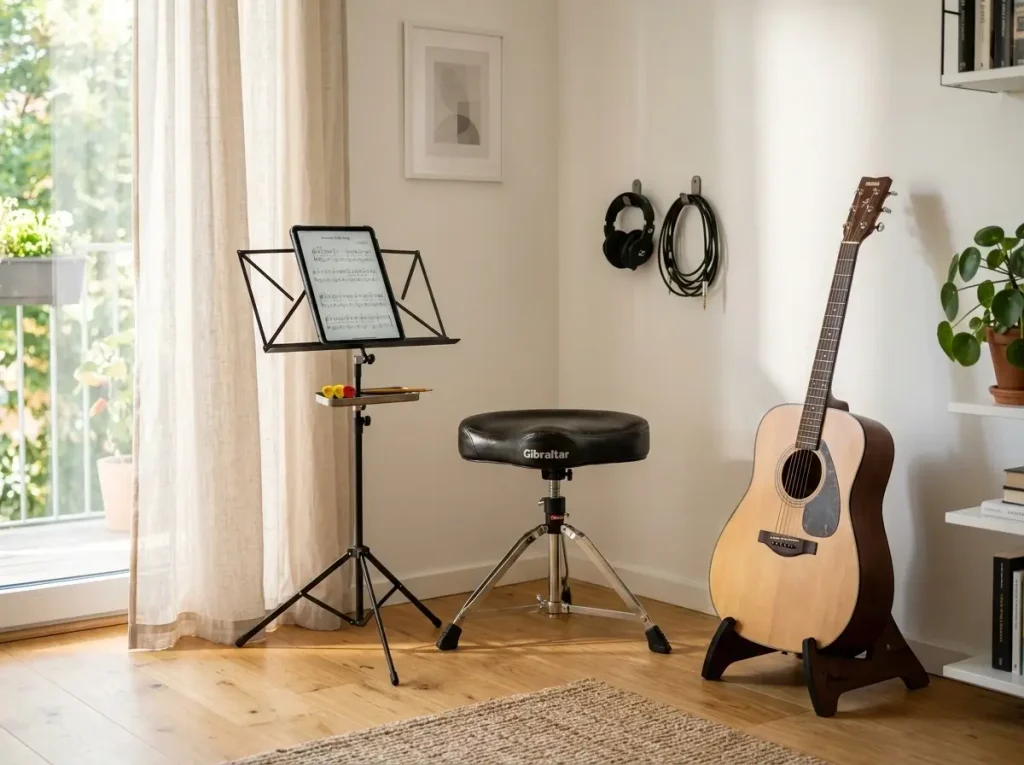
Opting for a compact, armless drummer throne or a padded folding practice stool is a highly effective approach when exploring small guitar room ideas.
Drummer thrones are specifically engineered for musicians, offering dense padding and complete freedom of movement for your elbows and the guitar’s body.
Because they are height-adjustable, you can perfectly align your knees and hips for optimal classical or casual playing postures.
If a heavy drum throne feels too permanent for your apartment, a high-quality folding guitar stool with a built-in footrest is a fantastic, renter-friendly alternative.
When your practice session wraps up, a folding stool can simply be collapsed and slid under a bed or tucked behind a door.
Maximizing Range of Motion
Once you secure the right seat, you must position it strategically within your room’s layout. You need ample clearance so that the headstock of your guitar does not strike a wall or a bookshelf if you pivot naturally while playing.
A reliable rule of thumb is to clear at least three feet of lateral space on your fretting side. Mapping out this invisible “swing space” is one of those essential small guitar room ideas that actively prevents heartbreaking dings and scratches on your gear.
You also need a comfortable way to read tabs, sheet music, or a tablet without straining your neck. Heavy, solid-backed orchestral music stands take up far too much permanent floor space in a small rental.
Instead, invest in a lightweight, folding wire sheet music stand. These minimalist accessories hold your tablet at the perfect ergonomic eye level, preventing you from slouching over your instrument.
Best of all, when you are done playing, a wire stand collapses down to the size of a small umbrella. It can easily slide under your sofa or sit completely unnoticed in a corner.
By combining armless seating, mindful spatial planning, and collapsible reading accessories, your playing station will feel remarkably spacious.
When your body is comfortable and your movements are unrestricted, your small guitar room ideas will naturally encourage you to practice longer and play better.
3. Safe Cable Management for Amps and Pedals
A comfortable seat is vital, but your practice session will quickly turn frustrating if you are constantly tripping over a maze of power and audio cables. Tackling the tangle of cords on your floor is one of the most transformative small guitar room ideas you can execute.
When you live in a compact apartment, every square foot matters. Leaving long cables sprawled across the carpet not only ruins the aesthetic of your space, but it also creates a significant tripping hazard that can easily result in a damaged guitar or a broken amplifier jack.
Managing this mess safely and efficiently, without drilling holes in the walls, requires a deliberate strategy.
Managing Amplifier Power Loads
When researching small guitar room ideas, many players completely overlook the physical hazards of heavy electrical loads. Guitars require pedals, pedals require power supplies, and amplifiers demand a significant draw from your apartment’s electrical grid.
A common mistake renters make is daisy-chaining multiple cheap power strips together to reach a distant wall outlet. This is incredibly dangerous, especially if you are running high-wattage tube amplifiers.
Thin, standard household extension cords are simply not built to handle the sustained draw of heavy musical equipment.
If you must run power across the room, always use a single, heavy-gauge extension cord rated for high-draw appliances. To ensure your setup remains fire-safe, it is highly recommended to review the safety standards for extension cords before plugging in your gear.
Keep your main amplifier plugged as close to a direct wall outlet as possible, and unplug your heavy equipment entirely when practice is over.
Routing Instrument Cables Without Damage
While power cables deal with electricity, your 1/4-inch instrument cables carry your delicate audio signal. These thick rubber cords are notoriously difficult to hide in a rental space. Cleanly routing your 1/4-inch cords is a hallmark of professional small guitar room ideas.
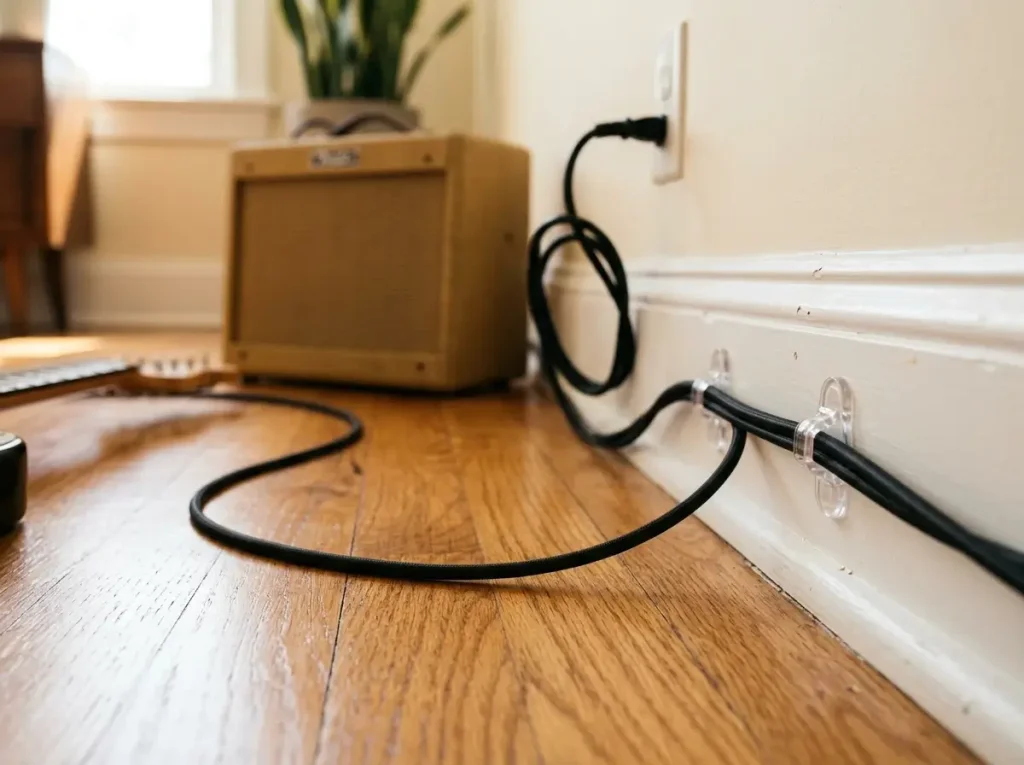
Instead of leaving them in a pile, route your long instrument cords along the edges of the room. You can easily do this without damaging your landlord’s drywall.
Use drill-free, clear adhesive cable clips and stick them directly above your baseboards. This keeps the thick cables tightly hugged to the perimeter of the room.
If a cable absolutely must cross a doorway or a main walking path, do not just tape it down. Instead, use a heavy-duty, low-profile rubber cable cover over your apartment carpet.
These drop cleanly over the cord, preventing trips and protecting the cable’s internal shielding from getting crushed underfoot.
Finally, maintaining a clean floor means effectively storing your spare gear. For the smaller items that tend to cause visual clutter, like picks, capos, slide rings, and spare patch cables, utilizing desktop organizers is key.
This approach to organizing tiny components without drilling keeps your daily-use accessories within arm’s reach while hiding the mess.
When your practice session ends, take sixty seconds to properly over-under coil your main instrument cable and hang it on a freestanding hook.
By prioritizing safety and organization, these small guitar room ideas will keep your practice space functional, visually pleasing, and completely hazard-free.
4. Decoupling Amps to Reduce Structure-Borne Noise
One of the most intimidating challenges when brainstorming small guitar room ideas is figuring out how to practice without constantly worrying about your neighbors. Living in a tight apartment usually means sharing thin walls and hollow floors.
If you play an electric guitar or a bass, managing the noise of your amplifier is non-negotiable. However, many renters focus on the wrong type of soundproofing and end up frustrated when the complaints still roll in.
Airborne vs. Structure-Borne Sound
To understand how to keep your neighbors happy, you first need to understand how sound actually travels through a building. There is a massive difference between airborne noise and structure-borne vibration.
Airborne sound is exactly what it sounds like—the higher frequencies of your guitar traveling through the air and bouncing off your walls. Structure-borne sound, on the other hand, occurs when the physical vibrations of your speaker cabinet transfer directly into the building materials.
If you want to dive deeper into the exact science behind this, it is worth looking into how the transmission of structure-borne vibrations works in residential buildings.
When you set an amplifier directly on a hard rental floor, the floorboards act almost like a giant secondary speaker cone.
The low-frequency bass notes travel directly down into your downstairs neighbor’s ceiling, creating a muffled, thumping sound that is guaranteed to cause a disturbance.
To truly optimize your practice space, mastering this distinction is a vital part of effective small guitar room ideas.
Elevating and Isolating Your Gear
A common mistake renters make is simply turning the master volume down, hoping it solves the issue entirely. Unfortunately, if the wooden cabinet of the amp is still physically touching the floor, those low-end vibrations will continue to transfer downward.
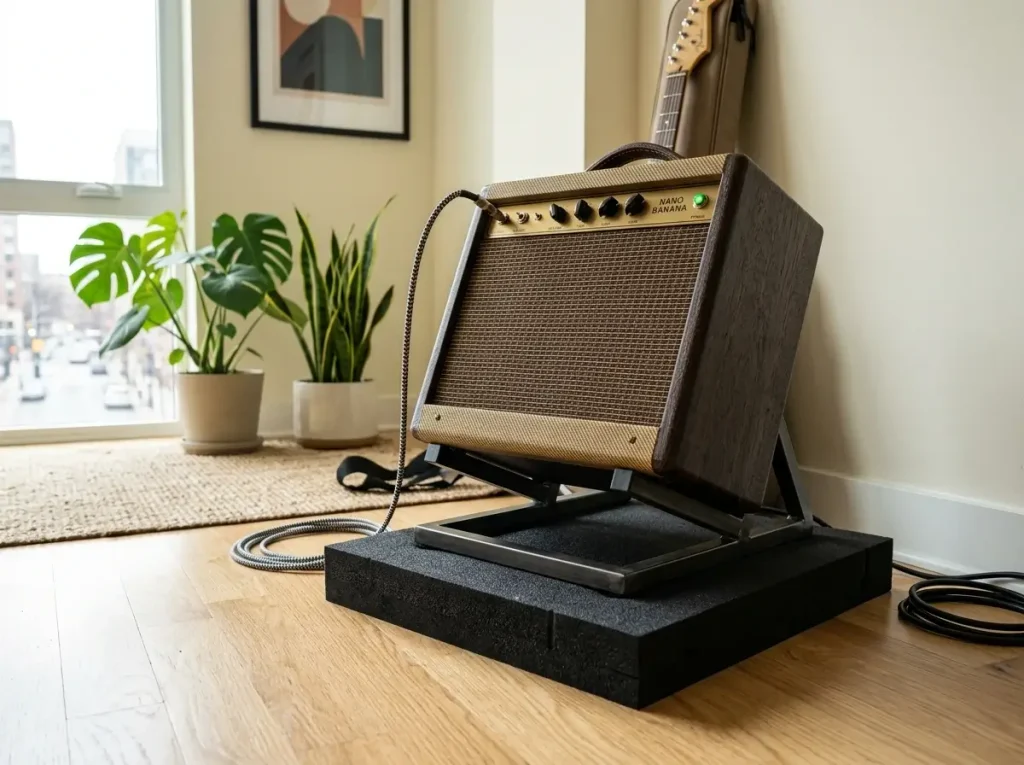
The solution is a process called acoustic decoupling. You need to physically disconnect your amplifier from the apartment’s structure. You can achieve this easily by placing your amp on a high-density acoustic isolation pad.
These thick, engineered foam platforms absorb the cabinet’s physical kinetic energy before it ever reaches the floorboards.
Amp Placement: Do This, Not That
- Do This: Place your combo amp on a thick acoustic isolation pad or a dedicated, tilted metal stand.
- Not That: Leave your amp sitting flat against hardwood floors or thin apartment carpeting.
Implementing acoustic decoupling is one of those incredibly simple small guitar room ideas that makes apartment living stress-free. For even better results, consider investing in a tilted amplifier stand to use in conjunction with your foam pad.
An angled stand physically elevates the speaker cabinet off the ground and points the speaker cone directly at your ears, rather than at your shins. When the sound is directed right at your head, you can hear your specific tone clearly at a significantly lower volume.
Once you have successfully decoupled your amplifier from the floor, you may notice that the higher frequencies are still bouncing around your room.
If you want to take your sound control a step further, exploring renter-friendly acoustic treatments for your walls is an excellent next step.
By simply getting your heavy gear off the floor, your small guitar room ideas will result in a much tighter-sounding room and a far more peaceful relationship with the people living below you.
5. Organizing Pedalboards and Heavy Gear Without Clutter
Guitars and sleek amplifiers might look beautiful on a display rack, but the less glamorous side of music gear can quickly ruin the aesthetic of a tight apartment.
Massive effects pedalboards, tangled power supplies, and heavy hardshell cases are awkward, bulky, and notorious for eating up valuable floor space.
If you are tripping over an empty acoustic case every time you walk to the kitchen, it is time to rethink your layout.
One of the most effective small guitar room ideas is establishing a strict physical boundary between your daily-use gear and your travel equipment. By aggressively hiding the bulky items, you keep your main playing area clean and focused.
Hiding Pedalboards in Plain Sight
Pedalboards are inherently difficult to store in a small rental. They are wide, heavy, and covered in delicate knobs or switches that can easily break if stepped on. Leaving a large effects board permanently on the floor creates visual clutter and a serious tripping hazard.
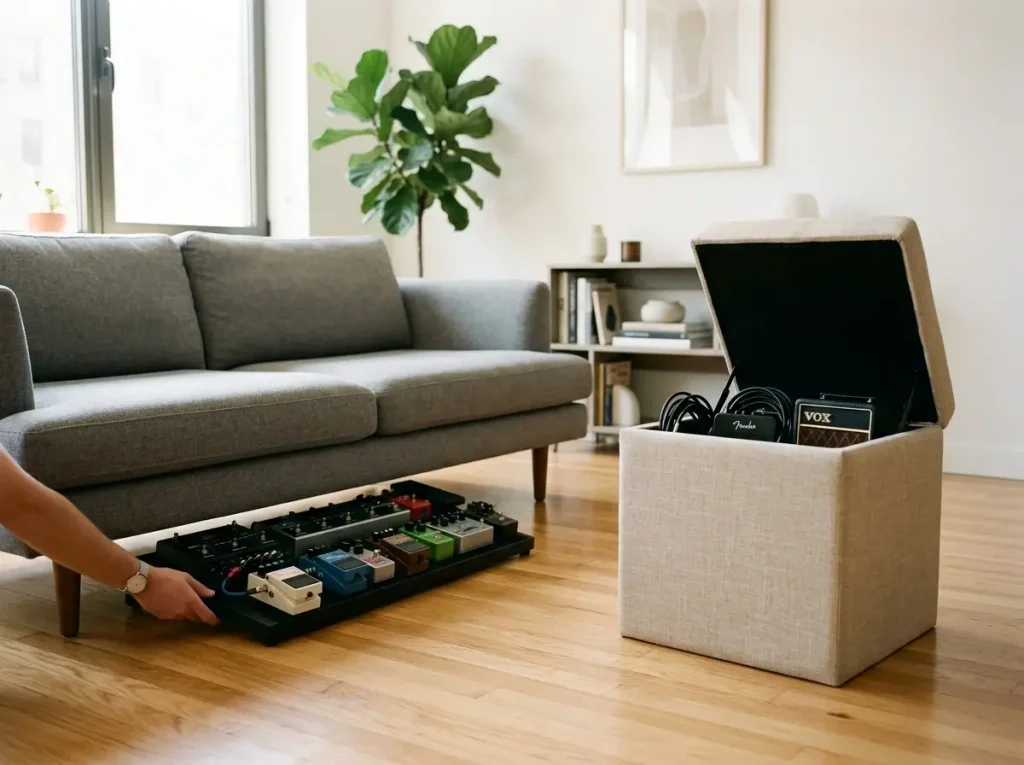
Instead of leaving your pedals out, utilize the hidden dead space beneath your existing furniture. Measure the exact clearance under your bed or your living room sofa.
A standard pedalboard can easily slide underneath, remaining completely out of sight and protected from dust until you are ready to play.
If you lack under-sofa clearance, incorporating multipurpose furniture that maximizes square footage is a brilliant alternative.
Using hollow storage ottomans, entryway benches, or lift-top coffee tables allows you to hide small practice amps, extra instrument cables, and compact pedalboards right in the center of the room.
By stashing this heavy gear out of the walking path, your small guitar room ideas will keep the apartment looking like a comfortable home rather than a disorganized storage locker. When it is time to practice, you simply lift the lid, pull out your board, and plug in.
Vertical Storage for Empty Cases
While your instruments are safely resting on a freestanding display rack, you are inevitably left with empty hardshell cases. These cases are essential for protecting your gear during moves or gigs, but they take up a tremendous amount of square footage if laid flat on the floor.
The smartest small guitar room ideas always leverage vertical space to minimize the footprint of awkward items. Instead of sliding empty cases under the bed—which should now be reserved for your pedalboards—stack them vertically in the back corners of your bedroom closet.
Stand them upright on their bottom metal bumpers, leaning them slightly against the back wall. This vertical footprint takes up mere inches of floor width compared to laying them down flat.
If you have a deep closet, you can easily slide them behind your hanging winter coats to keep them completely out of the way.
For heavier secondary gear, like backup combo amps or heavy recording interfaces, consider using freestanding heavy-duty shelving units. Wire utility shelves are inexpensive, incredibly strong, and completely renter-friendly since they require absolutely no wall anchors.
Storage Priorities for Small Spaces:
- Daily-Use Gear: Keep your primary guitar, main cable, and practice amp accessible at all times in your main area.
- Secondary Gear: Hide your pedalboard under the sofa or inside a hollow storage ottoman.
- Travel Equipment: Stack empty hardshell cases vertically in the deepest part of your closet.
By ruthlessly categorizing and organizing your bulky items, these small guitar room ideas ensure you have plenty of physical room to move, breathe, and play comfortably in your tight rental.
6. Climate Control Basics for Small Guitar Room Ideas
Even if your gear is perfectly organized and your cables are safely tucked away, an invisible threat could still be damaging your instruments. Climate control is frequently overlooked when renters begin brainstorming small guitar room ideas.
Guitars are built from thin, carefully carved pieces of wood, making them highly sensitive to environmental changes. In a compact apartment, the temperature and moisture levels in the air can fluctuate wildly throughout the day.
Failing to manage this microclimate can lead to expensive repairs or permanently ruined instruments.
Understanding the Threat of Dry Air
Because wood is hygroscopic, it naturally absorbs and releases moisture depending on the surrounding environment. The ideal humidity range for acoustic and electric guitars sits squarely between 45% and 55%.
When winter arrives, apartment radiators and central heating systems kick into high gear. This constant blast of hot air rapidly strips moisture from your living space.
If you review standard residential indoor humidity guidelines, you will quickly see that forced-air heating can plunge your apartment’s humidity well below healthy levels.
When humidity drops below 40%, the wood in your guitar begins to shrink. Conversely, if you live in a highly tropical climate without adequate air conditioning, the wood will absorb too much moisture and swell.
Properly accounting for these extreme shifts is one of the most vital small guitar room ideas you can implement to protect your investment.
Warning Signs of a Dangerously Dry Guitar:
- Sharp Fret Ends: The fretboard wood shrinks, causing the metal frets to protrude painfully along the edges of the neck.
- Sinking Tops: The belly of an acoustic guitar caves inward, dramatically lowering the string action.
- Fret Buzz: Because the top has sunk, the strings begin buzzing aggressively against the frets when played.
- Finish Cracks: In extreme cases, the wood splits completely, creating heartbreaking hairline cracks running down the body.
Monitoring Your Apartment’s Microclimate
You cannot fix a problem you are not actively measuring. Fortunately, tracking your room’s environment does not require heavy, space-consuming equipment.
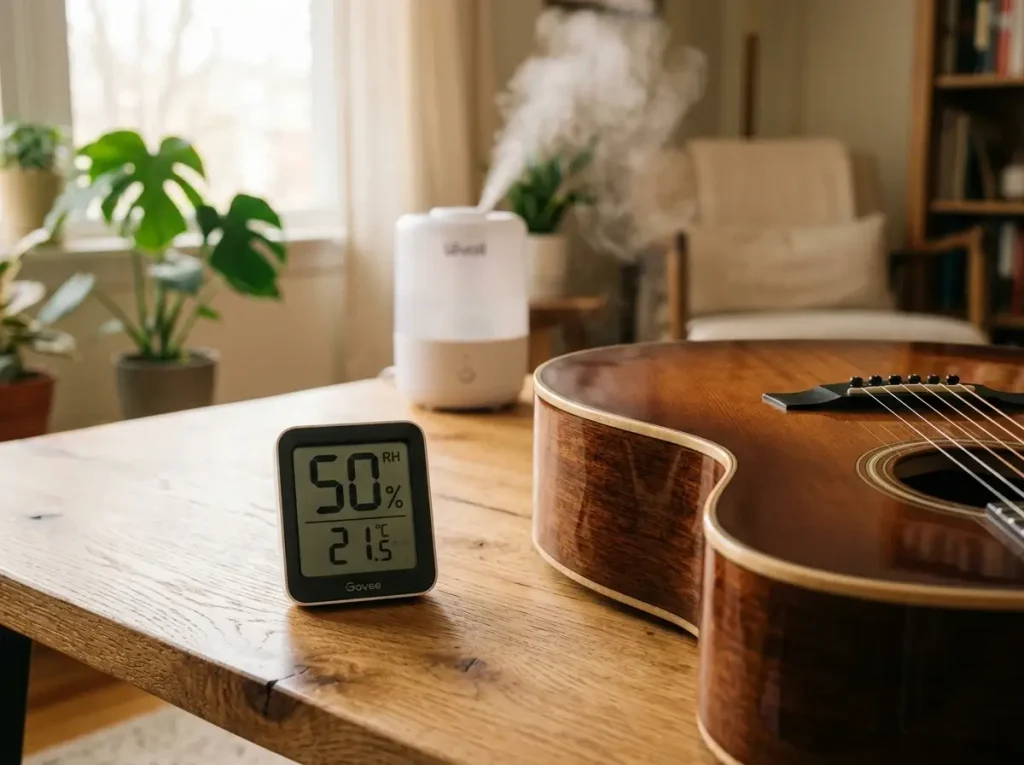
Integrating a compact digital hygrometer into your space is one of the smartest small guitar room ideas available for renters.
These tiny, battery-operated devices cost less than a set of premium strings and provide real-time readings of your room’s exact temperature and humidity. Simply sit one directly on your multi-guitar display rack or stick it to the side of your amplifier.
If your hygrometer reveals that your room is chronically dry, you have two renter-friendly options. The best solution for a dedicated practice space is a small, freestanding room humidifier.
Modern humidifiers have incredibly tiny footprints and can easily maintain a consistent 50% humidity level across a standard apartment bedroom.
If you simply do not have the floor space for another appliance, you will need to rely on two-way humidity control packs.
While this means you must store your most delicate acoustic guitars inside their hardshell cases rather than out on a display rack, the hydration packs will automatically release or absorb moisture to keep the case interior perfectly balanced.
Ultimately, taking the time to monitor the air around your instruments pays massive dividends. By proactively managing your apartment’s climate, these final small guitar room ideas guarantee that your gear remains in pristine, playable condition year-round.
Conclusion
Organizing your gear in a rental doesn’t have to mean sacrificing your deposit or living in a cluttered mess. By incorporating these small guitar room ideas, you can build a highly functional and inspiring practice space.
Focus on elevating your gear—both physically with freestanding racks and acoustically with isolation pads.
Keep your seating ergonomic, manage your cables safely, and never ignore the humidity levels in your room. If you are incorporating this practice space into a larger renter-friendly flex space, careful planning will ensure your music gear coexists peacefully with your other daily activities.
Take a quick inventory of your floor space today and order a simple digital hygrometer to protect your instruments.