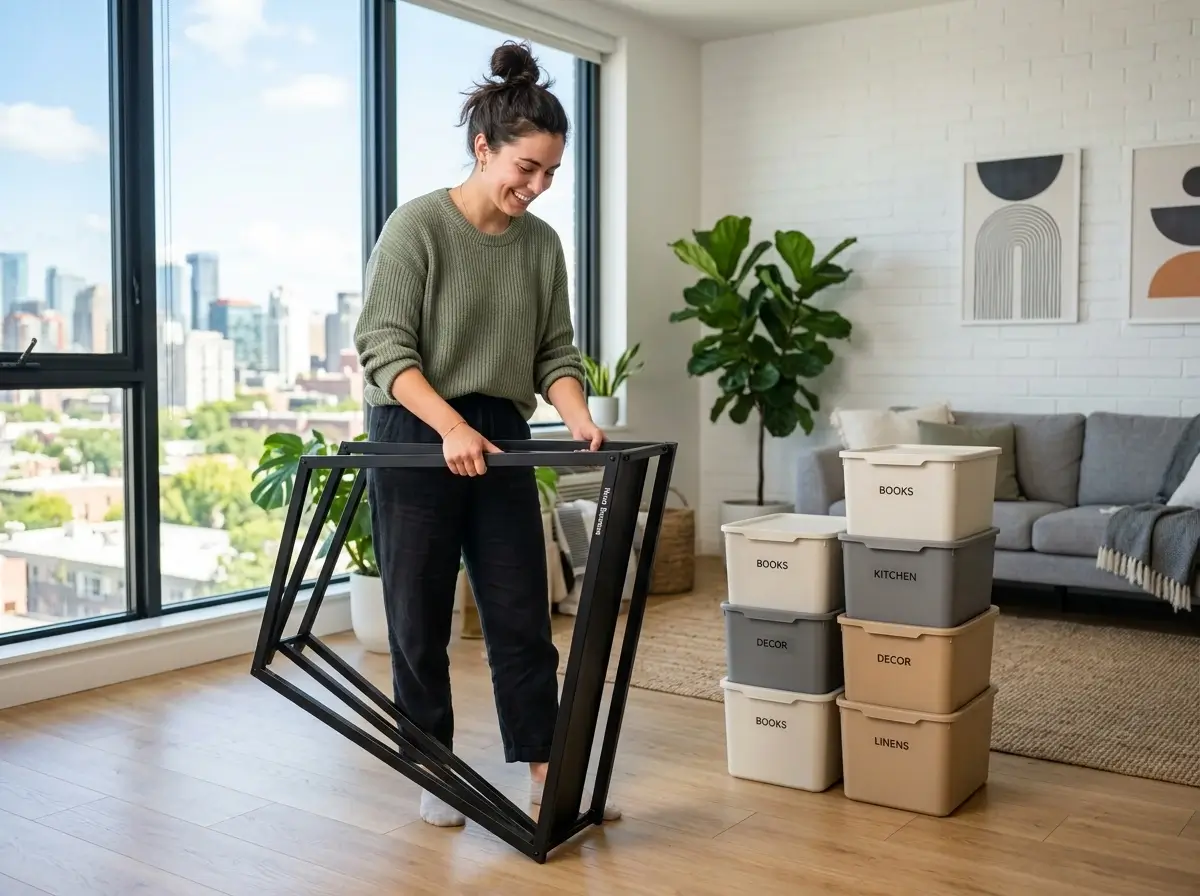
Moving is exhausting, especially when you are forced to lug heavy, awkward dressers up narrow apartment stairs.
If you’re a military family, travel professional, or serial renter, investing in the right portable storage furniture is an absolute game-changer.
You need lightweight, tear-down-friendly pieces that survive multiple relocations without snapping, stripping, or losing parts.
In this guide, we are breaking down the best modular systems, heavy-duty bins that double as aesthetic decor, and how to avoid the bulky furniture traps that ruin moving day.
Let’s get moving!
The Short Answer: What is the Best Portable Storage Furniture for Frequent Movers?
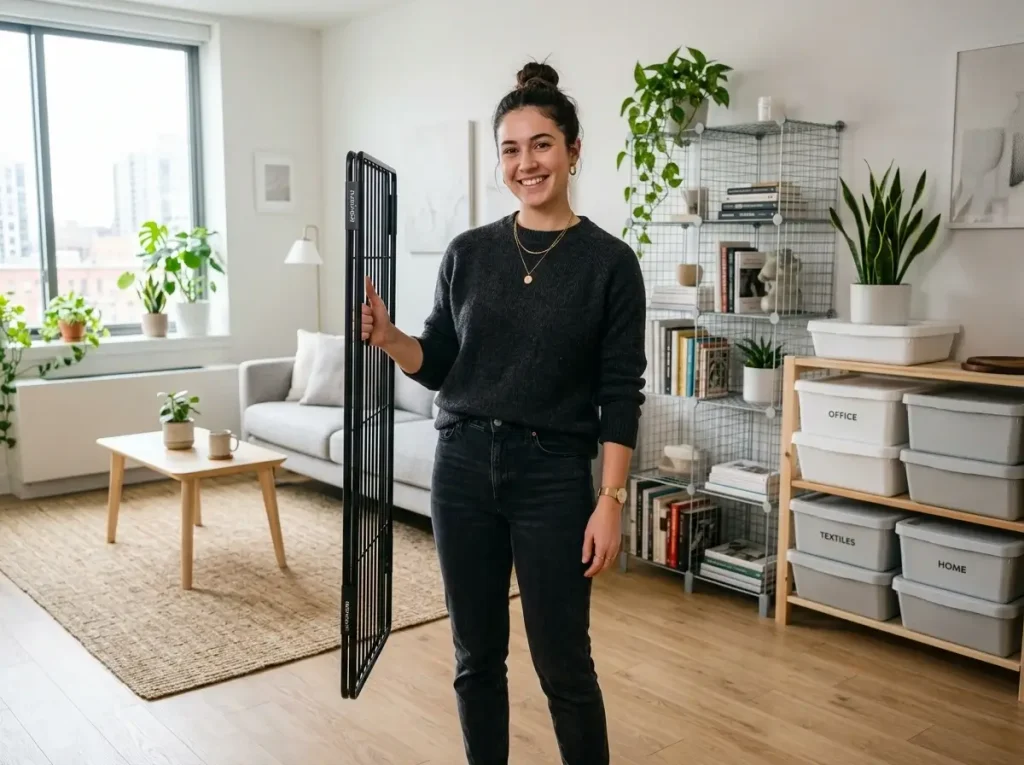
The best portable storage furniture for frequent movers includes lightweight modular wire grids, foldable metal baker’s racks, and heavy-duty aesthetic bins.
These specific pieces prioritize rapid tool-free disassembly, effortless stackability, and exceptional durability, ensuring they easily navigate narrow apartment stairwells and survive constant relocations without sacrificing their structural integrity.
When you are staring down the barrel of a multi-state move or your third apartment transfer in two years, traditional heavy wooden dressers are your absolute worst enemy.
To create a truly stress-free transition, you need to transition to dedicated portable storage furniture.
This isn’t just about buying smaller things; it is about investing in specific material architectures designed for extreme, repetitive mobility.
Whether you are a travel nurse or a military family, optimizing your apartment storage for relocation requires prioritizing materials that can be broken down in under five minutes flat and carried by a single person up three flights of stairs.
Here is the definitive breakdown of the top three categories of high-mobility storage and exactly why they outperform traditional flat-pack alternatives in terms of weight and usability:
- Lightweight Modular Wire Grids: Unlike heavy particleboard that inevitably crumbles, epoxy-coated steel wire grids are the holy grail of transportable shelving. Why? Because they utilize high-tension plastic ABS connectors instead of metal screws that strip out wood. A standard 6-cube wire organizer weighs a mere 12 to 15 pounds fully assembled, yet it can confidently support up to 40 pounds per cube. When it is time to pack up, you pop the connectors off by hand, stack the 14×14-inch steel panels flat into a single box, and carry the entire shelving unit out under one arm.
- Foldable Metal Baker’s Racks: If you utterly despise complex assembly, folding metal racks are your best option. These freestanding units feature pre-riveted, hinged shelving that collapses completely flat—typically reducing a bulky 60-inch tall bookshelf down to a highly manageable 3.5-inch thick profile. Because there are zero loose screws or cam locks to lose during transit, setup and teardown take literally five seconds. Look for powder-coated carbon steel models with heavy-duty locking casters; they weigh around 20 to 25 pounds but can easily handle heavy kitchen appliances, tools, or massive book collections.
- Heavy-Duty Aesthetic Bins: True portable storage furniture blurs the line between a moving box and daily home decor. Instead of relying on flimsy cardboard—where you must meticulously adhere to strict U-Haul moving box weight limits to prevent catastrophic crushing—invest in high-density polyethylene (HDPE) stacking bins with reinforced lockable latches. When you use opaque, aesthetically pleasing bins as your everyday “drawers” sitting on your wire grids, moving day simply involves snapping the lids shut and carrying the bins straight to the moving truck. A standard 27-gallon heavy-duty resin bin can hold up to 60 pounds of gear and withstand extreme vertical stacking pressure without buckling.
By restricting your interior design purchases exclusively to these three exact categories, you completely eliminate the anxiety of hiring expensive movers or begging friends to help carry 150-pound dressers.
You ensure your setup remains modular, scalable, and incredibly resilient. Your living space remains beautifully organized, while your entire infrastructure remains fundamentally ready to move at a moment’s notice.
Lightweight Modular Systems vs. Solid Flat-Pack Furniture: Which Survives Frequent Moves Better?
If you are evaluating the long-term cost of your apartment setup, understanding the mechanical differences between different types of portable storage furniture is the difference between keeping your organization systems for a decade or tossing them into a dumpster at the end of a single lease.
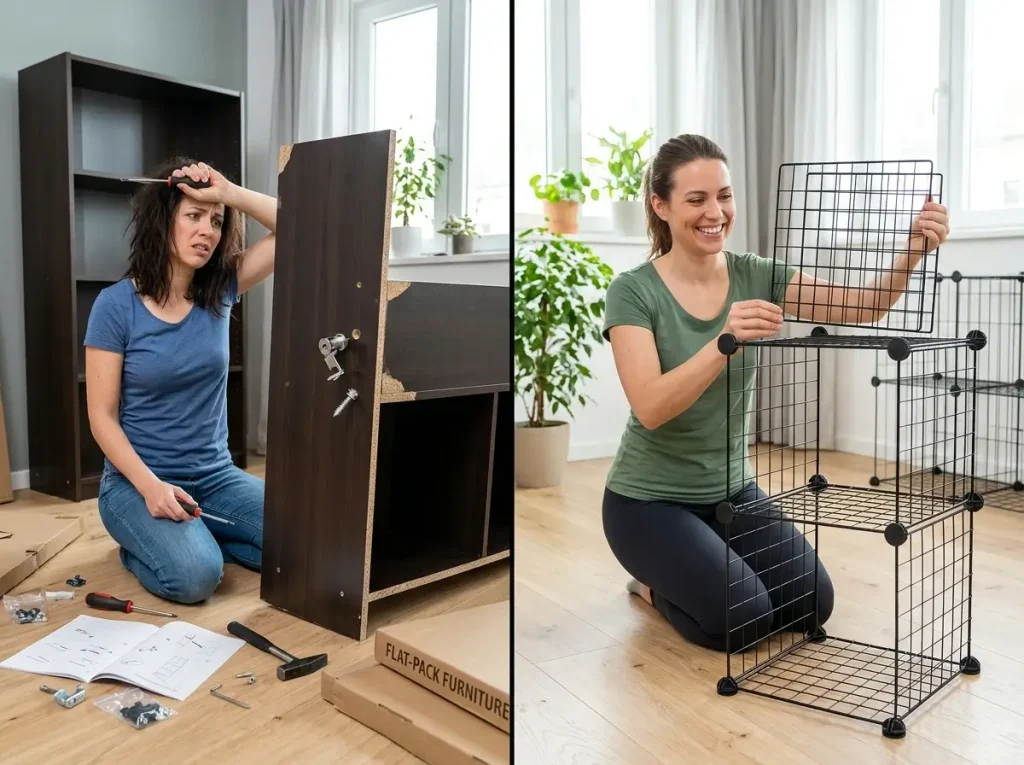
The reality is that lightweight modular systems significantly outlast solid flat-pack furniture during frequent moves.
Solid flat-pack items often suffer from stripped screw holes, sheared cam locks, and chipped corners after just one teardown.
Conversely, modular wire or plastic grids snap apart and reassemble endlessly without any structural degradation, making them the superior investment for serial renters.
To understand why this happens, you have to look at the physics of how affordable furniture is constructed.
Traditional solid flat-pack furniture is almost exclusively manufactured from particleboard or medium-density fiberboard (MDF).
These composite woods are created by compressing sawdust and resin under high heat. While they look great sitting still, they are mechanically hostile to movement.
The fasteners used in these pieces—typically steel screws and metal cam locks—bite directly into the fragile wood composite.
When you disassemble a flat-pack bookcase to move it, you pull those steel threads out, tearing the compressed wood fibers with it.
According to general Particleboard durability standards, once those internal fibers are stripped, a screw will never hold tight in that same hole again.
Attempting to bypass disassembly by moving flat-pack furniture fully built is equally disastrous. The lateral forces of carrying a heavy bookcase down a flight of stairs will cause the MDF joints to torque, eventually snapping the wooden dowels entirely.
In stark contrast, lightweight modular systems are engineered specifically for kinetic stress. Whether you choose epoxy-coated steel wire grids or flexible resin panels, these systems rely on friction-fit ABS plastic connectors rather than threaded metal screws.
- Zero Thread Stripping: Because you are simply popping a metal wire out of a plastic groove, there is no material degradation when you take the unit apart. You can assemble and disassemble a modular cube shelf one hundred times, and it will be just as sturdy on the hundredth build as it was on the first.
- Extreme Portability: When collapsed, a massive modular wall unit reduces to a stack of flat panels barely six inches high, easily sliding into the backseat of a sedan.
This absolute resistance to mechanical degradation is exactly why modular pieces dominate the portable storage furniture market for highly mobile individuals.
Furthermore, relying on lightweight, freestanding modular grids pairs perfectly with implementing damage-free hacks for renters, ensuring that neither your furniture nor your landlord’s drywall suffers any damage during your tenancy.
Here is a definitive mechanical comparison of how these two systems handle the stress of relocation:
| Feature | Solid Flat-Pack Furniture | Lightweight Modular Systems |
| Material Core | Compressed particleboard or MDF | Steel wire, powder-coated metal, or resin |
| Fastener Type | Metal screws, wooden dowels, cam locks | ABS plastic friction-fit joints, snap-locks |
| Disassembly Degradation | High: Screw holes strip, dowels snap off | Zero: Snap-fit joints do not cause material wear |
| Weight (6-Shelf Unit) | 60 to 90+ lbs | 12 to 20 lbs |
| Moving Viability | Survives 1-2 moves at best | Survives endless relocations indefinitely |
When your lifestyle demands frequent relocations, stop investing in heavy composites that anchor you down and break under pressure. Pivot entirely to modular frameworks that pack flat and move as quickly as you do.
How to Organize Daily Items Using Aesthetic Storage Bins That Double as Heavy-Duty Moving Boxes
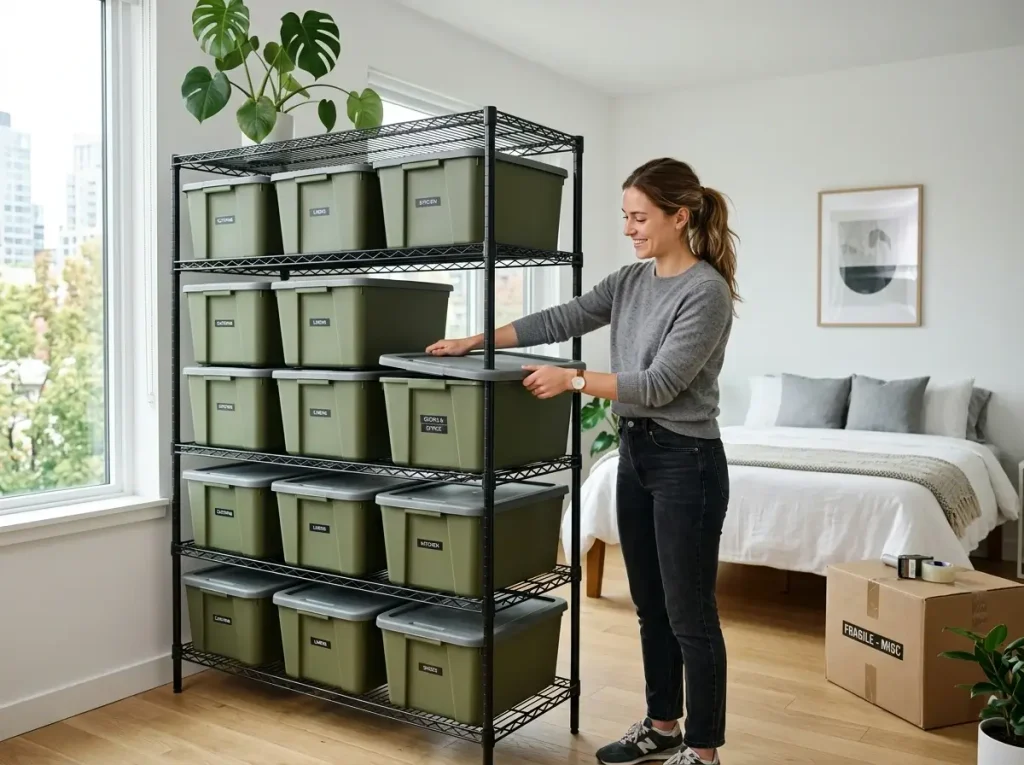
The traditional moving process is incredibly inefficient: you empty daily items out of heavy, stationary wooden dressers, pack them into disposable cardboard boxes, transport them, and then meticulously unpack them back into new stationary furniture.
The secret to an effortless, serial-renter lifestyle is removing that chaotic middle step entirely. To seamlessly transition from living to moving, utilize aesthetic storage bins crafted from high-density polypropylene.
By integrating these heavy-duty containers as your primary daily organizers, you eliminate the need for cardboard moving boxes altogether.
Simply secure the lids, stack them directly into the moving vehicle, and your unpacking process becomes instantaneous.
When you pair these dual-purpose bins with modular wire grids, you create the ultimate system of portable storage furniture. You are no longer packing up your life; you are simply transporting your established “drawers” from one location to the next.
However, to pull this off without your apartment looking like a commercial warehouse, you must understand exact material specifications and how to organize them for stylish daily living.
First, do not rely on brittle acrylic or standard, cheap plastic totes that easily crack under shifting weight.
You must source bins manufactured specifically from high-density polyethylene (HDPE) or high-impact polypropylene.
According to engineering data regarding High-density polyethylene (HDPE) properties, this specific thermoplastic is highly resistant to impact stress, moisture, and extreme temperature fluctuations—making it ideal for surviving the back of a sweltering moving truck or a damp storage unit.
A high-quality HDPE bin features an exceptional stacking weight capacity of up to 100 pounds, meaning you can confidently stack heavy winter clothes, dense electronics, or books five tiers high without the bottom container buckling or warping.
Here is the exact step-by-step methodology to integrate these moving bins into your daily interior design so they are instantly ready for your next lease:
- Standardize Your Footprint: Purchase identical bins in neutral, opaque colors (such as matte black, olive green, or cream). Uniformity is absolutely crucial; mixed sizes will not stack safely in a moving truck, and transparent bins create visual clutter that instantly ruins a modern apartment’s aesthetic.
- Adopt the “Open-Faced” Drawer System: During daily use, slide these bins into your modular shelving just like traditional wooden drawers. Store the heavy-duty lids flat against the back wall of the shelf or slide them under your bed. This gives you instant access to your clothes or pantry items without the friction of unlatching a lid every time you need a t-shirt.
- Upgrade to Active Latching Mechanisms: When purchasing your bins, strictly avoid cheap “snap-on” lids. You must buy bins engineered with mechanical, heavy-duty latching handles. When moving day arrives, you retrieve your hidden lids, and these latches clamp down securely, ensuring the lid will never pop off even if the bin tips over during a sharp turn in transit.
- Categorize for the Destination: Organize your daily items by their ultimate room destination. Keep all bathroom toiletries in one specific bin and all desk cables in another. When you arrive at the new rental, you simply carry the bin into the correct room, slide it onto the shelf, and you are immediately unpacked.
By treating these bins as the foundational components of your portable storage furniture setup, you are essentially pre-packed 365 days a year.
This entirely eliminates the frantic scramble for packing tape and structurally weak cardboard boxes.
When seamlessly combined with the right portable storage furniture frameworks, your entire apartment can be boxed up, loaded, and unloaded with unparalleled precision, leaving you perfectly organized the moment you unlock your new front door.
Which Lightweight, High-Capacity Storage Solutions Are Best for Carrying Up Narrow Apartment Stairwells?

Moving into a historic building or a top-floor walk-up presents a unique geometric nightmare: the narrow apartment stairwell.
Trying to pivot a standard solid wood dresser around a tight 90-degree switchback usually results in scraped knuckles, trapped furniture, and severely gouged drywall.
To conquer these spatial constraints, you need high-capacity portable storage furniture that prioritizes an ultra-thin collapsed footprint and extreme maneuverability over traditional rigid frames.
For narrow apartment stairwells, the absolute best high-capacity solutions are foldable metal baker’s racks and soft-sided portable wardrobes.
These items are intelligently engineered to collapse down to under four inches flat and typically weigh less than 15 pounds empty.
This extreme reduction in structural volume allows a single person to easily carry them vertically under one arm around tight corners without risking damage to the rental property or straining their back.
When you are navigating U-shaped stairs, sharp switchbacks, or narrow historic hallways, these specific categories of portable storage furniture will save your sanity:
- Foldable Carbon Steel Racks: Unlike rigid wooden bookcases that require a coordinated two-person team to tilt and pivot, these folding racks utilize a hinged back and drop-down shelves. When collapsed, a massive 5-tier rack forms a perfectly flat plane measuring roughly 3.5 inches thick. You can literally carry it up the stairs vertically, sliding right through narrow doorways. Despite their lightweight frame, high-quality models can hold an impressive 250 pounds per shelf.
- Soft-Sided Portable Wardrobes: If your new apartment lacks closet space, hauling a wooden wardrobe upstairs is nearly impossible. Instead, opt for a fabric-covered wardrobe built on a tubular steel frame. The entire unit breaks down into a small duffel bag weighing under 10 pounds. You carry it upstairs in one hand and assemble the tension-fit poles in minutes once inside the room.
- Collapsible Rolling Carts: For kitchen pantry and bathroom organization, heavy-duty metal mesh rolling carts that fold completely flat in the middle are essential. They eliminate the bulky, rigid footprint of standard kitchen islands while still providing vertical storage.
Navigating stairs isn’t just about protecting the walls; it is about physical safety. By transitioning to lightweight, collapsible options, you can easily keep the carrying weight of individual pieces well under 50 pounds.
This aligns perfectly with standard OSHA safe lifting guidelines to prevent musculoskeletal injuries during a DIY move.
Spatial Maneuvering Tactics for Tight Stairwells: Even with lightweight gear, how you carry it dictates your success.
Always transport folded racks vertically, holding them parallel to your body. This reduces your walking profile to your natural shoulder width, ensuring you never get “stuck” rounding a corner.
If you are moving modular wire grids, never carry them assembled. Break them down completely into their flat 14×14-inch panels, secure them tightly with heavy-duty stretch wrap, and carry them in a single, dense stack.
By prioritizing a completely collapsible portable storage furniture ecosystem, you guarantee that if you can walk up the stairs, your furniture can too.
Furthermore, once you have successfully carried your flat-pack gear up those three flights of stairs, you will want to secure taller units against the wall so they don’t tip over.
Since you are renting, be sure to utilize proven methods to safely install storage without leaving permanent holes in your landlord’s drywall.
How to Efficiently Pack Modular Shelving Systems So Pegs and Connectors Don’t Get Lost
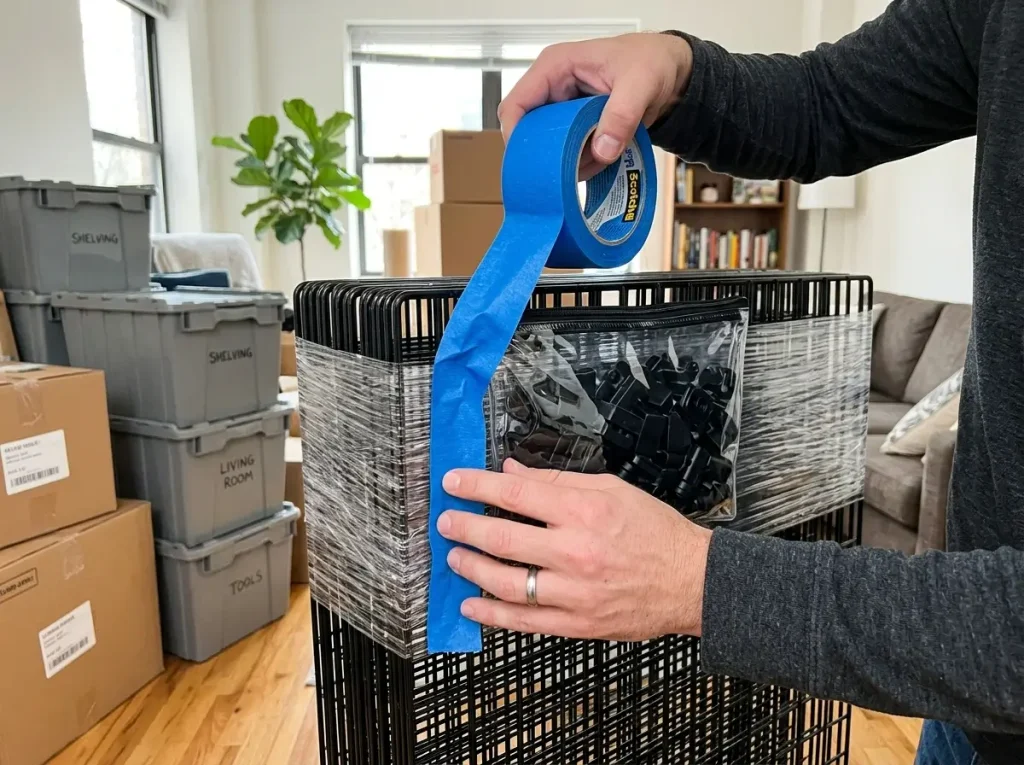
Losing small structural hardware is the number one reason renters are forced to abandon perfectly good organization systems during a move.
To efficiently pack modular shelving, you must immediately place all pegs, joints, and screws into a heavy-duty, clear zippered pouch the second you dismantle the unit.
Tape this pouch directly to the largest base panel of the disassembled furniture using residue-free painter’s tape. This guarantees the hardware stays united with its specific unit, ensuring your portable storage furniture is actually rebuildable when you arrive at your new apartment.
When you rely on modular grids and snap-together components, the entire structural integrity of your setup depends on tiny ABS plastic friction-fit joints or small steel shelf pegs.
If you casually toss these into a generic “hardware box,” you will inevitably spend hours hunting for the exact pieces needed to reassemble your shelves on the other side.
To maintain the true value of your portable storage furniture, you need a standardized, foolproof teardown procedure that strictly eliminates hardware separation.
Do not use flimsy sandwich bags; they puncture easily against the sharp corners of metal wire grids and easily pop open under pressure. Instead, invest in thick, reinforced PVC zipper pouches that can withstand being crushed in a moving truck.
Here is the exact step-by-step teardown protocol to guarantee you never lose a connector again:
- Create the Hardware Hub: Before you pop a single joint loose, have a transparent, heavy-duty PVC zipper pouch open and ready. Do not dismantle multiple units at once. Focus on one specific piece of furniture from start to finish to prevent cross-contaminating parts.
- Dismantle Top-Down: Always remove panels starting from the top tier. As soon as you snap a plastic ABS connector off a wire grid, place it immediately into the pouch. Never put joints in your pocket or set them on the floor.
- Bundle the Core Panels: Once all panels are separated, stack them tightly together. Use a heavy-duty industrial stretch wrap to bind the panels into a single, dense block. This prevents the flat panels from shifting, sliding against each other, and scratching their powder-coated finish in transit.
- Secure the Hardware Pouch: Zip the hardware pouch completely shut. Using high-quality blue painter’s tape, securely tape the hardware pouch directly to the outside of the stretch-wrapped panel bundle. According to 3M Painter’s Tape residue properties, genuine blue painter’s tape can remain on surfaces for up to 14 days without leaving sticky adhesive behind, making it perfect for securing items temporarily during a relocation.
- Label the Bundle: Use a permanent marker to write directly on the painter’s tape, noting exactly what the unit is and the piece count (e.g., “Living Room 6-Cube Shelf – 24 Connectors”).
By marrying the hardware directly to the disassembled panels, you completely eliminate the friction of rebuilding.
The moment you unwrap the flat-packed panels at your new rental, the exact connectors you need are literally taped to the frame, reducing your reassembly time to mere minutes.
Conclusion: Final Thoughts on Portable Storage Furniture
Relocating doesn’t have to mean destroying your furniture or breaking your back carrying it.
By choosing high-quality portable storage furniture, you guarantee a smoother, faster, and cheaper move every single time.
The transition away from traditional, heavy wooden dressers and brittle particleboard bookcases is ultimately a lifestyle upgrade for anyone who lives life on the move.
Whether you are a travel nurse rotating through three-month contracts, a military family dealing with sudden deployments, or a serial renter chasing new career opportunities across the country, your environment should support your mobility, not hinder it.
When you calculate the true cost of renting, the physical toll and financial drain of the moving process itself are often vastly underestimated.
Every time you have to hire professional movers because a solid flat-pack wardrobe is too heavy to carry, or every time you are forced to discard a chipped MDF shelf in a dumpster because the cam locks sheared off, you are losing money.
By strategically investing your budget strictly into lightweight modular grids, foldable metal baker’s racks, and heavy-duty aesthetic HDPE moving bins, you completely eliminate these hidden relocation taxes.
Your portable storage furniture becomes a permanent, reliable asset rather than a disposable, fragile liability.
Let’s review the core structural and financial benefits of committing to a fully modular, highly mobile apartment setup:
- Zero Material Degradation: By relying on friction-fit ABS plastic connectors and folding metal hinges instead of threaded metal screws, your furniture can be assembled and disassembled an infinite number of times without ever stripping the joints or tearing the composite wood fibers.
- Drastic Weight Reduction: Transporting a 15-pound epoxy-coated wire grid system instead of an 80-pound solid wood dresser keeps your carrying weight well below dangerous limits, actively protecting your joints, knees, and spine from severe musculoskeletal injuries.
- Immediate Unpacking Capabilities: Utilizing high-density, opaque storage bins as your everyday open-faced drawers allows you to bypass the chaotic cardboard box stage entirely. You simply snap the heavy-duty lids on for transit and slide them right back onto your shelves the second you arrive.
- Superior Spatial Maneuverability: Opting for folding metal racks that collapse down to a 3.5-inch profile guarantees that you will never again get large furniture “stuck” in a narrow, historic apartment stairwell or a tight switchback corner.
The days of dreading the packing process and living in a state of chaotic transition are officially over.
You now have the exact blueprints and material specifications to build a living space that is beautiful, highly organized, and fundamentally ready to move the exact moment your lease expires.
For a broader look at maximizing your rental space, be sure to review our complete guide on the Best Apartment Storage Solutions.
If you found this guide helpful for your next relocation, please share it with your fellow renters, travel professionals, and military families to help them save time, money, and stress on their next big move!