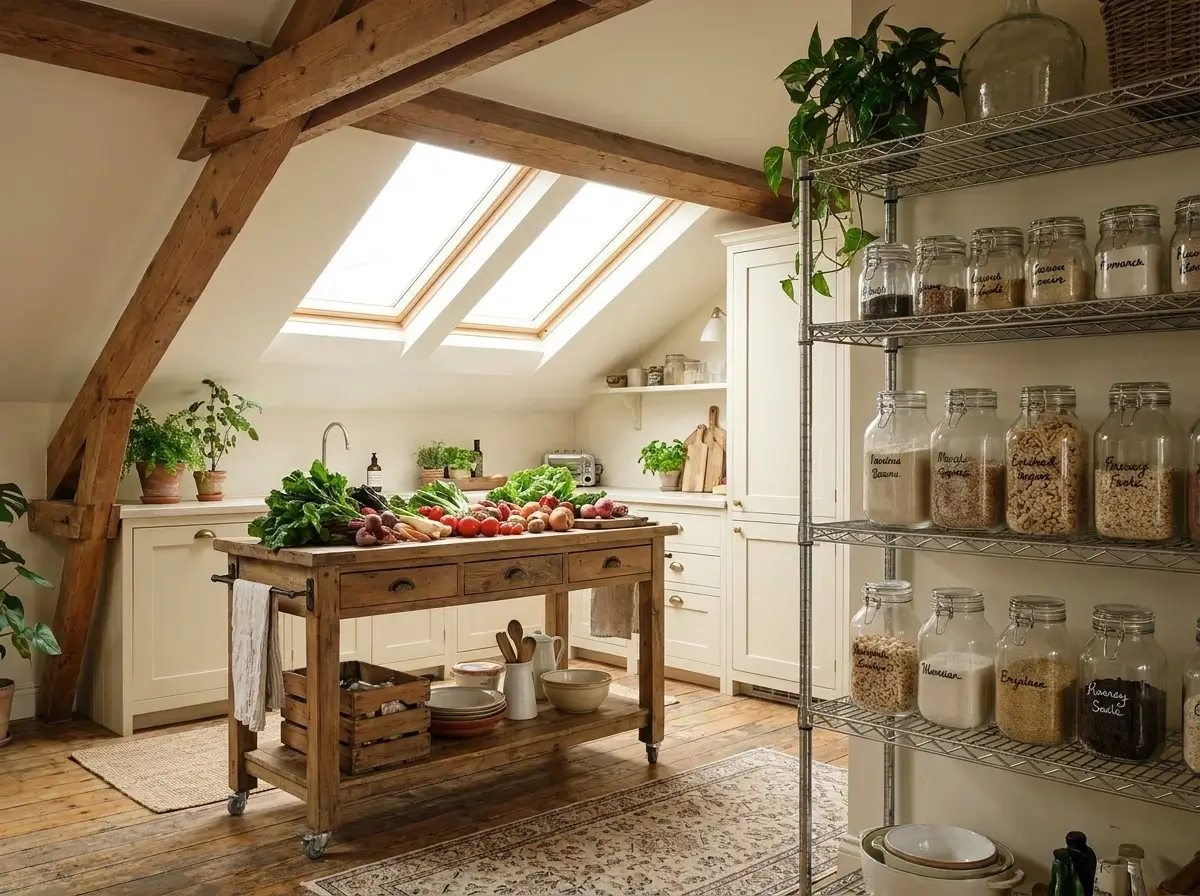
Cooking in a loft often means battling awkward angles, low ceilings, and a severe lack of counter space.
For renters, this challenge is doubled because you cannot simply tear down walls or install permanent upper cabinets.
However, you do not need a renovation budget or power tools to build a highly functional culinary workspace.
The most effective small loft kitchen ideas rely entirely on freestanding furniture, vertical tension, and clever zoning.
By utilizing rolling carts, modular shelving, and magnetic storage, you can turn tight eave spaces into organized prep stations that leave your drywall completely untouched.
In this guide, we will walk through drill-free pantry solutions, safe portable appliance placement, and how to create expandable counter space.
Whether you are living in a converted attic or an open-concept apartment, these renter-friendly strategies will help you reclaim your kitchen footprint.
Freestanding Pantry Solutions: Core Small Loft Kitchen Ideas
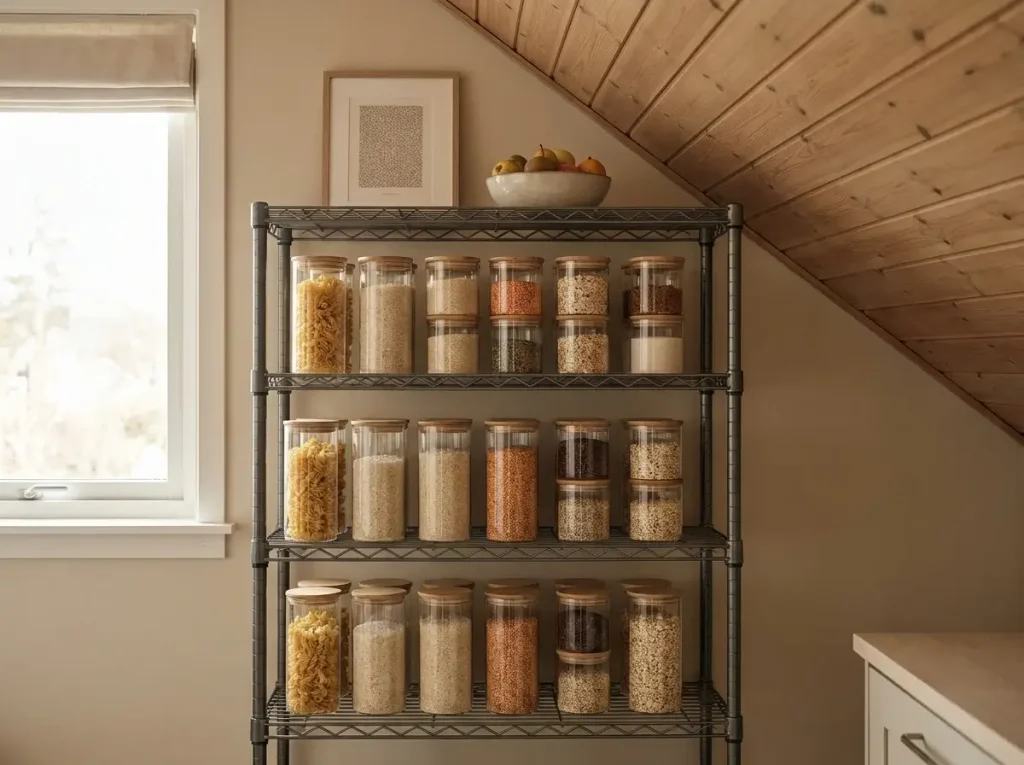
Traditional pantries fail in slanted-ceiling lofts because they rely on standard 90-degree corners and towering vertical drywall. Most pre-fabricated pantry cabinets are at least 72 inches tall, which instantly collides with the sloping eaves of a converted attic.
If you are renting, installing custom built-in cabinets to match your ceiling pitch is entirely out of the question. Developing drill-free small loft kitchen ideas starts with rethinking how and where you store your everyday dry goods.
Choosing Heavy-Duty Racks
Instead of fighting the architecture, place adjustable wire shelving racks against your tallest flat wall. These modular units are the absolute backbone of practical small loft kitchen ideas.
Because the individual shelves are easily adjustable, you can customize the vertical spacing. You can fit tall cereal boxes on the bottom tier and short spice jars near the top to accommodate a pitched roof.
Look for commercial-grade steel racks with locking wheels if you want the option to shift your pantry around when sweeping.
Heavy-duty racks also offer excellent weight distribution for canned goods and heavy countertop appliances without requiring a single drywall anchor.
Furthermore, their open-wire design maintains critical airflow, preventing your food storage from feeling visually heavy in an open-concept apartment layout.
Decanting for Vertical Space
Once your freestanding shelves are assembled, you need to address the visual clutter of branded packaging. Decanting dry goods into stackable airtight containers is a renter-friendly game-changer.
Cardboard boxes and plastic bags waste valuable inches and look incredibly messy on open shelving. By transferring your pasta, rice, flour, and snacks into uniform, clear containers, you maximize vertical space utilization perfectly.
The most effective small loft kitchen ideas always prioritize visual calm. When your pantry items double as intentional decor, your tight galley kitchen immediately feels organized and less chaotic.
Use a simple label maker to stick expiration dates on the bottom of the bins so you never lose track of freshness.
Managing Loft Temperatures
Finally, you must consider the unique, fluctuating climate of a loft space. Because heat naturally rises, upper-level apartments and converted attics often experience significant ambient temperature swings.
The importance of monitoring ambient loft temperatures for food storage cannot be overstated. If your metal shelving rack sits in a sun-drenched dormer window or near the absolute highest point of the ceiling, your groceries will degrade much faster.
It is critical to review and follow safe pantry temperature guidelines to prevent accidental spoilage. Keep heat-sensitive items like olive oil, spices, and chocolate on the lowest possible shelves where the air is cooler.
Alternatively, reserve your freestanding loft pantry strictly for durable canned goods and dry pasta, keeping perishables safely in the refrigerator.
Protecting your food from ambient heat is just as important as organizing it when implementing these small loft kitchen ideas.
Clever Small Loft Kitchen Ideas for Rolling Carts
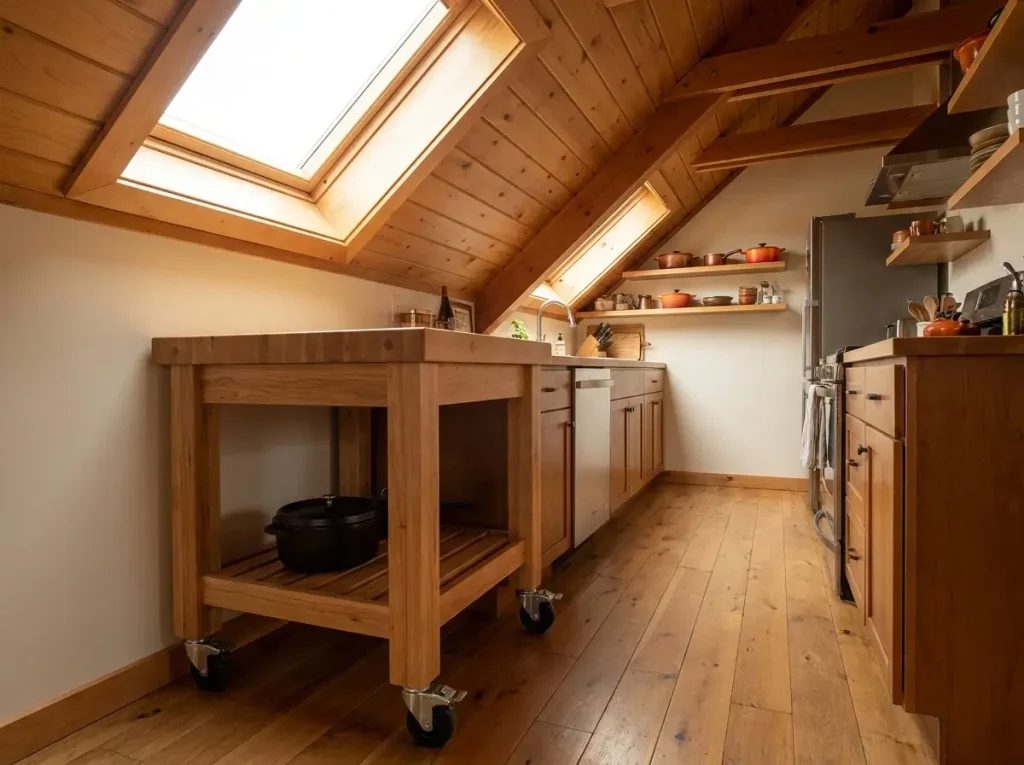
When dealing with a tight galley kitchen layout, fixed prep spaces are often your biggest hurdle. In a standard apartment, you might have long stretches of continuous countertop to chop vegetables or mix ingredients.
But in a converted attic or upper-level studio, you are usually restricted to a few precious inches right next to the sink.
This is exactly why mobile islands are essential for renters. When you cannot build new counters, you have to bring the counters to you.
Among all the small loft kitchen ideas available, introducing a high-quality rolling cart is arguably the most transformative step you can take.
While homeowners might focus on integrating a permanent layout, renters rely heavily on rolling kitchen carts to achieve the same highly efficient workflow without risking their security deposit.
Choosing the Right Cart
Selecting a solid butcher-block rolling cart as your mobile island provides an instant, durable prep station. The thick wooden top serves as a heavy-duty cutting board, allowing you to dice and slice without risking damage to any existing rental surfaces.
When shopping for the perfect cart, look closely at the hardware, specifically seeking models with locking caster wheels.
You need the flexibility to push it to the center of the room while cooking, but it must remain completely stationary when you are actively chopping root vegetables.
A wobbly surface is a major culinary safety hazard, so always prioritize sturdy, commercial-grade options over lightweight plastic alternatives.
Additionally, you should utilize the cart’s lower tiers for your absolute bulkiest items. Finding space for a heavy stand mixer, a large food processor, or a cast-iron dutch oven is a constant struggle in a small rental.
By placing these incredibly heavy tools on the bottom shelves of your rolling island, you effectively lower the center of gravity.
This makes the cart safer and easier to roll, while instantly freeing up your limited built-in cabinets.
The most effective small loft kitchen ideas always serve dual purposes—in this case, acting as both an expansive prep station and essential deep storage.
Stowing Under Eaves
The true genius of a rolling cart is its ability to completely disappear when you are finished cooking. One of the most brilliant small loft kitchen ideas is utilizing the awkward architectural angles of your apartment directly to your advantage.
Most loft apartments feature knee walls—the short, vertical walls where the slanted roofline meets the floorboards.
These low-clearance zones are notoriously difficult to use, as you simply cannot stand up straight beneath them. However, they are the absolute perfect parking spot for a mobile prep station.
Simply measure the exact height of your knee wall before purchasing a cart to ensure a clean fit. Once dinner is served and the dishes are washed, you can effortlessly tuck the cart entirely out of the way, pushing it straight under the lowest part of the ceiling.
This instantly opens up your central floor plan, removing bulky visual clutter and allowing your tight galley kitchen layout to breathe.
If you have guests coming over, you can even pull the stowed cart out slightly and repurpose it as a temporary bar station or a buffet serving table against the wall.
By keeping your walking paths clear when you are not actively cooking, you make the entire apartment feel significantly larger.
Implementing these dynamic, movable small loft kitchen ideas ensures that you never have to sacrifice a comfortable living room footprint just to prepare a great home-cooked meal.
Renter-Friendly Countertop Expansion Tricks
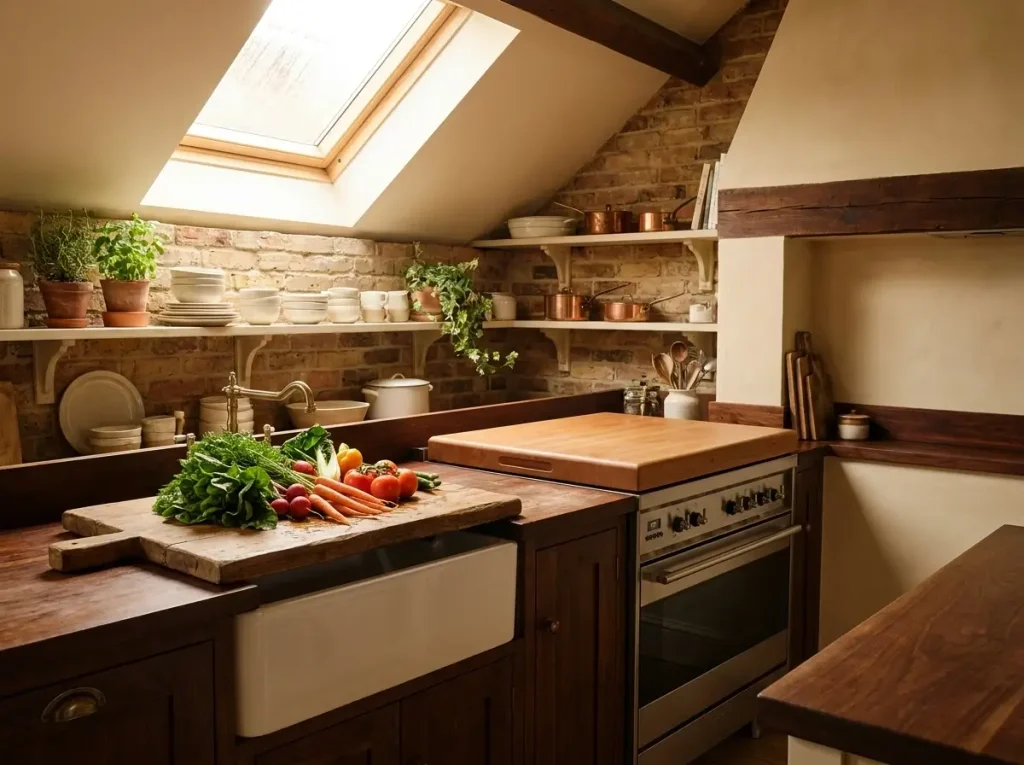
In a converted attic or upper-level apartment, flat surfaces are often the most valuable real estate you have.
When brainstorming damage-free small loft kitchen ideas, creating more countertop space is usually the number one priority for renters.
You cannot simply install an expansive kitchen island or extend the builtin laminate without risking your security deposit.
However, you can instantly multiply your available prep area by strategically covering existing fixtures.
If you find yourself balancing mixing bowls on the edge of the sink or chopping vegetables on top of your microwave, it is time to deploy some renter-friendly expansion tricks.
Over-the-Sink Solutions
One of the most effective small loft kitchen ideas involves borrowing unused space directly from your sink basin.
An over-the-sink cutting board is an absolute lifesaver for cramped culinary layouts. These oversized wooden or plastic boards are designed with grooved edges that lock perfectly over the rim of a standard sink, preventing them from slipping while you work.
By sliding one of these boards over half of your basin, you create an instant, sturdy prep zone. You can rinse vegetables on the open side and immediately slide them onto the board for chopping.
To make this work seamlessly, you must also organize the sink area to keep the surrounding counter completely clear.
A common mistake in tight apartments is cluttering the tiny perimeter of the sink with dish soap bottles, wet sponges, and scrub brushes. Instead, use an adhesive, drill-free wire caddy on the tiled backsplash to hold these items.
Moving your cleaning supplies to a vertical plane ensures your new over-the-sink prep station remains unobstructed.
Stovetop Covers and Noodle Boards
Your stove takes up a massive portion of your countertop footprint, but you only use the burners for a fraction of the day. Stovetop covers—often traditionally called noodle boards—are brilliant solutions for reclaiming this lost space when the burners are cool.
These large, raised wooden trays sit securely over your gas grates or electric coils. Instantly, your stovetop transforms into a smooth, expansive counter perfect for assembling meals, laying out baking sheets, or holding small portable appliances.
These wooden trays are staple small loft kitchen ideas because they look beautiful while keeping your daily workflow highly efficient.
Always double-check that every single burner is completely turned off and cool to the touch before placing a wooden board over your stove. This simple, non-negotiable safety habit guarantees you get the maximum prep space without introducing any fire risks to your rental.
Folding Drop-Leaf Extensions
Finally, consider how your freestanding furniture can expand on demand. Folding drop-leaf tables attached to existing freestanding furniture offer incredible flexibility for a narrow floor plan.
If you purchased a rolling cart or a modular shelving unit, look for clamp-on drop-leaf extensions. These clever additions give you an extra foot or two of flat surface when you need to roll out dough, chop large melons, or plate multiple dinners.
When you are finished, the leaf folds perfectly flat against the side of the cart.
By utilizing foldable extensions, you keep your walkways wide open during the day.
This proves that the best small loft kitchen ideas are those that adapt dynamically to your daily routine, giving you breathing room only exactly when you need it most.
Brilliant Small Loft Kitchen Ideas for Utensil Storage
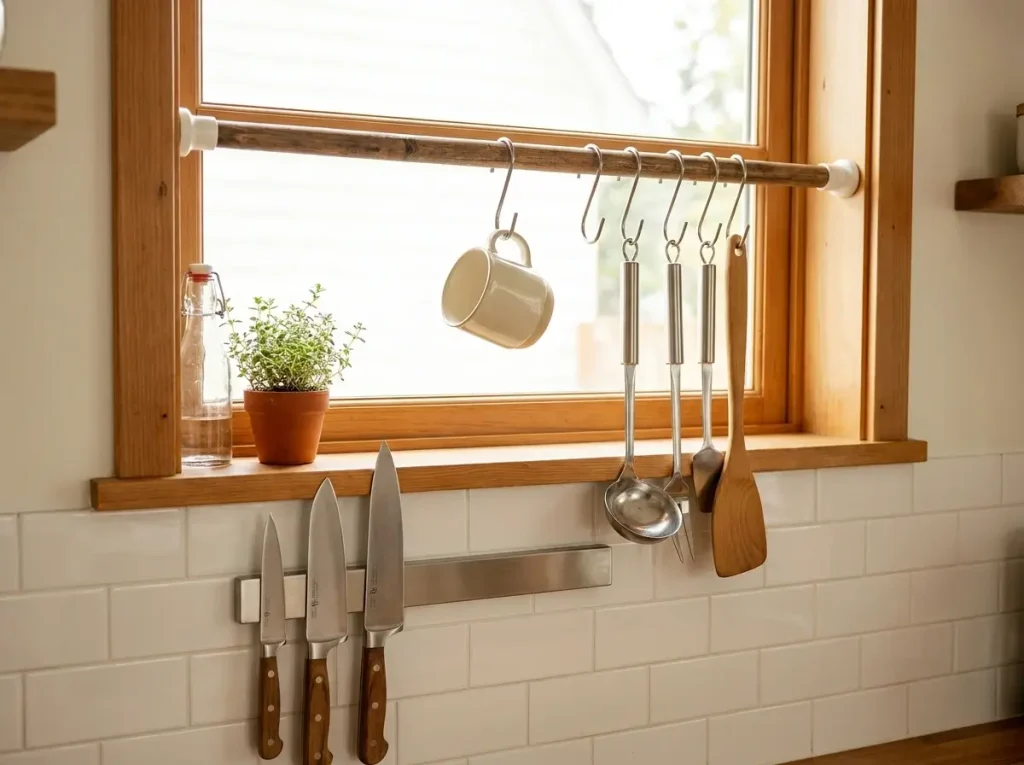
If you are trying to apply general loft storage concepts, getting utensils out of your drawers and onto vertical planes is step one. In a cramped apartment or converted attic, drawer space is an absolute premium, and you simply cannot afford to waste it on bulky spatulas, tongs, and ladles.
The most effective small loft kitchen ideas rely heavily on maximizing your vertical space without ever reaching for a power drill or a hammer.
When you cannot make permanent holes in the drywall to install a traditional pegboard, you have to get creative with friction and renter-safe adhesives.
Moving your everyday cooking tools onto the walls completely transforms your daily culinary workflow and eliminates visual clutter.
Tension Rod Hacks
One of the smartest, damage-free small loft kitchen ideas involves repurposing simple, spring-loaded tension rods. Normally reserved for window curtains or bathroom shower liners, these adjustable poles are incredibly sturdy when tightened correctly.
If your loft has a deep dormer window frame above the sink, or a narrow gap between two freestanding shelving units, you can easily install a short tension rod horizontally. Because they rely entirely on outward pressure against the walls, they leave absolutely no marks or holes behind.
Once your rod is securely in place, simply add a pack of heavy-duty stainless steel S-hooks. You can now hang your most-used ladles, whisks, slotted spoons, and even lightweight coffee mugs directly over your prep station.
Keeping these essential items visible and within arm’s reach speeds up your cooking process and prevents you from frantically digging through a jammed drawer while a pan is hot on the stove.
Adhesive Magnetic Strips
Knives are notoriously difficult to store safely in tight rental spaces. Traditional heavy wooden knife blocks consume way too much of your precious countertop area, while keeping loose knives rattling in a drawer is a serious safety hazard.
The solution is a wall-mounted magnetic knife strip, perfectly adapted for lease compliance.
You can mount heavy-duty magnetic strips using water-resistant, renter-safe adhesive strips rather than the included mounting screws.
A common mistake is using standard poster adhesives; instead, be sure to purchase heavy-duty strips designed specifically for humid environments (like bathrooms), as kitchens experience frequent temperature and moisture changes from boiling water.
Press the magnetic strip firmly against a smooth tile backsplash or a flat section of drywall. Always wait the recommended 24 hours for the adhesive to cure completely before attaching your chef’s knives, metal spice tins, and kitchen shears.
By combining tension rod organization with magnetic strips, you free up massive amounts of valuable drawer space for actual silverware and flat items.
Moving bulky, everyday items to the walls is the cornerstone of successful small loft kitchen ideas, ensuring your cooking space feels highly functional rather than chaotic.
Best of all, when your lease is up, everything comes down cleanly without risking your security deposit.
Safe Appliance Placement Under Slanted Ceilings
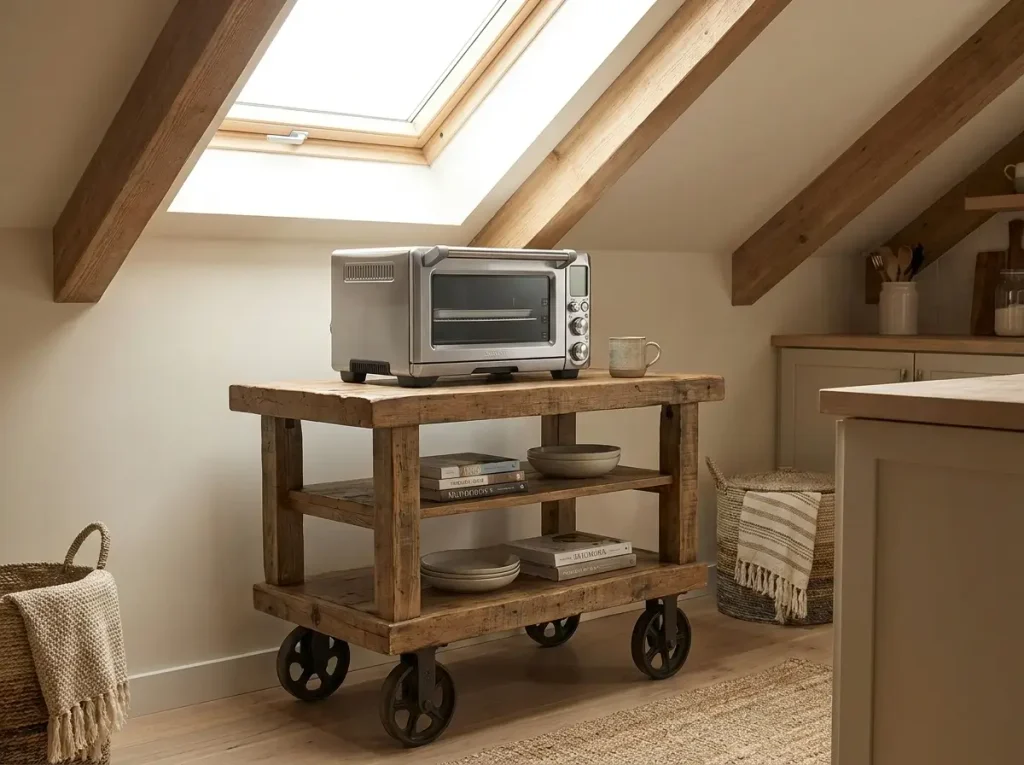
When executing practical small loft kitchen ideas, aesthetics must never compromise basic fire safety. Converted attics and upper-level apartments feature unique architectural quirks, most notably low, slanted wood ceilings.
A common mistake is treating these cramped eaves exactly like standard high-ceiling countertops. If you place heat-generating tools directly underneath a pitched roof, the concentrated heat has nowhere to escape.
Ventilation Clearance
Incorporating heat-generating appliances is one of the most challenging small loft kitchen ideas because of restricted vertical clearance. Appliances like toaster ovens, air fryers, and portable microwaves require significant breathing room to operate safely.
When heat rises from a toaster oven and hits a low wooden ceiling, the surface can become dangerously hot in a matter of minutes.
Furthermore, trapped heat prevents the appliance’s internal cooling fans from working correctly, which can drastically shorten its lifespan and increase the risk of an electrical fire.
To protect your rental unit and your security deposit, you must measure the exact inches of vertical space above your planned appliance station.
It is highly recommended to review the official kitchen appliance clearance standards to determine exactly how much space is required for proper heat dissipation.
If your only available countertop is shoved deep into a low knee wall, do not place your toaster there.
Instead, the safest small loft kitchen ideas often involve using your rolling cart to pull appliances out from under the lowest eaves while they are actively running. Once the appliance is completely cooled, you can easily tuck the cart back away.
You must also be highly strategic about where you place your renter-friendly wall organizers. Keep your heat-generating tools far away from any walls utilizing adhesive hooks or magnetic strips.
Prolonged exposure to radiant heat will quickly melt the adhesive, causing your perfectly organized utensils and heavy knives to crash onto the counter.
Power Load Management
Beyond physical clearance, you must also consider the hidden electrical constraints of an older rental. Many converted attics run on older electrical grids that were never originally designed to handle the heavy wattage of modern culinary tools.
Managing power loads is absolutely critical when relying on portable units rather than built-in ranges. If you plug a high-wattage induction burner and a microwave into the same shared circuit, you run a high risk of tripping the breaker.
Selecting energy-efficient countertop tools ranks among the most crucial small loft kitchen ideas for older rental units. Before purchasing a new hot plate or compact microwave, consult resources on portable appliance efficiency to find models that draw less power.
A smart practice is to map out which wall outlets belong to which electrical circuits before you finalize your prep stations.
Staggering your high-draw appliances across different walls ensures you distribute the electrical burden safely.
Ultimately, balancing power consumption guarantees that your damage-free kitchen setup remains as functional as it is secure.
Maximizing Low Knee Walls for Cookware Organization
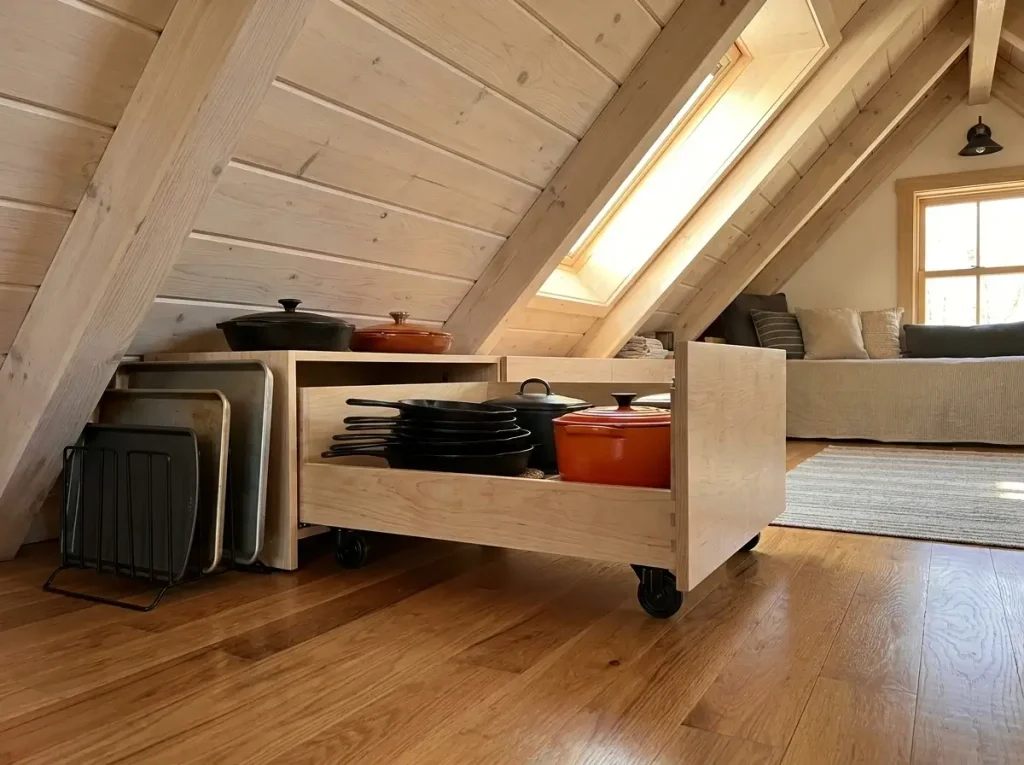
When executing effective small loft kitchen ideas, you must account for the unique architecture of an attic space. The most notoriously difficult feature to navigate is the “knee wall.”
This is the short, vertical section of the wall where the severely slanted ceiling finally meets the floor. Because you physically cannot stand straight up beneath a knee wall, these low-clearance zones often turn into wasted dead space.
However, when you are trying to maximize every inch of a tight galley layout, these awkward angles offer a hidden opportunity.
Repurposing these floor-level areas is actually one of the most brilliant small loft kitchen ideas you can implement for heavy culinary gear.
Floor-Level Bins for Heavy Cookware
Instead of shoving random cardboard boxes into the dark corners of your eaves, create a dedicated zone strictly for your heaviest cookware. Dutch ovens, cast iron skillets, and large stock pots take up massive amounts of room in standard kitchen cabinets.
Using slide-out floor bins equipped with small caster wheels allows you to store these bulky items right against the knee wall.
If you are worried about scratching the rental unit’s hardwood floors, simply attach heavy-duty felt pads to the bottom of wooden crates instead of using wheels.
When you need to sear a steak, simply slide the bin out into the open floor plan, grab your heavy pan, and push it safely back under the eaves. This keeps your most cumbersome tools incredibly accessible without forcing you to bend at an awkward angle under a low ceiling.
Prioritizing Safe Weight Distribution
When renting a loft, you are likely relying heavily on freestanding wire racks rather than wall-anchored cabinets. A common mistake is placing heavy cast-iron pots on the upper tiers of these freestanding shelving units.
Doing so makes the rack incredibly top-heavy, creating a severe tipping hazard if you accidentally bump into it while cooking. Therefore, keeping heavy items as low to the ground as possible is a fundamental safety rule for small loft kitchen ideas.
By utilizing the knee wall for your heaviest cast iron, you guarantee your freestanding racks remain perfectly balanced and safe.
Repurposing Low Shelves for Baking Sheets
Beyond large pots, knee walls are perfect for storing wide, flat items that are awkward to fit anywhere else. Repurposing deep, low shelves specifically for your seldom-used baking sheets, muffin tins, and oversized cutting boards keeps them completely out of the way.
You can even slide basic office magazine files under the lowest part of the eaves to hold these flat metal trays vertically.
By keeping the bulkiest, heaviest items safely at ground level, you ensure your eye-level storage remains visually light and clutter-free.
This approach proves that the best small loft kitchen ideas do not just find more space—they logically distribute the weight of your culinary tools to make the kitchen safer and easier to navigate.
Lighting Solutions for Dark Kitchen Eaves Without Hardwiring
One of the most frustrating challenges of cooking in a converted attic is the severe shadow effect caused by working under slanted loft ceilings. Standard overhead lighting usually sits in the center of the room at the highest peak of the roof.
When you stand at a prep station tucked under a low eave, your own body blocks that central light, casting dark, dangerous shadows directly over your cutting board. Finding ways to illuminate these cramped corners is one of the most frequently overlooked small loft kitchen ideas.
To chop vegetables and handle hot pans safely, you cannot rely on dim, ambient light. It is highly recommended to understand proper task lighting levels so you know exactly how bright your culinary workspace needs to be to prevent accidents.
Fortunately, you can achieve this professional-level illumination without hiring an electrician or losing your security deposit.
Rechargeable Puck Lights
The absolute fastest way to brighten a dark eave is by using rechargeable, motion-sensor LED puck lights. These lightweight, circular lights attach directly to slanted wood ceilings or the undersides of your freestanding shelving units using renter-safe adhesive pads.
Because they are battery-operated and easily recharged via USB, you never have to worry about routing ugly extension cords across your tiled backsplash. A motion-sensor model is a brilliant addition to your collection of small loft kitchen ideas.
The moment you step up to your over-the-sink cutting board or pull out your rolling cart, the puck light instantly clicks on. When you are finished, it automatically powers down, saving battery life and keeping your hands free while cooking.
Adhesive LED Strip Lights
For a more seamless, architectural look, adhesive LED strip lights are an incredible, damage-free solution. These thin, flexible ribbons of light can be cut to size and stuck directly along the undersides of your heavy-duty wire pantry racks.
Running an LED strip above your decanted dry goods not only makes it easier to read expiration dates, but it also creates a warm, high-end glow.
Incorporating ambient lighting is a core pillar of the best small loft kitchen ideas, as it visually expands tight spaces and makes the kitchen feel intentional rather than cramped.
Look for LED strips that offer adjustable color temperatures. Being able to switch from a bright, cool white while chopping onions to a soft, warm amber while eating dinner gives your open-concept loft incredible versatility.
Portable Task Lamps
Finally, do not underestimate the power of simply positioning portable task lamps to illuminate your prep areas safely. A small, heavy-based table lamp or a heavy-duty clamp lamp can easily attach to the edge of your rolling butcher-block cart.
When you roll your mobile island out from under the knee wall, the light travels right along with it. This provides an intense, focused beam of light exactly where your knife is working.
By combining movable task lamps with adhesive LEDs, you ensure that every inch of your workspace is perfectly lit.
Embracing these mobile, adaptable small loft kitchen ideas guarantees that your culinary layout is just as bright and functional as a fully renovated, hardwired space.
Conclusion
Navigating a cramped culinary layout does not have to mean sacrificing your cooking routine. By implementing these completely damage-free small loft kitchen ideas, you can transform awkward angles into highly efficient prep zones while keeping your security deposit safe.
The key is to prioritize flexibility over permanence. Freestanding shelving provides necessary pantry space, while a rolling cart ensures your counter space can move exactly where you need it.
Remember to always prioritize safety when placing heat-generating appliances under low ceilings, and utilize tension rods to keep your essential tools within arm’s reach.
If you are looking to overhaul the rest of your apartment layout, check out our complete guide on how to maximize space and storage across your entire floor plan. Start by adding one rolling cart or tension rod this week, and watch your loft kitchen open up.