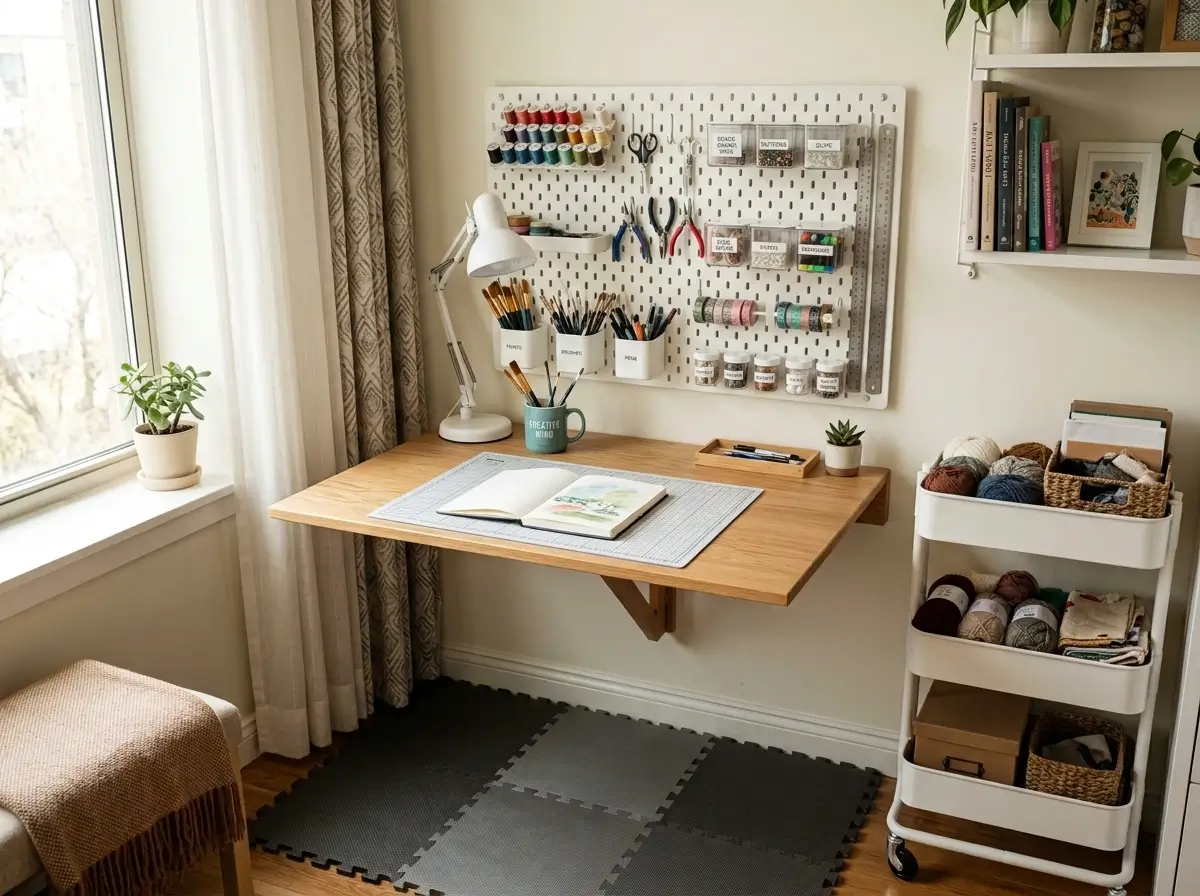
Finding space for your passions in a cramped apartment can feel impossible. When every square foot is spoken for, carving out a dedicated zone for model building, sewing, or electronics often falls to the wayside.
A common mistake is assuming you need a spare bedroom to create a functional workspace. In reality, you can build a highly efficient small hobby room out of a closet, a living room corner, or a dining alcove—without altering the property.
The secret lies in utilizing damage-free organization, vertical storage, and modular setups that adapt to your rental’s strict rules.
In this guide, we will explore practical ways to maximize your layout, implement no-drill storage for tiny components, and safely manage power cords.
You will also learn renter-friendly techniques for soundproofing and protecting your floors, ensuring your creative space is both inspiring and compliant.
Maximizing the Layout of a Small Hobby Room
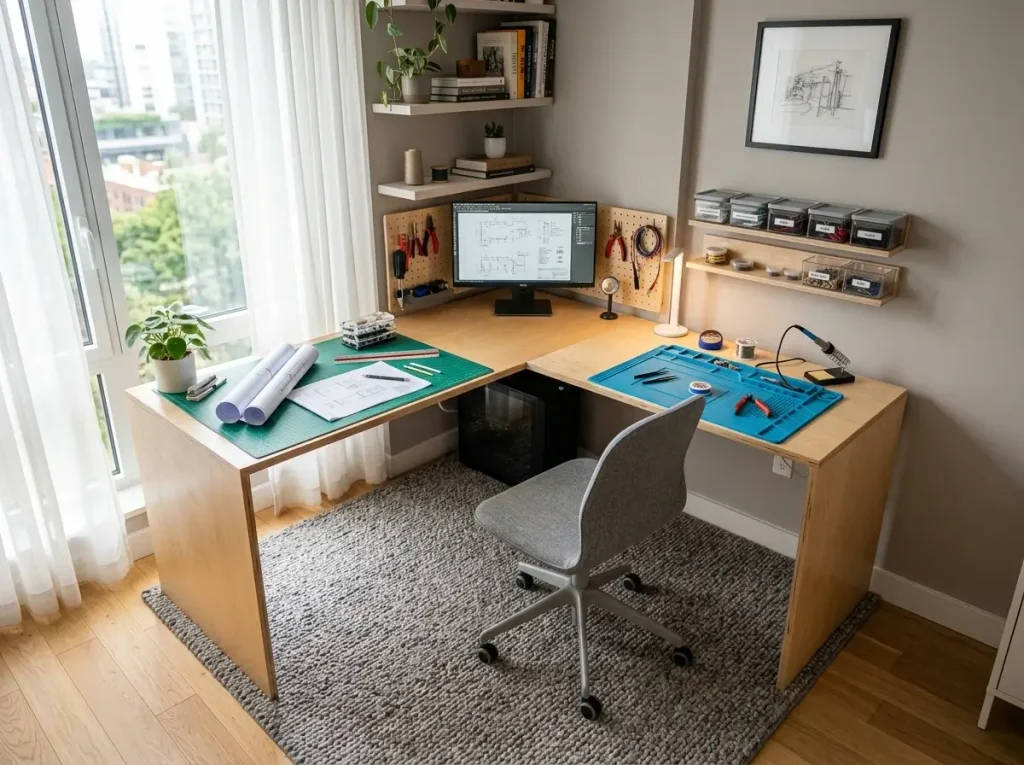
Finding the right layout is the foundational step when building a small hobby room in a tight rental apartment. When every inch of space is already accounted for, carving out a dedicated area requires more than just pushing a desk against a blank wall.
A common mistake is trying to fit all aspects of a complex pastime into one undifferentiated pile. Instead, you need to strategically assess your available footprint and divide it based on the specific physical demands of your projects.
Separating Work Zones
To get the most out of your small hobby room, start by evaluating your space for “clean” versus “dirty” tasks.
For example, if you build scale models or tinker with electronics, you need a designated “dirty” zone for sanding, soldering, or using messy adhesives.
Conversely, you also need a “clean” zone for delicate assembly, painting, or viewing delicate instructional blueprints.
Even if your workspace is just a tiny corner of your living room, separating these functions prevents your tools and debris from cross-contaminating your pristine materials.
You do not need to build physical walls to achieve this separation. Using distinct area rugs or angling a low bookshelf can visually block off your workspace from the rest of the apartment.
Many renters find that simply placing a durable, low-pile rug under the desk instantly signals where the living area ends and the workspace begins.
By intentionally placing furniture to imply boundaries, you create a distinct mental and physical zone for your projects. If you need broader strategies on physically splitting the room’s function, renting-friendly dividers can also be highly effective for larger open-concept spaces.
The Closet Conversion Method
If you lack a free corner in your main living areas, consider adapting a standard reach-in closet into a hidden small hobby room.
Often referred to as a “cloffice” in the remote-work world, this method is absolutely perfect for equipment-heavy hobbies.
By temporarily removing the closet doors and safely storing them under your bed, you instantly gain a recessed alcove.
This setup naturally contains your hobby chaos. It keeps small parts, heavy tools, and ongoing projects neatly tucked away from main traffic paths.
When you move out, you simply reattach the closet doors and take your setup with you, completely preserving your security deposit.
Ensuring Adequate Walkway Clearance
No matter where you establish your small hobby room, maintaining adequate walkway clearance is vital. You must leave enough room to comfortably push back a rolling chair without banging into your sofa or scratching a nearby wall.
- Measure twice: Ensure you have at least 36 inches of clearance behind your workstation for a standard rolling chair to pivot safely.
- Check equipment access: Verify you can easily reach the back of your 3D printer, sewing machine, or heavy equipment without having to drag heavy tables across the floor.
- Test the flow: Always test your planned layout with masking tape on the floor before purchasing any new furniture or shelving.
Furthermore, if you share your apartment with a roommate or partner, a cramped layout will quickly become a point of frustration.
A well-planned layout not only makes your workspace more enjoyable to use, but it also ensures your hobby seamlessly coexists with your everyday apartment life.
Desk and Workstation Solutions for a Small Hobby Room
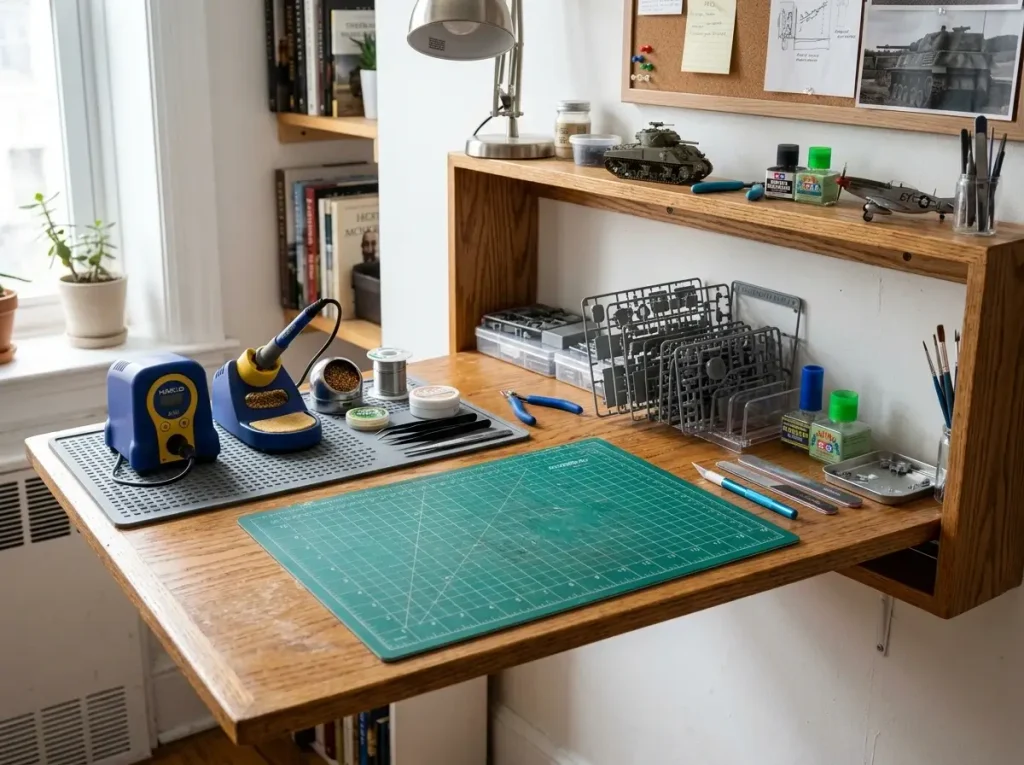
When you are building a small hobby room, your desk is the command center of your entire operation. A flimsy folding card table might suffice for a quick weekend craft, but specialized hobbies require a foundation that won’t wobble when you apply pressure or use precision tools.
A common mistake is assuming you need a massive, heavy wooden workbench that dominates the room to get real work done. Instead, you can find incredibly durable workstations designed specifically to adapt to tight rental square footage.
The goal is to balance stability with modularity, ensuring your workspace fits your life without damaging your apartment.
Modular and Folding Desks
If your small hobby room needs to vanish at the end of the day, a fold-down, wall-mounted desk is an excellent space-saving solution.
These modular desks attach directly to the wall and fold completely flat when not in use, instantly reclaiming your floor space for everyday living. Before installing one, you must check your lease agreement regarding wall mounting.
If permitted, always use heavy-duty wall anchors rated for at least 50 pounds, ensuring your work surface can handle the weight of your equipment.
A fold-down table is particularly useful if you are converting a closet space, as it allows you to easily close the closet doors without having to disassemble your entire setup.
If wall mounting is strictly prohibited by your landlord, consider using a heavy-duty utility cart topped with a solid butcher block surface.
A rolling modular workstation allows you to wheel your entire project into the center of the room when working, and tuck it neatly into a corner when finished.
These heavy-duty carts often feature locking casters, giving you the stability of a fixed desk without leaving a permanent footprint in the room.
Choosing a Durable Work Surface and Ergonomic Height
Not all desk surfaces are created equal, especially when your small hobby room is regularly exposed to sharp blades, hot solder, or heavy mallet strikes. You must select an impact-resistant surface that can withstand the physical demands of your specific projects.
For high-impact hobbies, a solid wood butcher block or a steel-topped rolling workbench provides incredible durability and longevity.
If you are stuck with a cheaper, delicate laminate desk provided by a furnished rental, you can easily protect it by placing a large, self-healing cutting mat or a high-temperature silicone project mat permanently over the top.
Beyond the material surface, selecting the right desk height is absolutely crucial for your physical comfort. Will you be sitting for hours assembling tiny electronic parts, or standing while you cut fabric and mold clay?
You should tailor your desk height to your dominant posture. For seated tasks, ensure your feet rest flat on the floor with your knees at a comfortable 90-degree angle.
For standing tasks, the desk should sit right at your elbow height to prevent hunching.
To prevent long-term physical strain during marathon project sessions, it is highly recommended to follow established guidelines for ergonomic reach zones, keeping your most frequently used hand tools well within an easy, comfortable arm’s sweep.
By combining a sturdy, adaptable desk with a thoughtfully chosen surface, your small hobby room will look great and function exactly like a professional workshop.
Organizing Tiny Components Without Drilling
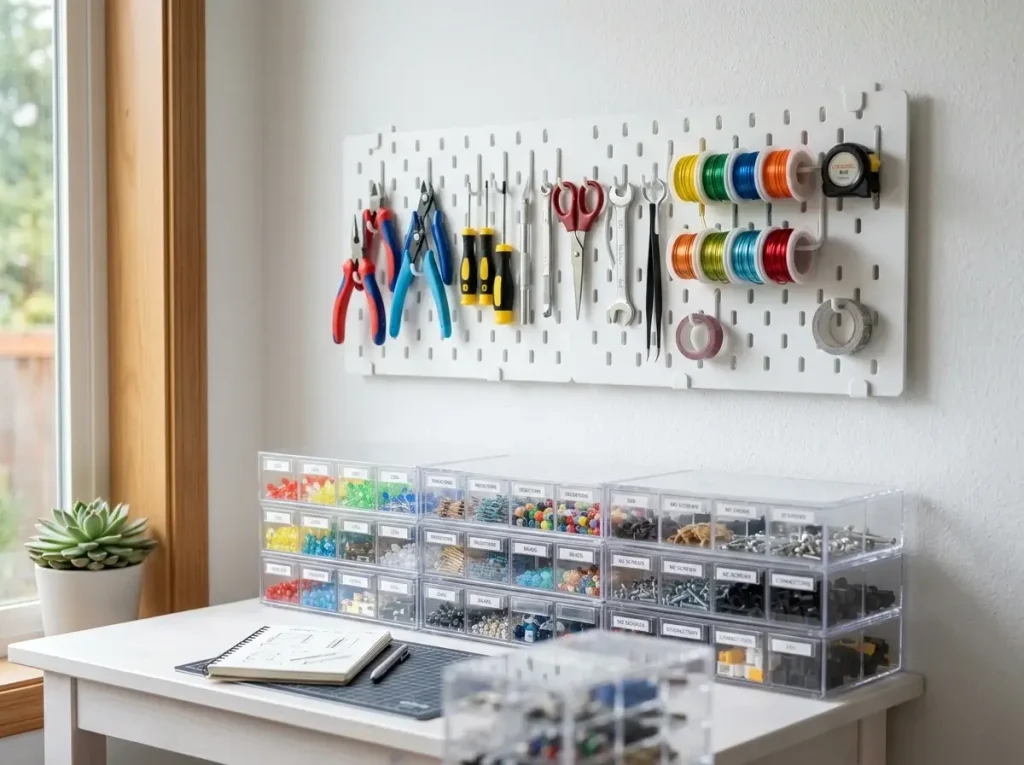
The fastest way to ruin the functionality of a small hobby room is by losing control of your tiny components.
Whether you are dealing with microscopic electronic resistors, hundreds of colorful glass beads, or assorted screws for model building, clutter is the absolute enemy of creativity.
When these tiny pieces scatter across your desk, you spend more time searching for parts than actually working on your project.
A common mistake renters make is assuming that effective vertical storage requires power tools and heavy drywall anchors.
If you rent your apartment, drilling dozens of holes for custom wooden shelving is a guaranteed way to lose your security deposit. Fortunately, you can achieve incredible organization using strictly damage-free methods.
Tension Rod Systems and Clear Drawers
When space is at a premium, you have to look for hidden vertical real estate. Tension-rod shelving systems are a fantastic addition to a small hobby room.
Because they rely entirely on outward pressure rather than permanent screws, you can safely install them inside deep window frames, narrow closets, or tight architectural alcoves.
These temporary rods create instant, sturdy platforms for your lightest materials. To maximize this newfound shelf space, invest in stackable, clear-drawer organizers.
Rapid visual identification is crucial when you are in the middle of a complex project. Instead of digging through opaque cardboard shoeboxes, clear acrylic drawers allow you to see exactly where your red thread or 5mm screws are located at a mere glance.
By stacking these lightweight drawers on tension shelves, you keep your essential parts at eye level while keeping your main desk surface completely clear for active work.
Adhesive Pegboard Setups and Door Organizers
Pegboards are widely considered the gold standard for workspace organization. However, traditional masonite pegboards are heavy and require drilling directly into wall studs.
To get this professional look in a rental, opt for lightweight, modular plastic pegboards designed specifically to mount with high-capacity adhesive strips.
By applying these removable adhesive strips correctly—and strictly following the weight limits printed on the packaging—you can utilize blank wall space in your small hobby room without leaving a single scratch on the paint.
You can hang your scissors, pliers, tape rolls, and wire cutters on small hooks exactly where you need them most.
Finally, do not ignore the largest piece of unused vertical space in your apartment: the back of the room’s door. Hanging an over-the-door shoe or jewelry pocket organizer is an inexpensive way to add massive storage capacity instantly.
These hanging organizers provide dozens of clear, individual pouches that are absolutely perfect for sorting larger, awkwardly shaped items like yarn skeins, small spray paint cans, or bulky power cables.
By combining these drill-free strategies, your small hobby room will remain perfectly organized, visually inspiring, and entirely compliant with your strict lease agreement.
Safe Cable Management for Small Hobby Room Gear
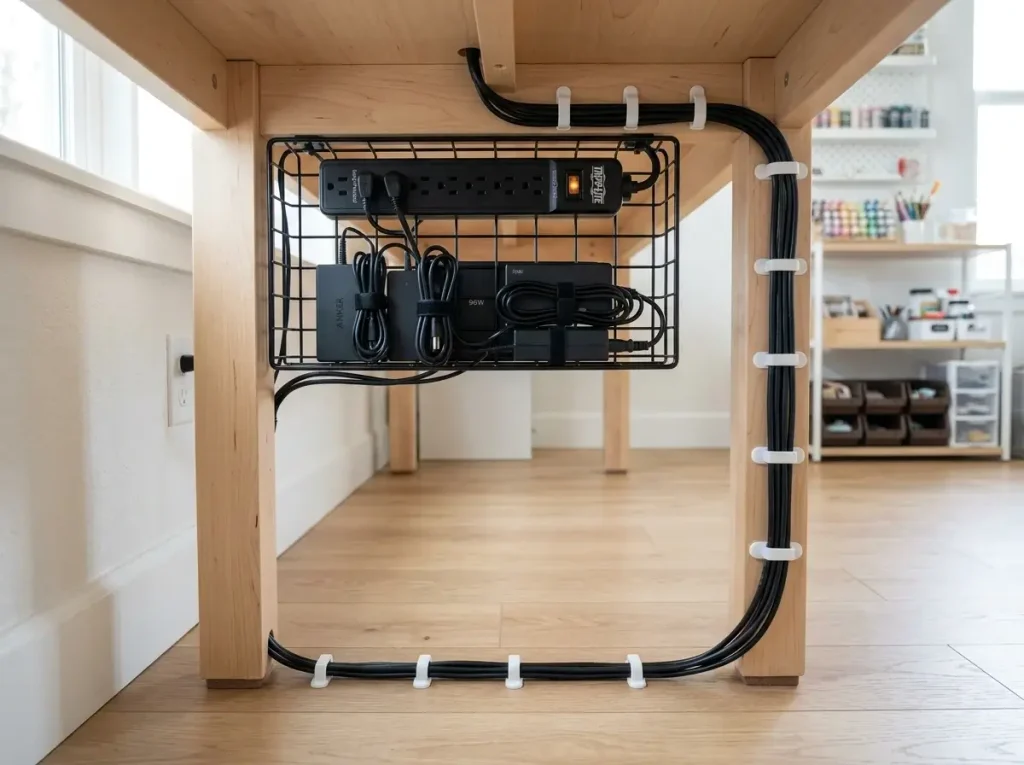
When you bring electronic equipment into a small space, cords can quickly become a chaotic, tangled mess. Setting up a small hobby room often involves plugging in sewing machines, 3D printers, soldering irons, and bright task lighting.
A common mistake is simply plugging everything into a single wall outlet using whatever cheap extension cords happen to be lying around. This is not only a massive eyesore, but in older rental apartments, it is a serious fire hazard.
Power Load and Safety
Before you plug in a single tool, you need to assess the electrical capacity of your small hobby room. Many rental units, especially older apartments, run multiple rooms on a single circuit breaker.
Calculating the power load of your hobby equipment is critical to avoid constantly tripping the rental’s breakers when you turn on a heat press or a heavy-duty rotary tool.
Always check the wattage requirements printed on the back of your devices. If you must use multiple high-draw tools, make sure they are distributed across different outlets, or even different electrical circuits if possible.
For all enclosed indoor setups, investing in high-quality, heavy-duty surge protectors is an absolute must to protect your sensitive electronics.
However, you must be extremely careful about how you arrange these power strips in confined spaces.
You should always follow recognized safe extension cord practices, which specifically warn against “daisy-chaining”—the highly dangerous practice of plugging one power strip directly into another.
Proper power load safety ensures your expensive equipment is protected from sudden electrical spikes while keeping your rental unit compliant with basic fire codes.
Routing Cords Cleanly
Once you know your electrical setup is safe, it is time to manage the visual and physical clutter. You do not want to be tripping over loose wires or rolling your desk chair over delicate power cables in a tight small hobby room.
Because you cannot drill into the drywall to hide cables inside the walls, you need exterior solutions.
The best approach for renters is to route cables cleanly along the top of baseboards, around doorframes, or up the backs of furniture legs using damage-free adhesive wire clips.
These small, inexpensive clips hold cords securely in place and peel off easily when your lease is up, leaving the apartment’s paint completely untouched.
To keep the floor entirely clear beneath your feet, mount an under-desk wire management tray directly to the underside of your workstation.
If you are using a solid butcher block top or a piece of owned furniture, you can attach these trays with short wood screws. If you are using a hollow desk or a rented table, heavy-duty double-sided mounting tape works perfectly to hold the lightweight metal baskets in place.
You can tuck your heavy surge protectors, bulky power bricks, and excess cord length up into these trays, lifting the messy wires completely off the ground.
By dedicating a little extra time to proper cable management, your small hobby room will look significantly cleaner, feel much more spacious, and operate with maximum safety.
Proper Ventilation for Hobby Adhesives and Materials
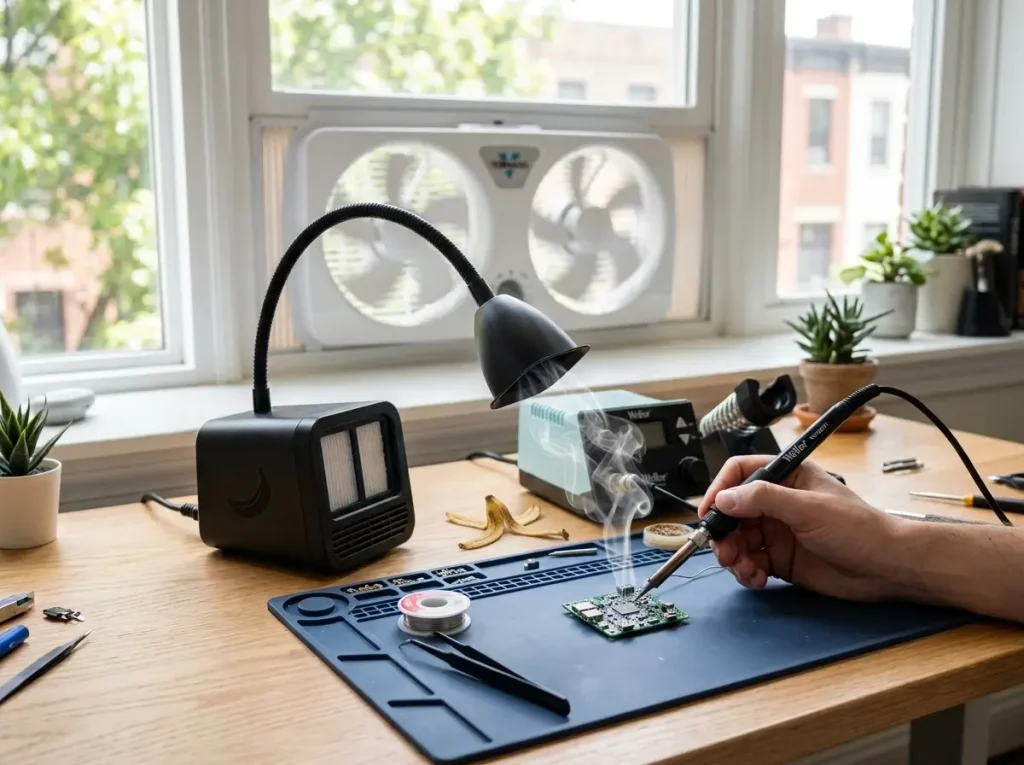
A highly organized small hobby room isn’t just about aesthetics; it is also about maintaining a safe and healthy environment. When you work with materials like superglues, epoxy resins, 3D printing filaments, or soldering flux in a tight space, the air quality can degrade rapidly.
A common mistake is assuming that simply cracking a nearby window open an inch is enough to keep you safe from harmful vapors.
Enclosed apartment spaces easily trap fumes, allowing them to linger for hours after your project is put away.
If your projects involve heavy chemical solvents for oil painting or canvas work, you will need a dedicated approach for managing painting fumes.
However, for standard dry-hobby fumes like melting plastic, cyanoacrylate off-gassing, or electronic solder smoke, you can manage the air safely without installing a permanent, landlord-prohibited exhaust hood.
Creating Window Airflow
Establishing active, intentional cross ventilation is the most effective way to clear the air in a small hobby room. You cannot rely on passive breezes; you need mechanical assistance.
The best renter-friendly approach is setting up a dual-window fan system to create positive and negative airflow.
If you have a single window, place a reversible twin window fan securely in the frame. Set one fan blade to pull fresh air into the room and the other to blow contaminated air out.
If you are lucky enough to have two windows in the space, set a fan in one to pull fresh air in, and a high-powered box fan in the other facing outward to exhaust the room.
Understanding how airflow works is vital. If you only blow air into your workspace, you will simply push the chemical odors under your door and into the rest of your apartment.
It is crucial to respect recognized indoor air quality guidelines, which clearly detail how quickly volatile organic compounds (VOCs) can accumulate and pose health risks in poorly ventilated residential spaces.
Desktop Fume Extractors and Safe Storage
Sometimes a window breeze isn’t enough, especially if you live in a climate where opening a window in the middle of winter is impossible. In these scenarios, investing in a portable desktop fume extractor is an absolute game-changer for your small hobby room.
These compact, motorized units sit just inches from your active work zone. They actively pull the harmful smoke or glue vapors directly into a thick HEPA and activated carbon filter before the fumes ever reach your breathing zone.
They require absolutely zero hardwired installation, plug right into a standard wall outlet, and can be easily tucked away in a closet or clear drawer when not in use.
Finally, proper ventilation isn’t just about active working hours. Volatile materials can continuously off-gas even when their caps are screwed on tight. Storing these materials safely is essential for maintaining a healthy small hobby room.
Use airtight, renter-friendly plastic storage bins equipped with heavy-duty silicone gaskets to house your liquid glues, 3D printing resins, and chemical accelerators.
By keeping these specific containers tightly sealed and stored away from direct heat or sunlight, you prevent lingering chemical odors from permanently seeping into your apartment’s carpets, curtains, or upholstery.
Renter-Friendly Soundproofing for Noisy Hobbies
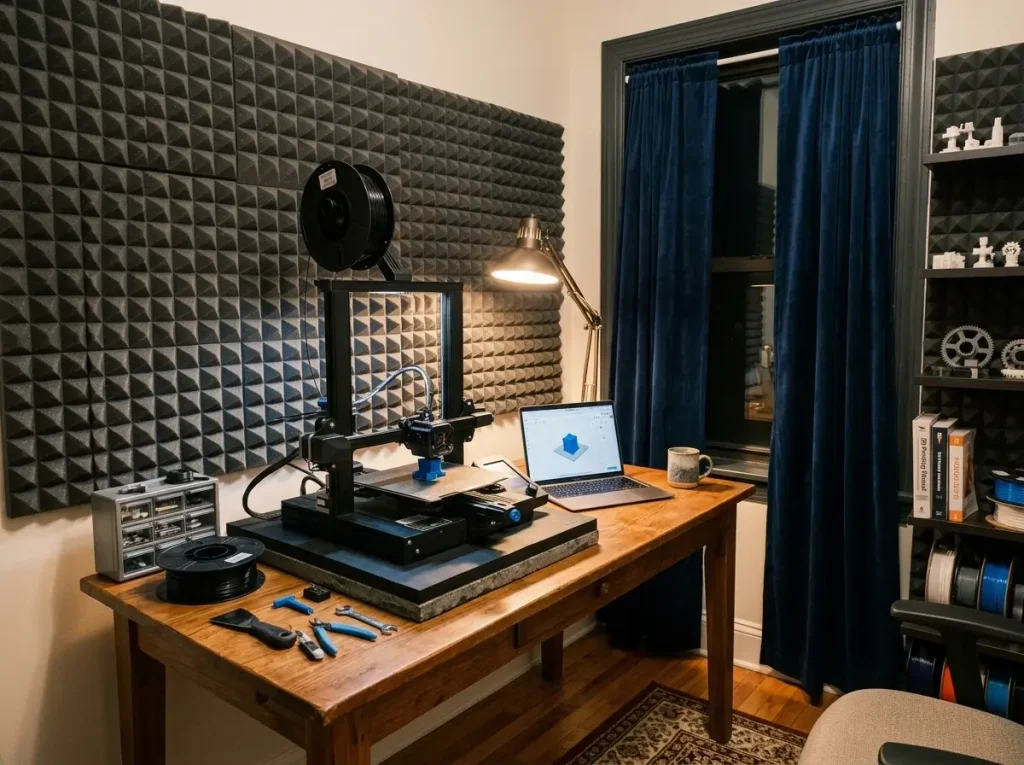
Living in an apartment means sharing walls, floors, and ceilings. When you set up a small hobby room, managing the noise your equipment produces is essential for keeping the peace.
A common mistake is assuming that just closing a hollow interior door will block the whir of a 3D printer, the high-speed whine of a small rotary tool, or the rapid thumping of a heavy-duty sewing machine.
To be a considerate neighbor while still enjoying your craft at all hours, you need a smart, renter-friendly soundproofing strategy.
Stopping Vibrations
The most disruptive sound in any multi-family dwelling isn’t usually loud voices; it is the physical vibration of heavy machinery. In acoustics, this is known as impact noise, and it travels straight down through the floorboards.
To understand why your downstairs neighbor can hear every movement of your scroll saw, it helps to look at sound transmission standards for residential buildings, which often demonstrate how easily structural vibrations bypass standard apartment subfloors.
To stop these vibrations at the source, you should place thick, high-density vibration-isolation pads directly under any motorized equipment in your small hobby room.
These inexpensive rubber or cork mats absorb the kinetic energy of a sewing machine or an air compressor before it ever reaches your desk surface.
Furthermore, if your desk sits on a hard floor, adding a thick rug with a felt underlayment provides an excellent secondary barrier. This significantly deadens the low-frequency rumble that easily travels down the legs of your workstation and into the building’s floor joists.
Deadening Airborne Noise
While thick mats handle the physical shaking, you still need to address the high-pitched whines and whirs traveling through the air. This type of sound is called airborne noise, and it easily bounces off the hard, flat drywall of modern apartments.
A simple, drill-free way to absorb these echoes in a small hobby room is by hanging heavy acoustic curtains.
If your workspace has a window or sits near a thin interior door, installing a tension rod with dense, sound-dampening velvet curtains will drastically cut down on sound leakage into the hallway.
For the walls themselves, you can apply acoustic foam panels without losing your security deposit.
- The Poster Board Trick: Instead of using the permanent spray adhesive recommended by the foam manufacturer, attach the foam squares to a large piece of rigid poster board using standard glue.
- Damage-Free Hanging: Next, attach the entire foam-covered poster board to the wall using heavy-duty, removable command strips. This creates a lightweight, modular sound panel that requires absolutely zero drywall repair when you move out.
Finally, strategic equipment placement is your best free soundproofing tool. Whenever possible, position your noisiest tools away from shared party walls.
By consciously placing your workbench against an exterior wall that faces the outside street rather than your neighbor’s bedroom, you ensure your small hobby room remains a private, distraction-free creative sanctuary without risking a noise complaint.
Protecting Rental Floors from Heavy Hobby Equipment
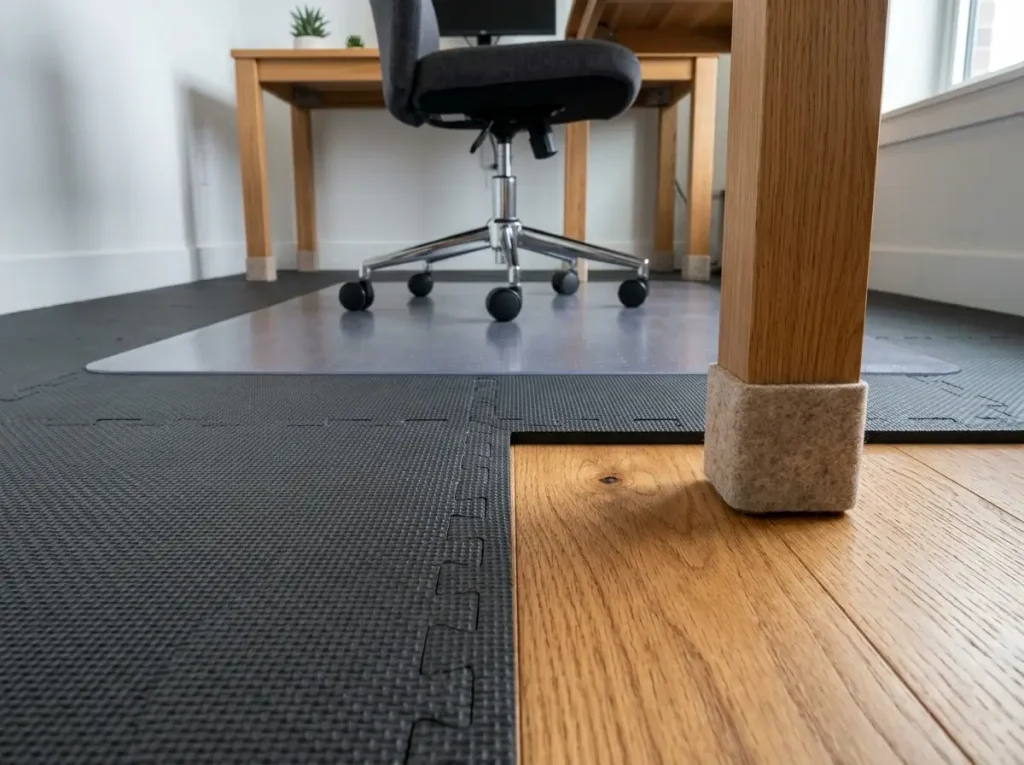
The final step in securing your small hobby room is protecting the ground beneath you. Landlords are notoriously strict about flooring damage during move-out inspections.
A common mistake is assuming that a standard decorative area rug will provide enough armor against the rigors of an active workspace.
While a rug might catch a little dust, it will not stop a dropped hammer from denting the hardwood, nor will it stop a hot soldering iron from melting the carpet. To ensure you get your security deposit back in full, you need industrial-grade floor protection tailored for renters.
Interlocking Floor Systems
If you are setting up a workspace for electronics, 3D printing, or model building, you are going to be handling heavy, sharp, or hot items. If you drop a heavy wrench or a metal component in your small hobby room, it will dent cheap laminate or crack delicate tile instantly.
The absolute best renter-friendly defense is laying down interlocking EVA foam tiles. These thick, shock-absorbing mats piece together like a giant puzzle, allowing you to custom-fit them perfectly to the exact dimensions of your layout.
They provide an incredible layer of impact resistance. If you accidentally knock a heavy tool off your desk, the foam absorbs the kinetic energy, saving your floor from permanent gouges.
Additionally, you should always place high-temperature silicone mats directly under your active workstation.
While the foam tiles protect against blunt force, a silicone mat catches stray chemical adhesives, superglue drips, or hot solder before they can sear into the apartment’s bare flooring.
Preventing Rolling Damage
Beyond accidental drops, the everyday friction of moving around your workspace can cause massive wear and tear. Standard office chair rolling casters are the silent killers of any small hobby room.
Over just a few months, hard plastic wheels will permanently snag and crush apartment carpet, or leave deep, unsightly scratch tracks across laminate and hardwood floors.
To prevent this, you must invest in a heavy-duty polycarbonate chair mat. Unlike cheap vinyl mats that easily crack and curl at the edges, polycarbonate remains completely rigid.
It evenly distributes your body weight and the weight of the chair, allowing you to glide smoothly without driving the casters into the delicate subfloor.
Finally, before you move any heavy utility carts, folding desks, or storage shelves into their final positions, apply thick felt pads to every single furniture leg.
When you inevitably need to slide your desk forward to retrieve a dropped screw or adjust a power cable, those felt pads will prevent the furniture from violently gouging the floorboards.
Quick Do’s and Don’ts for Apartment Flooring:
- Do: Clean the apartment floor thoroughly before laying down any mats to prevent trapped dirt from causing friction scratches.
- Do: Buy foam tiles with straight edge pieces to create a clean, intentional border around your workspace.
- Don’t: Rely on thin fabric rugs to stop heavy tools or sharp hobby knives from piercing the floor.
- Don’t: Drag heavy hobby equipment or desks across bare floors without thick felt pads installed on the legs.
By taking these simple, proactive precautions, your small hobby room will remain a safe, functional, and completely deposit-friendly creative haven.
Conclusion
Creating a highly functional small hobby room in a rental apartment doesn’t require knocking down walls or forfeiting your security deposit.
By focusing on damage-free vertical storage, modular workstations, and safe cable management, you can carve out an inspiring space for your favorite pastimes.
A common mistake is waiting for the perfect permanent home to pursue your passions. Instead, start small: measure your available corner, order a set of interlocking floor mats to protect the rental floor, and set up a folding desk.
If you are looking for even more ways to maximize your apartment’s footprint, explore our comprehensive guide on renter-friendly flex spaces to transform every inch of your home.