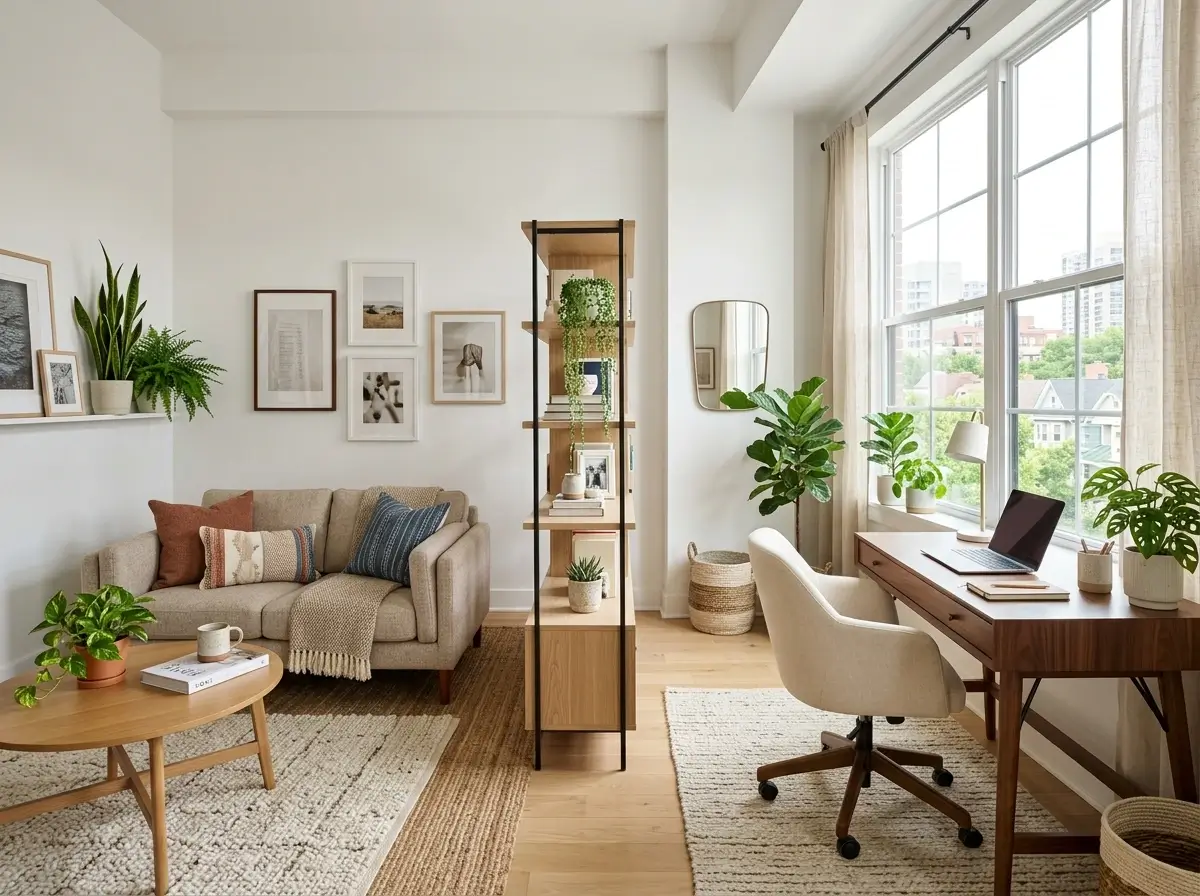
Renting a small space often means your floor plan has to work overtime. When your guest room is also your home office, or your living room needs to double as a dining area, finding the right layout is critical.
The biggest challenge? You have to do it all without drilling into the walls or losing your security deposit.
A successful flex space relies on visual boundaries and smart furniture choices, not permanent construction. If you are struggling to blend two distinct functions into one footprint, the right multipurpose room ideas can make your apartment feel twice as large.
In this guide, we will walk through exactly how to zone your space using freestanding dividers, no-drill vertical storage, temporary floor coverings, and strategic lighting so every square foot serves a purpose.
Defining Your Core Needs Before Exploring Multipurpose Room Ideas
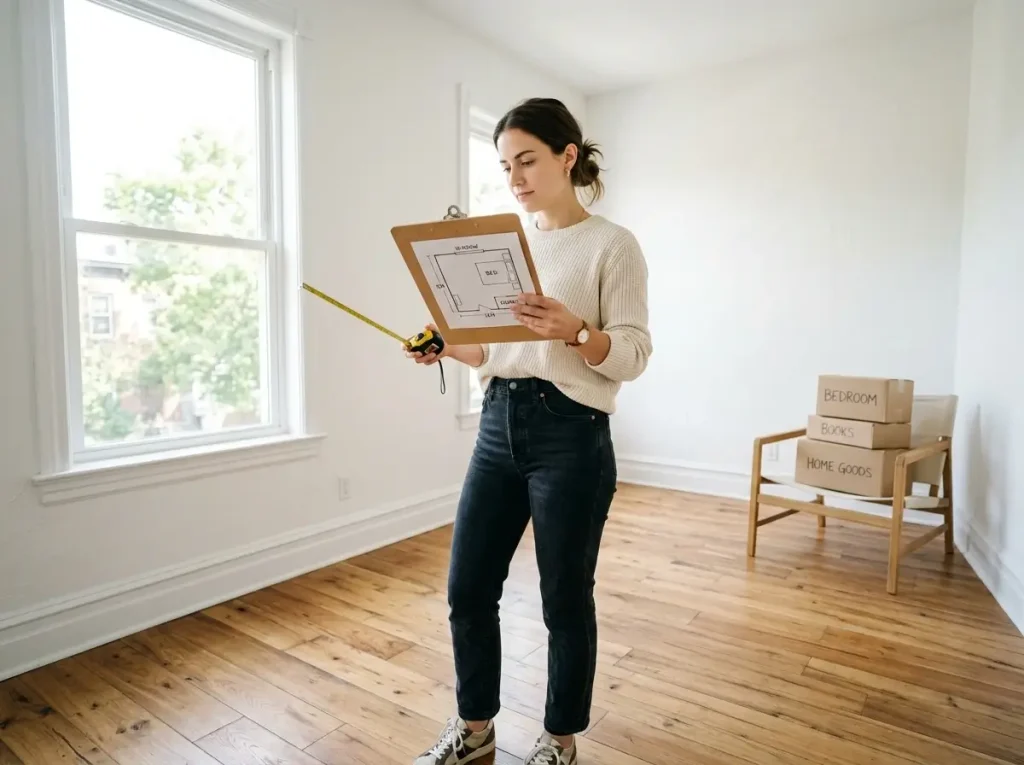
Before you start buying furniture or looking at multipurpose room ideas, you need a solid plan. A common mistake is rushing to buy room dividers or storage bins without truly understanding what the space needs to accomplish.
If you just throw furniture at an empty room, it quickly becomes a cluttered storage unit rather than a functional living space.
Establish Primary vs. Secondary Functions
The first step in planning your layout is determining the room’s actual job. You must clearly define the primary and secondary functions. Is it a home office that occasionally hosts out-of-town guests, or a dedicated guest room where you happen to pay bills once a week?
Assigning these roles dictates your furniture footprint. The primary function should command the most floor space and the most accessible areas. The secondary function should fold away, tuck into a corner, or remain visually quiet until needed.
If you skip this crucial step, even the best multipurpose room ideas will still leave your apartment feeling chaotic.
The 80/20 Rule of Space Planning
A highly effective method for layout design is the 80/20 rule. Look at how you actually spend your time in this specific room. If you work from home 80% of the time and have a guest stay over 20% of the time, your budget and floor plan should reflect that exact split.
Once you know your ratio, it is time to measure your floor space. Do not just measure wall to wall. You must actively map out your foot traffic pathways.
Pay attention to how doors swing open, where windows are located, and how you naturally walk through the room to access closets or electrical outlets.
- Mark clear paths: Ensure there is at least 36 inches of walking space in primary pathways.
- Check clearances: Leave enough room to pull out a desk chair without hitting a bed or a bookshelf.
Placing a bulky desk directly in a natural pathway will make the room feel cramped, no matter how clever your storage setup is.
Identifying Overlaps and Setting Boundaries
Next, look for overlapping needs. Can your sturdy work desk also serve as a sewing table or a daily makeup vanity?
Finding dual uses for a single piece of furniture is the backbone of successful multipurpose room ideas. When one table serves two distinct tasks, you instantly win back precious square footage.
However, you must set strict physical boundaries. A single room can comfortably handle two distinct functions, and maybe a small third function if the space is large enough.
But trying to cram a home office, a workout corner, a guest room, and a storage space into one standard bedroom is a recipe for disaster.
To maintain a relaxing environment, limit the room’s jobs. Implementing professional organization strategies for spatial planning often means learning to say no to adding just one more function.
By setting a firm boundary on what the room will not be used for, you guarantee that its main functions will actually thrive. Once your core needs are locked in, you can start executing the practical multipurpose room ideas that will finally bring the space to life.
High-Impact Multipurpose Room Ideas: Renter-Friendly Room Dividers
Once you know exactly how you want to use the space, the next major challenge is creating actual physical separation. If you rent your apartment, building a new drywall partition is completely out of the question.
However, you do not need a contractor to change your layout. Some of the most effective multipurpose room ideas rely entirely on clever, temporary barriers.
Creating distinct visual zones tricks the eye into seeing two completely separate spaces within a single, shared footprint.
Open Shelving as Faux Walls
A common mistake in small apartments is using heavy, solid bookcases to divide a room. While this blocks the view, it also blocks natural light, making your entire apartment feel instantly dark and cramped.
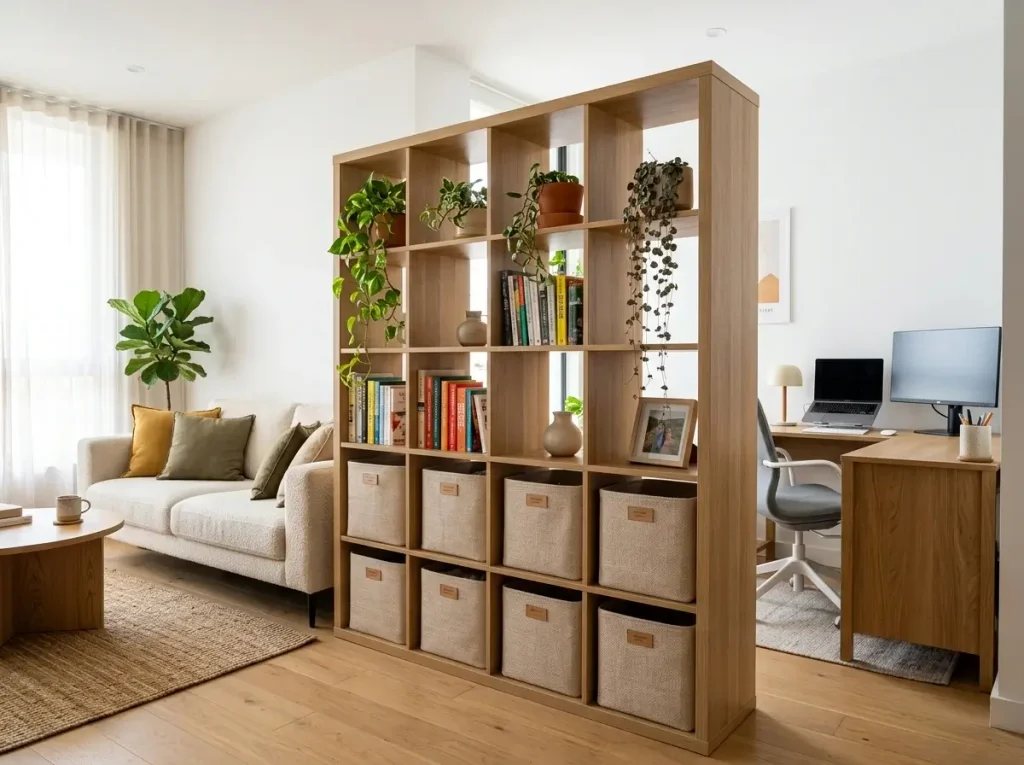
Instead, opt for backless cube organizers or open-frame geometric bookshelves. These pieces act as sturdy physical barriers while still allowing sunlight and air to pass freely from one side of the room to the other.
You can customize how much privacy you want by how you style the shelves. Fill the bottom cubbies with solid, opaque storage bins to hide ugly office clutter or cables.
Keep the upper shelves sparsely decorated with trailing houseplants, glass vases, or curated books. This is one of those classic multipurpose room ideas that gives you massive storage capacity while solving your layout problem at the exact same time.
Tension-Rod Curtains for Instant Privacy
If your secondary area needs to disappear entirely—such as a bulky guest bed or a messy inventory nook—fabric is your best friend.
Installing heavy-duty tension rods between two walls or inside a natural room alcove allows you to hang curtains without drilling a single hole into your landlord’s drywall.
When you are working from home or hosting friends for dinner, simply pull the curtains closed. The room immediately feels streamlined, tidy, and focused on its primary job.
When guests stay over, they can pull the curtain closed for instant nighttime privacy. These types of flexible, hideaway setups are the cornerstone of successful multipurpose room ideas for renters in studio apartments.
Folding Screens and Acoustic Panels
Sometimes you only need a visual block during specific hours, like a workday, and want the floor plan wide open on the weekends.
Traditional folding screens, like paper shoji screens or slatted wooden room dividers, are incredibly lightweight.
You can easily fold them flat and slide them under a bed when not in use. They also add a beautiful, intentional architectural element to an otherwise plain rental box, gently directing foot traffic away from your desk.
If your flex space doubles as a home office where you take daily video calls, consider investing in freestanding acoustic panels on rolling casters. Not only do they block the view of your living room from your laptop’s webcam, but they also actively dampen distracting room echoes.
Crucial Safety Considerations for Renters
Before you rush to implement these multipurpose room ideas, you must carefully account for your specific apartment’s safety quirks.
Many older rental units and basement apartments rely on electric baseboard heaters or exposed steam radiators. Placing a wooden folding screen, a cardboard acoustic panel, or hanging a long fabric curtain too close to an active heat source is a severe hazard.
Always review the fire safety guidelines for heating clearances before setting up any temporary room dividers. You must ensure that your faux walls and hanging fabrics maintain a safe, regulated distance from all vents, heaters, and radiators to keep your rental unit secure.
Multipurpose Furniture That Maximizes Square Footage
When you are working with a highly limited layout, every single piece of furniture needs to earn its footprint.
Traditional, single-use furniture simply wastes too much space. A standard dining table that only gets used twice a month is actively stealing real estate from your daily home office.
To make your flex space truly functional, you need items that seamlessly transform based on the time of day. Replacing static items with adaptable, dual-purpose pieces is one of the smartest multipurpose room ideas you can implement in a small apartment.
Hidden Storage Seating
A common mistake is buying standard chairs for a secondary seating area. Instead, look for furniture that serves as a storage unit first and a seating option second.
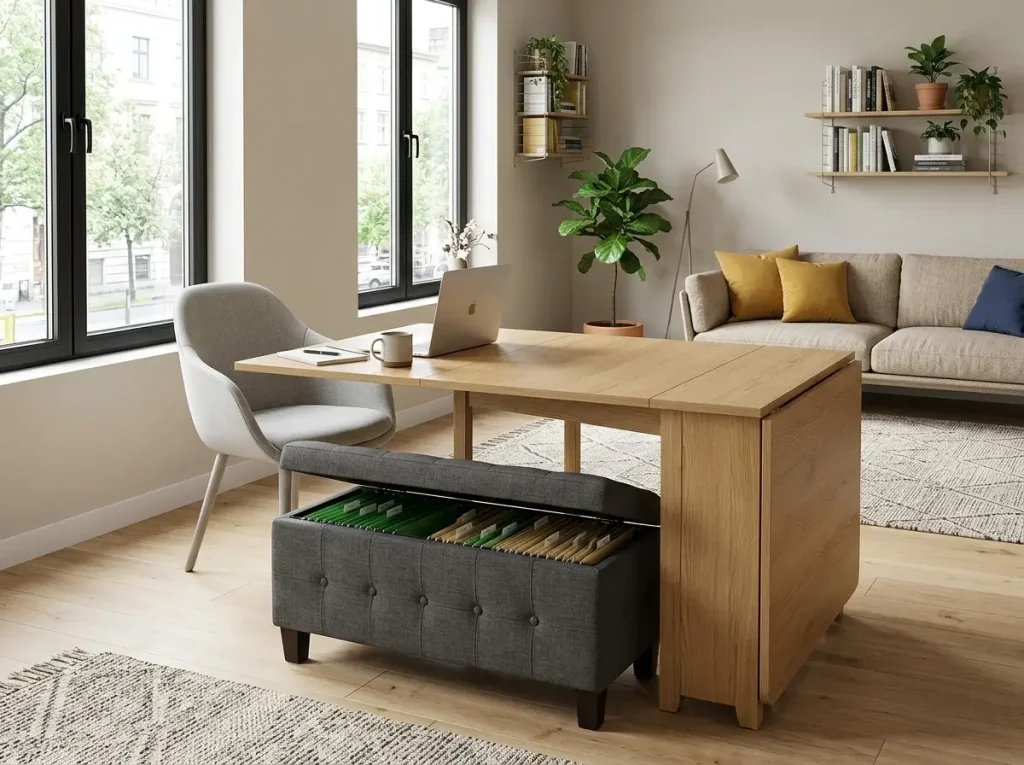
- Storage ottomans: These are perfect for tucking under a desk or resting in front of a sofa. While they offer a place to prop your feet, their hollow interiors can completely replace a bulky metal filing cabinet.
- Storage benches: Placing a long storage bench under a window creates an instant reading nook. More importantly, it provides a massive horizontal bin to hide away extra guest linens, seasonal clothing, or large workout gear.
When you research the best multipurpose room ideas, hidden storage seating is consistently recommended because it actively removes visual clutter from your daily sightline.
Transformable Tables and Nesting Sets
If your flex room needs to alternate between a workspace and an entertaining area, you must avoid heavy, permanent desks.
Drop-leaf or extendable tables are the ultimate renter-friendly hack. During the workweek, a drop-leaf table can sit flat against the wall, acting as a narrow, unobtrusive console desk for your laptop.
On the weekend, simply pull it away from the wall, lift the leaves, and you instantly have a dining table that seats four.
Nesting tables offer a similar spatial magic. Rather than buying a large coffee table that blocks your walking path, a set of three nesting tables stacks into the footprint of just one. When guests arrive, you can easily pull them apart to hold drinks and snacks.
These adaptable, expanding surfaces are brilliant multipurpose room ideas for people who move frequently.
Navigating Renter-Friendly Furniture Safety
While transformable furniture is incredibly useful, it does introduce a unique challenge for renters. Many space-saving pieces, such as tall fold-out desks or freestanding hybrid shelving, are naturally top-heavy.
Because renters typically avoid drilling heavy-duty wall anchors into the drywall to protect their security deposit, you must be extremely cautious about weight distribution.
Always place your heaviest items—like thick textbooks or dense storage bins—on the absolute bottom shelves to lower the center of gravity.
Furthermore, you should familiarize yourself with freestanding furniture tip-over safety guidelines. If a dual-purpose piece cannot be safely secured to the wall, you must strictly follow the manufacturer’s weight limits to prevent an accidental collapse.
By selecting safe, transformable pieces, your multipurpose room ideas will finally provide the flexibility your layout desperately needs.
Vertical Storage Solutions Without Drilling
When your floor space is completely maxed out with dual-purpose furniture, the only direction left to go is up. However, utilizing vertical height is often the most intimidating challenge for renters.
Most traditional wall-mounted shelving requires heavy-duty screws, toggle bolts, or plastic drywall anchors. Installing these permanent fixtures almost guarantees you will be patching holes and repainting walls to save your security deposit on move-out day.
Fortunately, you do not need to pick up a power drill to take advantage of your apartment’s vertical footprint. The most effective multipurpose room ideas leverage your wall height using entirely damage-free, temporary solutions.
Tension-Pole Shelving Systems
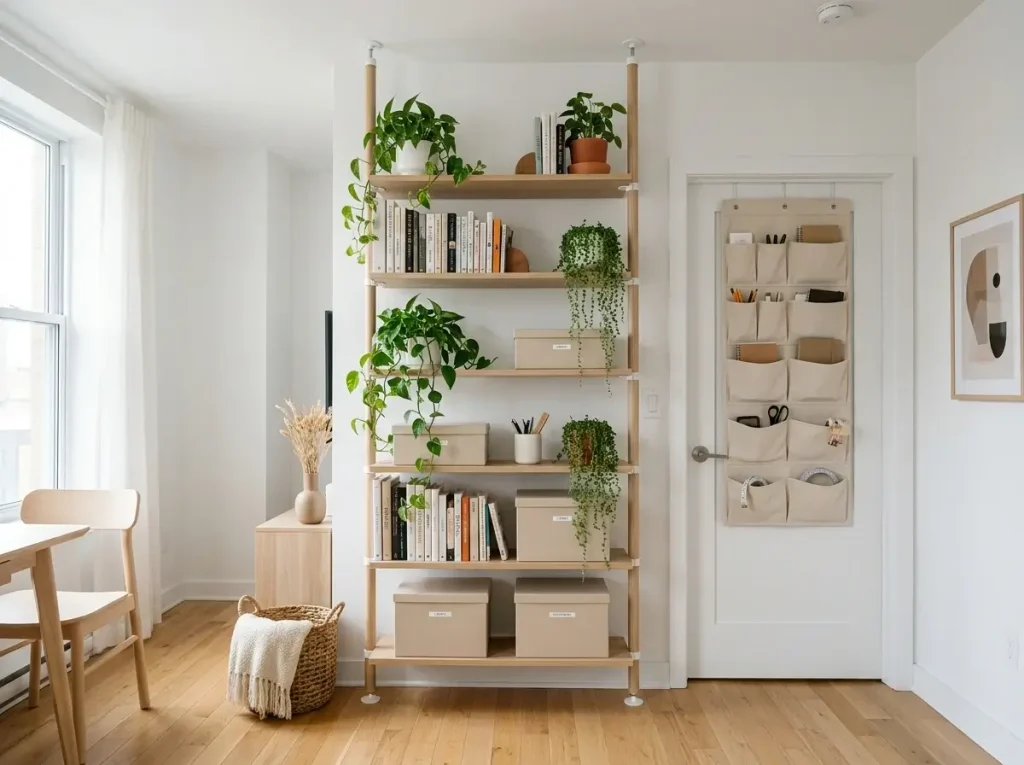
If you need a substantial amount of vertical storage for books, files, or display items, tension-pole shelving is a renter’s best-kept secret.
Instead of anchoring into the drywall, these ingenious units use strong, spring-loaded vertical poles. They wedge securely between your solid floor and your ceiling, creating a sturdy, floor-to-ceiling frame.
Once the vertical poles are locked into place, you simply attach the adjustable shelves between them.
Integrating a tension-pole shelf is one of those brilliant multipurpose room ideas that completely changes a room’s storage capacity in minutes.
Because they are freestanding, you can even place them perpendicular to a wall to act as a slim room divider, separating a sleeping area from a workspace while adding massive storage.
Over-the-Door Space Maximizers
One of the most overlooked areas for vertical storage is the back of your doors. Whether it is the main entry door to the room or a sliding closet door, this empty vertical real estate is highly valuable.
Over-the-door organizers hook cleanly over the top hinges, requiring zero hardware. In a flex space, you can use these hanging pocket systems to store small electronics, extra office supplies, charging cables, or lightweight accessories.
When curating multipurpose room ideas for tiny apartments, hidden vertical storage is always a top priority. By moving your smallest, most easily tangled items out of your desk drawers and onto the back of a closet door, you keep your primary work surfaces beautifully clear.
Removable Adhesive Hooks and Uniform Bins
For lightweight items, heavy-duty removable adhesive hooks are an absolute necessity. However, you must read the packaging carefully and strictly follow their stated weight limits.
A hook rated for three pounds is perfect for hanging a lightweight wire basket to hold mail or dry-erase markers. Pushing that limit with heavy winter coats or dense bags will inevitably pull the paint right off the drywall.
Finally, when stacking items vertically on top of cabinets or tension shelves, always use uniform, visually opaque storage bins. Clear plastic bins expose all the messy details of what is inside, making a dual-purpose room feel instantly chaotic.
Combining matching, solid-colored bins with damage-free hanging solutions creates a clean, intentional look. This approach ensures your multipurpose room ideas feel like elevated design choices rather than temporary, desperate fixes.
Lighting Strategies to Separate Room Functions
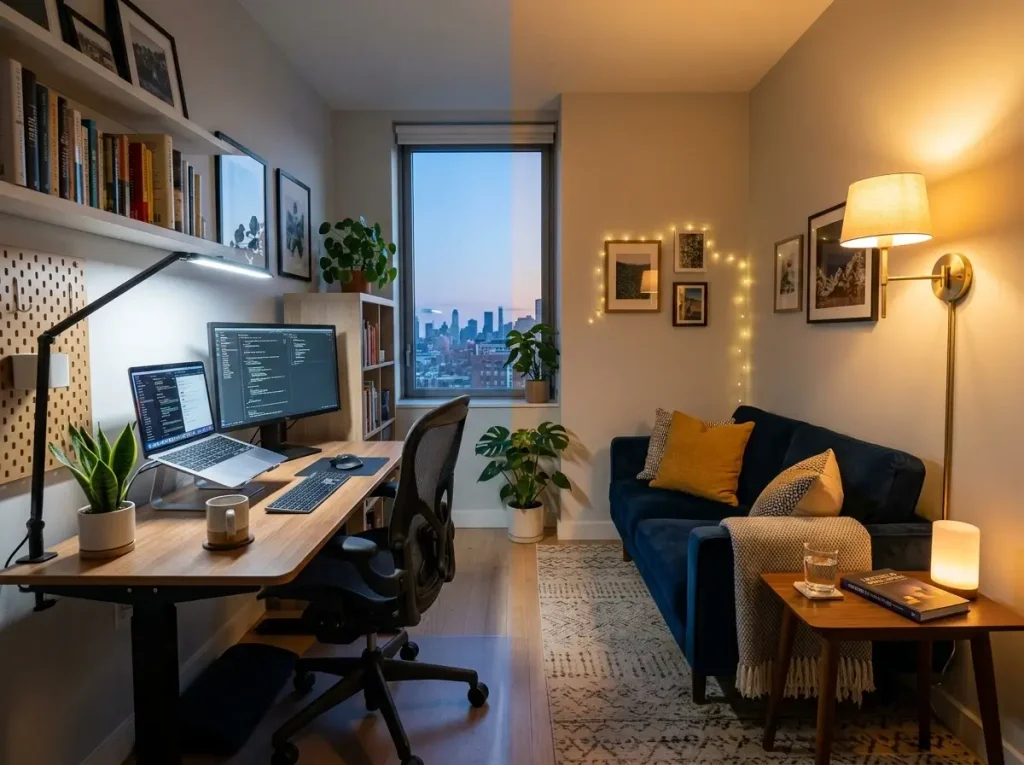
Lighting is arguably the most powerful tool in your design arsenal when trying to separate a single room. While furniture and temporary room dividers create physical boundaries, lighting dictates the actual atmosphere and perceived boundaries of each zone.
When renters search for the best multipurpose room ideas, they often overlook how different light sources actively trick the brain. A single, harsh overhead light makes an entire room feel like a sterile office, completely ignoring the cozy reading chair sitting in the corner.
To effectively split a room without building walls, you must understand the difference between ambient lighting and focused task lighting. Ambient lighting provides the baseline glow for the entire room, usually coming from a ceiling fixture.
Task lighting layers—like a focused reading lamp or an under-cabinet light—are what actually separate a functional desk from a relaxing lounge area.
By applying proper layered lighting principles for interiors, you can define completely distinct areas in a small apartment using nothing but strategic illumination.
Plug-In Wall Sconces and Directional Lamps
One of the biggest hurdles for apartment renters is the inability to hardwire new light fixtures. Fortunately, plug-in wall sconces have revolutionized renter-friendly lighting design.
By mounting a pair of plug-in sconces above a small guest bed or a reading chair, you instantly designate that specific square footage as a dedicated relaxation zone.
Because these sconces plug directly into a standard wall outlet, you get the high-end look of architectural lighting without losing your security deposit. This kind of visual zoning is essential for executing successful multipurpose room ideas.
Similarly, directional floor lamps act as invisible room dividers. If your home office desk sits right next to your living room sofa, placing an overarching floor lamp directly over the desk creates an isolated pool of light.
When the desk lamp is on, it highlights the workspace. When you turn it off and switch on the ambient living room table lamps, the office area visually disappears into the shadows.
Smart Bulbs for Rapid Mood Shifting
Beyond the physical placement of your lamps, the actual color temperature of your light bulbs completely dictates how a room functions.
In a hybrid space, you need the environment to adapt as your day progresses. One of the most brilliant multipurpose room ideas involves swapping out standard apartment light bulbs for adjustable smart bulbs.
During the workday, you can set the smart bulbs over your desk to a cool, crisp, daylight temperature. This blue-toned light boosts productivity, reduces eye strain, and keeps you alert while working.
However, when the evening arrives and the room needs to transition into a relaxing guest space or a cozy TV room, that harsh blue light will ruin the mood. With a simple tap on your phone, you can shift those exact same bulbs to a warm, amber glow.
This immediate color shift signals to your brain that the workday is officially over. It is one of the easiest, most cost-effective multipurpose room ideas you can implement to ensure your flex room never feels like a 24-hour corporate cubicle.
By layering your light sources and controlling their temperature, your small apartment will function beautifully around the clock.
Best Multipurpose Room Ideas for Office and Hobby Combos
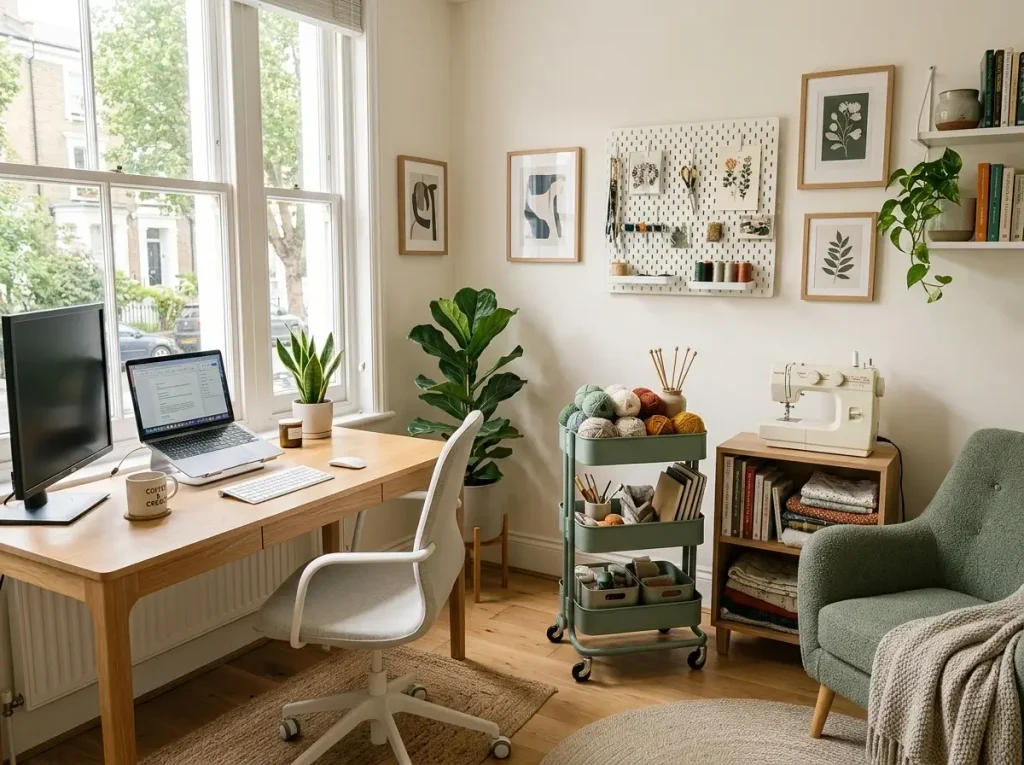
One of the most requested configurations for small apartments is the guest room office combo that also needs to function as a personal creative zone. Balancing professional work with a messy, creative hobby in the same square footage requires careful planning.
When your 9-to-5 job lives right next to your weekend painting or crafting station, it is incredibly easy for the two zones to bleed together.
Fortunately, implementing the right multipurpose room ideas can help you maintain a strict home office boundary without sacrificing your creative outlet.
Managing Webcam Backgrounds
A common mistake when designing a hybrid room layout is ignoring how the space looks on camera. If you take daily video calls, your coworkers do not need to see your half-finished knitting projects or a towering stack of guest linens.
When positioning your primary furniture, always place your office desk facing a solid wall or a window. This intentionally puts the “hobby” or “guest” side of the room behind the camera’s field of view.
If your desk must face the center of the room, you will need to utilize temporary room dividers or acoustic screens right behind your office chair.
When researching multipurpose room ideas for hybrid setups, always prioritize your professional digital footprint first, then build your hobby zone in the remaining blind spots.
Mobile Storage Solutions
Hobby supplies have a unique way of creating massive visual clutter. Unlike standard office paperwork that slides neatly into a drawer, craft supplies often require varied, bulky storage.
Finding flexible storage is another cornerstone of the best multipurpose room ideas. Instead of buying a heavy, stationary craft cabinet, invest in a rolling utility cart. A tiered metal cart allows you to organize your paints, fabrics, or tools efficiently.
During the workweek, you can simply roll the cart into a nearby closet or tuck it behind a tension-rod curtain so the room functions strictly as a formal office. When the weekend arrives, roll it right up to your desk to instantly transform your professional workstation into a creative studio.
If your secondary room function revolves around a creative hobby, there are highly specific DIY small craft room setups that utilize pegboards and foldable tables to keep your primary office space clutter-free.
Creating a Cohesive Visual Transition
Finally, the secret to making a shared office and hobby room feel intentional is a unified color palette.
If your office side features sleek black metal and cool grey tones, but your hobby side is packed with neon pink storage bins, the room will inherently feel chaotic and stressful. You want the transition between “work” and “play” to feel seamless.
Select a strict color palette for all your visible storage, furniture, and textiles. If you use natural oak and sage green on the office side, carry those exact same tones over to your hobby storage boxes and guest seating.
By unifying the color scheme, your multipurpose room ideas will result in a space that feels like a masterfully designed retreat, rather than two conflicting rooms shoved into one.
Temporary Floor Coverings to Define Areas
When you are looking for the most impactful multipurpose room ideas, you must not ignore what is happening right beneath your feet.
While we have covered temporary walls, modular furniture, and overhead lighting, the floor is often the final piece of the puzzle.
One of the easiest and most affordable ways to establish a strict visual boundary in a rental apartment is to define your spaces from the ground up.
Anchoring with Area Rugs
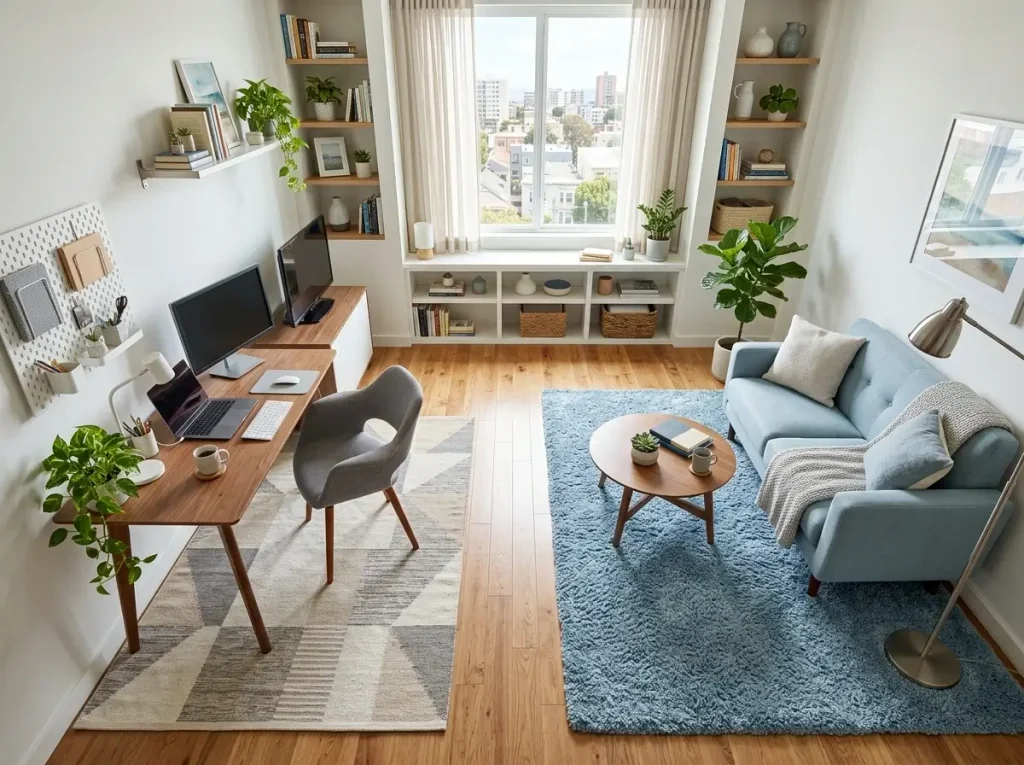
In interior design, the concept of “anchoring” involves grouping a specific set of furniture onto an area rug to create a distinct visual island. In a shared space, a bare hardwood floor makes everything feel like it is floating in one large, undefined box.
By placing your home office desk and chair entirely on a low-pile area rug, you immediately signal that this exact square footage is dedicated to work.
Even if your office and your living area share the exact same room, anchoring them on different rugs instantly tells the brain that these zones serve completely different purposes.
To make a single room feel truly divided, use two distinct but complementary rugs. You might choose a sleek, flat-weave rug under your desk to allow your office chair to roll easily, while selecting a plush, high-pile shag rug for your lounge space.
This contrast in texture physically and visually separates the working zone from the relaxing zone.
Using rugs as floor-level boundaries is one of the most effective multipurpose room ideas because it requires zero installation and leaves absolutely zero damage behind.
However, when placing multiple rugs in a small footprint, proper spacing is critical. You must avoid overlapping the edges of the rugs, which easily creates dangerous tripping hazards in high-traffic flex rooms.
Always leave at least six to twelve inches of bare floor between the two rugs. This visible strip of bare floor acts as a “hallway,” clearly defining the walking path between your two distinct zones.
Modular Carpet Tiles
If you want a more structured change in flooring but cannot permanently alter your rental unit’s original floors, consider modular carpet tiles.
These individual squares allow you to build a custom-sized rug that fits the exact dimensions of your secondary zone, perfectly contouring around strange apartment corners or radiator pipes.
Applying peel-and-stick carpet tiles is a fantastic way to create a designated soft space, such as a morning yoga corner or a temporary reading nook. Just be extremely cautious about adhesive safety for rental floors.
Some cheaper carpet tiles use aggressive double-sided tape that can strip the finish off hardwood or leave a sticky residue behind.
To protect your security deposit, test a small, hidden corner first, or simply lay the tiles tightly together over a high-quality, non-slip rubber rug pad without actually sticking them to the floor.
Quick Checklist: Sizing a Rug for a Room Sub-Section
- Office Zone: Ensure the rug extends at least 24 inches behind your desk chair so the back wheels do not constantly catch on the edge when you roll backward.
- Seating Area: At least the front two legs of your sofa and any accent chairs should rest securely on the rug to properly anchor the conversational space.
- Sleeping Zone: If sectioning off a guest bed, the rug should extend 18 to 24 inches on the exposed sides and foot of the bed, giving guests a soft place to step in the morning.
Exploring creative, damage-free flooring options is a vital step in executing a flawless layout. By thoughtfully defining your floor plan with distinct rugs and modular tiles, you solidify the boundaries you previously established with your furniture and lighting.
Grounding your furniture ensures your multipurpose room ideas will result in a highly organized, intentional home that maximizes every single inch of your rental.
Conclusion
Turning one room into two distinct spaces does not require a contractor or a forfeited security deposit. By implementing these renter-friendly multipurpose room ideas, you can build a highly functional layout that adapts to your lifestyle.
Start by ruthlessly defining the primary purpose of the space. From there, utilize freestanding room dividers, invest in dual-purpose furniture, and leverage lighting and rugs to establish clear visual boundaries.
Remember that vertical, no-drill storage is your best tool for keeping the floor plan open and manageable.
Ready to tackle your space? Pick the one zone causing the most clutter today, and start by mapping out a new, temporary divider to take back control of your floor plan.