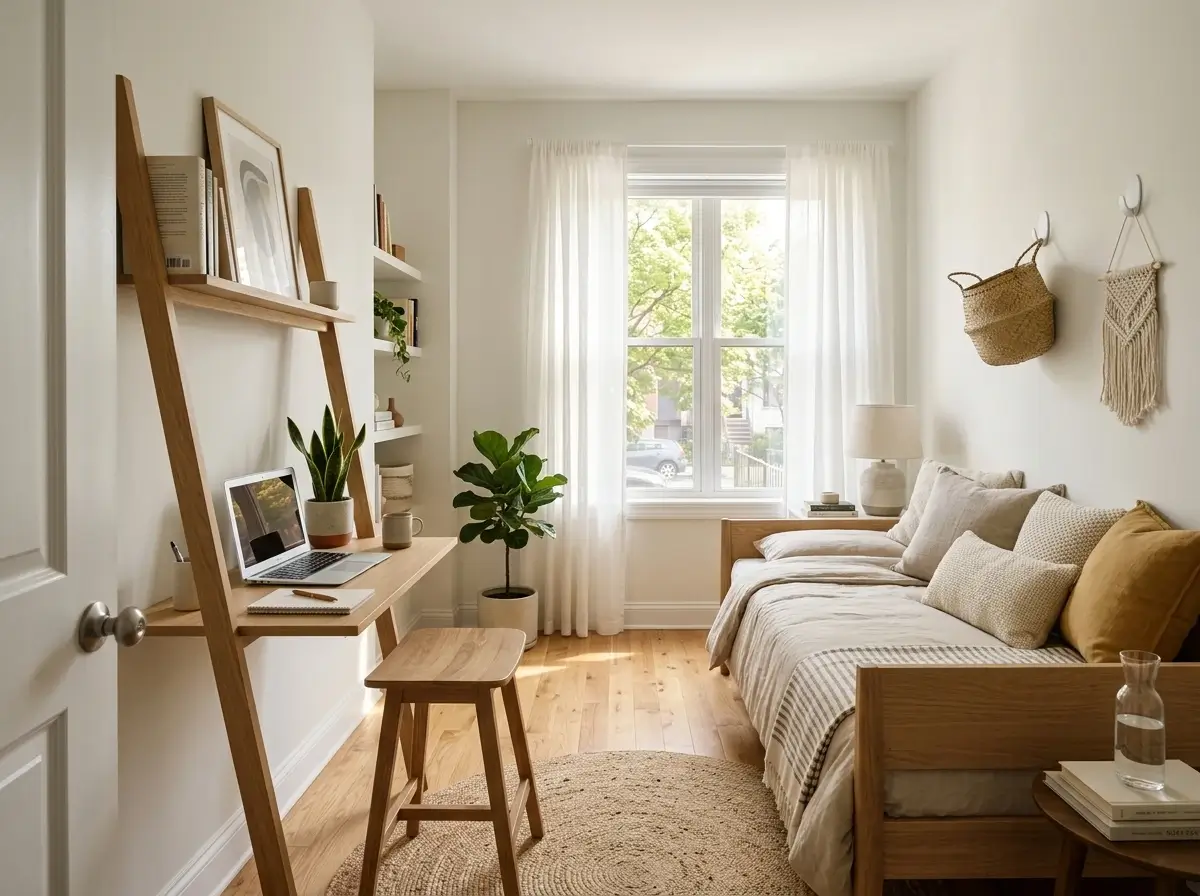
When you move frequently or live in an apartment with strict lease terms, dedicating an entire room solely to occasional visitors rarely makes sense. You need a functional workspace for your daily routine, but you also want a welcoming space when family or friends stay over.
Balancing productivity with hospitality in a confined footprint is challenging, especially when you cannot drill heavy anchors into the walls or install a permanent Murphy bed.
The secret to a successful small guest room and office lies in flexible furniture and drill-free organization.
By prioritizing modular pieces and clever cable management, you can create a room that works hard from 9 to 5, then seamlessly transitions into a restful retreat.
Here are seven renter-friendly ways to maximize your square footage without risking your security deposit.
1. Planning the Layout for a Small Guest Room and Office
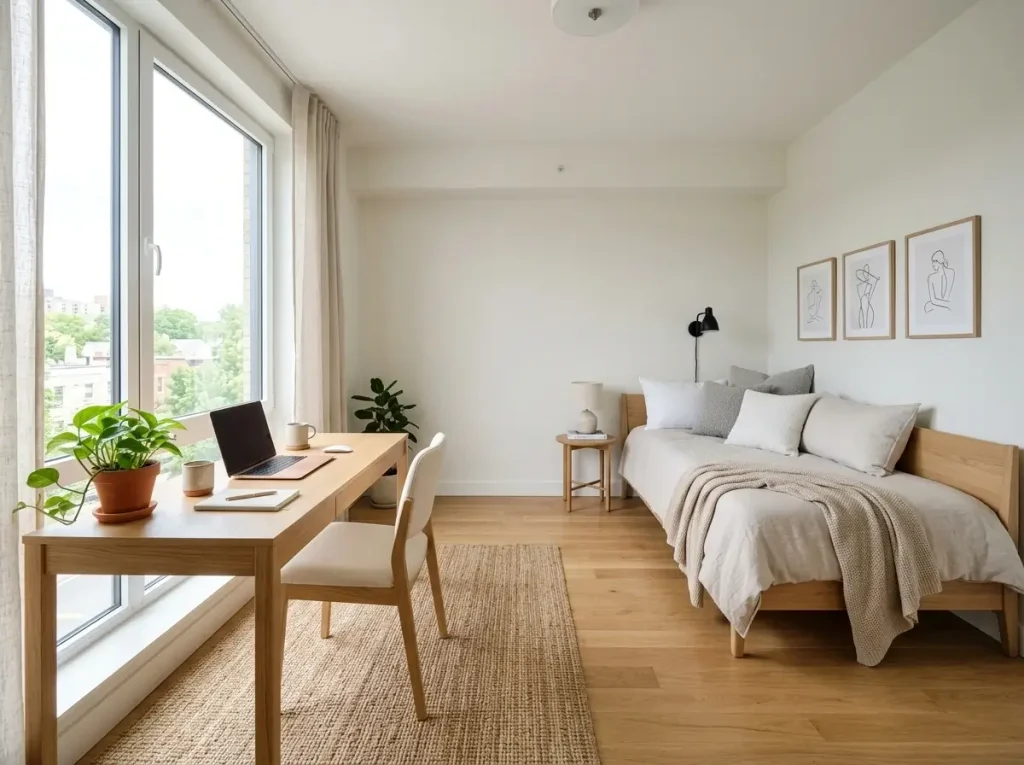
Before you buy a single piece of modular furniture or unpack any moving boxes, you must establish a highly functional layout. A common mistake renters make is prioritizing the bed placement first, leaving the desk awkwardly crammed into a dark, unproductive corner.
When designing a small guest room and office, your daily work routine should dictate the initial floor plan. You will use the workspace far more often than you will actually host overnight visitors, so it deserves priority.
Mapping Your Power Sources
Start by locating all the power outlets and internet jacks in the room. Rentals, especially older apartments, are notorious for having incredibly limited electrical access.
You do not want to realize your ideal desk location is entirely unplugged after you have already arranged the heavy furniture. Many lease agreements strictly forbid modifying the electrical setup, so you must work exclusively with the existing infrastructure.
Map out exactly where your computer monitor, laptop charger, and desk lamp can safely reach the wall without running extension cords across the center of the room.
By anchoring your tech needs first, you establish a natural, safe hub for the workspace half of your small guest room and office.
Optimizing Your Camera Background
Once you know where the power lives, think carefully about your line of sight. Position the desk facing a window or a solid wall whenever possible. This simple configuration serves a crucial dual purpose for remote workers.
First, looking out a window provides flattering natural light for your face during meetings and helps drastically reduce afternoon eye strain. Second, and more importantly, it prevents the bed from dominating your video call background.
Nothing disrupts professional boundaries quite like a messy, unmade guest bed sitting right behind your office chair. Keeping the sleeping area entirely out of frame ensures your small guest room and office maintains a strict business atmosphere during your 9-to-5 hours.
Visual Zoning and Floor Clearance
Next, determine the exact footprint for your temporary bed. Regardless of what type of space-saving sleep solution you choose, leave at least 30 inches of walking clearance around the accessible edges of the sleeping area.
This standard measurement ensures safe navigation for visitors trying to use the restroom in the middle of the night without tripping over your ergonomic office chair.
Visitors will also need a place to drop their overnight bags, and giving them room to breathe makes the space feel welcoming.
Finally, establish distinct zones within the room using temporary visual cues. A well-placed area rug positioned directly under the desk instantly anchors the workspace as a separate “room” within the room.
If your layout allows for a bit more division, you might even consider adding a lightweight, drill-free partition to block the bed from view entirely. For more inspiration on creating distinct functional areas, explore our guide on creative ways to divide multipurpose spaces.
By deliberately zoning the floor plan from day one, your small guest room and office will feel less like a crammed storage closet and more like a thoughtfully designed, highly flexible suite.
2. Renter-Friendly Sleep Solutions That Maximize Floor Space
When you are trying to squeeze a comfortable bed into a small guest room and office, the most common piece of advice you will hear is to install a Murphy bed. While these fold-away beds are incredibly efficient for homeowners, they are often a massive financial liability for renters.
Traditional wall beds require heavy-duty lag bolts driven directly into the wall studs to prevent the heavy frame and mattress from crashing down. In almost every standard apartment lease, drilling heavy structural anchors into the drywall is strictly prohibited.
If you try to sneak a permanent wall bed into your rental, you are almost guaranteed to forfeit your security deposit when you eventually move out.
Instead, a truly renter-friendly small guest room and office relies entirely on freestanding furniture that maximizes your available floor space without causing permanent damage to the property.
The Case for Daybeds
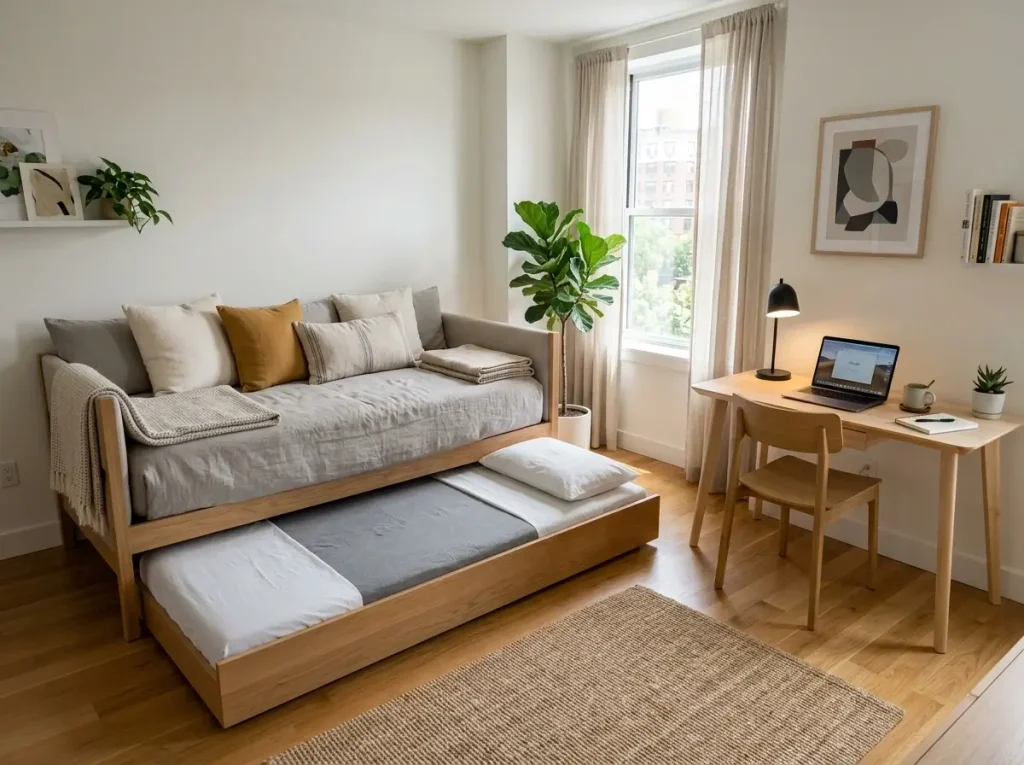
If you have enough square footage to leave a bed set up permanently, a daybed with a pull-out trundle is arguably the best investment you can make.
Unlike a traditional queen-size mattress that dominates the floor plan and clearly looks like a bedroom, a daybed mimics the profile of a standard deep sofa.
During your workday, a well-styled daybed serves as a comfortable spot to review documents or take a quick screen break away from your desk chair.
It also provides a much more professional, living-room-style background for your video calls than a traditional headboard and comforter ever could.
When visitors arrive, the top cushion serves as one bed, while the hidden trundle drawer seamlessly rolls out to accommodate a second person. This seamless, drill-free dual-functionality is exactly what makes a small guest room and office actually work on a daily basis.
Storing Inflatable Options
If your room is so tight that any permanent bed would block your desk drawers or closet doors, you must look at temporary, storable solutions. Modern, high-profile air mattresses have evolved significantly over the past decade.
Today’s premium models inflate in mere minutes via built-in electric pumps and sit nearly two feet off the floor, perfectly mimicking the height of a real bed so older guests do not have to struggle up from the floor. However, not all temporary beds are created equal.
You still want your visitors to wake up feeling rested, not with a stiff lower back.
When shopping for an inflatable option, it is wise to review ergonomic mattress support guidelines to ensure the air bed features internal coil structures that distribute body weight evenly throughout the night.
The absolute greatest advantage of a premium air mattress in a small guest room and office is that it deflates completely the moment your guests leave. It easily packs away into a small closet bin, instantly returning your room to a dedicated, spacious workspace.
For ultra-tiny apartment footprints where even a deflated air mattress feels like a hassle to set up, consider sleeper chairs or convertible fold-out ottomans.
These clever, highly compact pieces function as simple accent seating or footrests during your normal workweek.
When a single guest stays the night, they unfold into a narrow cot in seconds. They require zero drilling, involve zero complex assembly, and perfectly respect the strict boundaries of modern rental living.
3. Selecting a Desk for Your Small Guest Room and Office
When selecting a desk for your small guest room and office, the goal is to find a workspace that supports your daily 9-to-5 routine without physically dominating the room when visitors arrive.
A bulky, traditional executive desk will instantly make the space feel claustrophobic and unwelcoming.
To maintain harmony in a shared-purpose room, you must prioritize desks that are modular, vertical, or highly mobile.
Folding and Stowing Desks
If your daily workflow requires nothing more than a laptop and a notebook, a heavy wooden desk is a waste of valuable square footage. Instead, evaluate modern folding desks that can be entirely collapsed and tucked away into a closet when guests arrive.
This simple swap instantly returns several feet of floor space to your visitors, allowing them to open their suitcases comfortably.
However, a common mistake renters make is buying the cheapest, flimsiest folding table available. Because you will be using this surface daily, look for folding models that meet industry safety and stability standards.
A desk that wobbles every time you type will quickly ruin your workday productivity, regardless of how neatly it stores away.
Vertical Ladder Desks
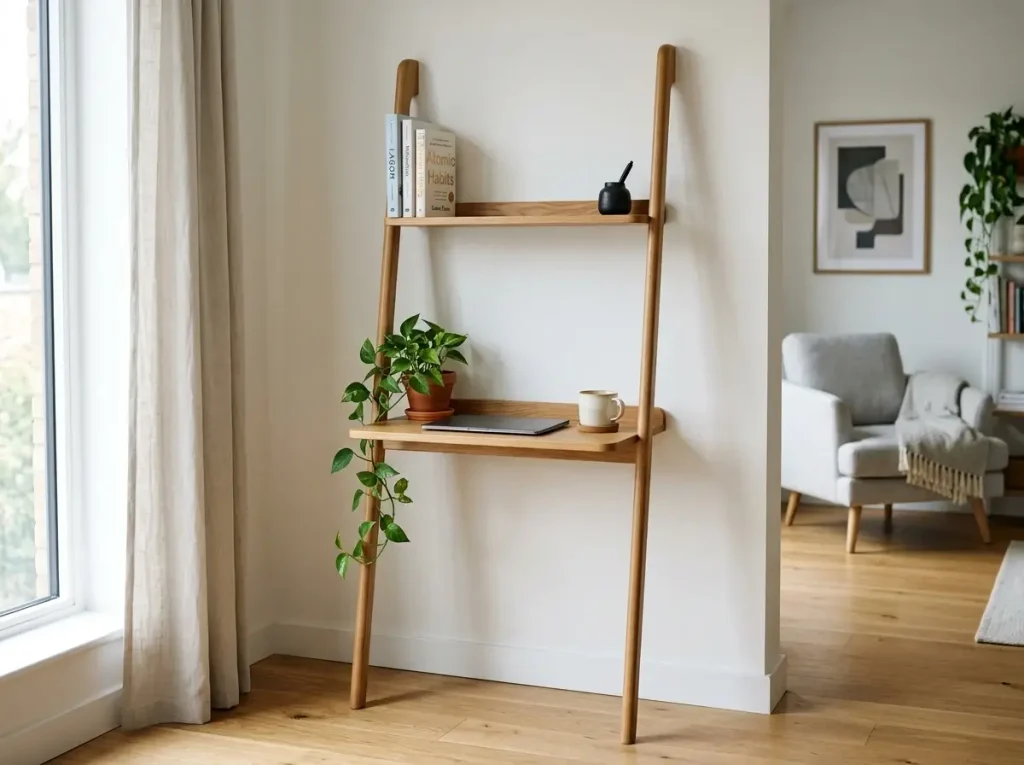
If you need a permanent workstation set up in your small guest room and office, leaning ladder desks are an exceptional renter-friendly choice.
These clever designs require a remarkably minimal floor footprint, utilizing vertical space for shelving while pushing the work surface close to the wall.
The greatest advantage of a ladder desk for renters is the weight distribution. Rather than requiring heavy lag bolts driven into the drywall—which risks your security deposit—these desks use gravity to lean securely against the wall.
You get the benefit of built-in vertical shelving for your office supplies without violating the terms of your apartment lease.
Mobile C-Tables and Minimalist Carts
For an ultra-minimalist approach, consider a heavy-duty C-table or a mobile sit-stand cart on casters. These hyper-compact workstations can hold a laptop and a mouse, and they seamlessly roll into a corner—or even into the living room—when your guest needs the bedroom.
Prioritizing Rounded Edges
Finally, pay close attention to the shape of the desk surface itself. Because a small guest room and office requires navigating very tight clearances—especially when the temporary bed is deployed—sharp corners are a major physical hazard.
Choosing a desk with rounded, soft edges prevents painful bruised shins and bumped hips when you or your guests are moving around the room at night.
By keeping the footprint small, the edges soft, and the design flexible, your workspace will complement the room’s hospitality rather than competing with it.
4. Drill-Free Storage for Office Supplies and Guest Luggage
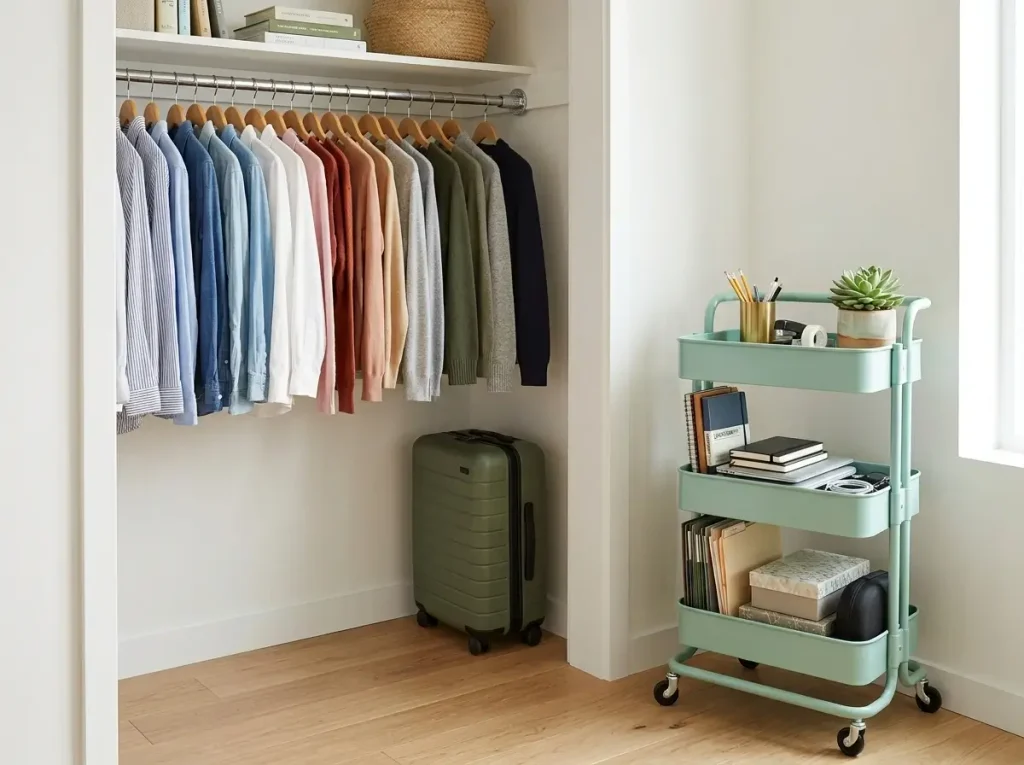
One of the biggest challenges in any small guest room and office is managing the sheer volume of stuff required to support both functions simultaneously.
You have reams of printer paper, file folders, reference books, and pens for your daily work. Conversely, your visitors arrive with bulky suitcases, hanging clothes, and toiletry bags that need a temporary home.
If you try to force both of these distinct categories into a set of standard, bulky bookshelves, the room will instantly feel like an overcrowded storage unit.
Because apartment leases strictly forbid drilling heavy floating shelves into the drywall, you must rely entirely on clever, mobile, and modular storage solutions.
The goal is to keep your daily work items perfectly accessible to your desk while leaving obvious, dedicated space for your guests’ belongings.
Rolling Utility Carts for Office Supplies
Forget purchasing heavy, metal filing cabinets that are a nightmare to move. A three-tiered rolling utility cart is the absolute best renter-friendly storage solution for a small guest room and office.
These compact carts can hold your daily planners, tech accessories, and important documents right next to your desk while you work. You can even use small magnetic bins attached to the metal sides of the cart to corral loose pens and charging cables.
The true magic happens when a visitor arrives. You simply wheel the entire cart into your living room, or tuck it out of sight in a nearby hallway closet.
By keeping your office supplies mobile, you never have to scramble to clear off stationary shelves before company arrives. Your workspace remains fluid, organized, and effortlessly adaptable.
Maximizing Closet Real Estate for Luggage
If your hybrid room has a built-in closet, you must treat it as premium real estate. A common mistake renters make is filling this entire closet with out-of-season coats and bulky household vacuums, leaving their guest with nowhere to put their clothes.
In a well-planned small guest room and office, you should always leave the bottom third of the closet completely empty. This provides a dedicated, out-of-the-way spot for your visitor to slide their suitcase, preventing their luggage from eating up your valuable floor space.
To make up for this lost storage capacity, install a heavy-duty tension rod halfway up the closet. This brilliant, drill-free hack instantly creates a temporary second tier for hanging your own clothes, doubling your vertical storage without violating your lease agreement.
Because tension rods rely purely on spring pressure, they leave zero marks on the walls when you move out.
Under-Bed Storage and Flex Space Tactics
Finally, never ignore the dead space beneath your furniture. Slim, wheeled under-bed storage boxes are perfect for hiding archived paperwork, tax documents, or the bulky spare linens you need for your temporary guest bed.
By putting these bins on casters, you avoid scratching up the rental’s hardwood floors every time you slide them out to grab a fresh towel. Interestingly, these exact same drill-free principles also work beautifully if you occasionally use the desk space for other creative pursuits.
If you plan to expand the room’s function even further, you can explore our broader guide on DIY flex space organization strategies for additional inspiration.
By keeping your storage modular, hidden, and completely damage-free, your small guest room and office remains a peaceful, highly functional environment for both working and hosting.
5. Managing Tech Clutter in a Small Guest Room and Office
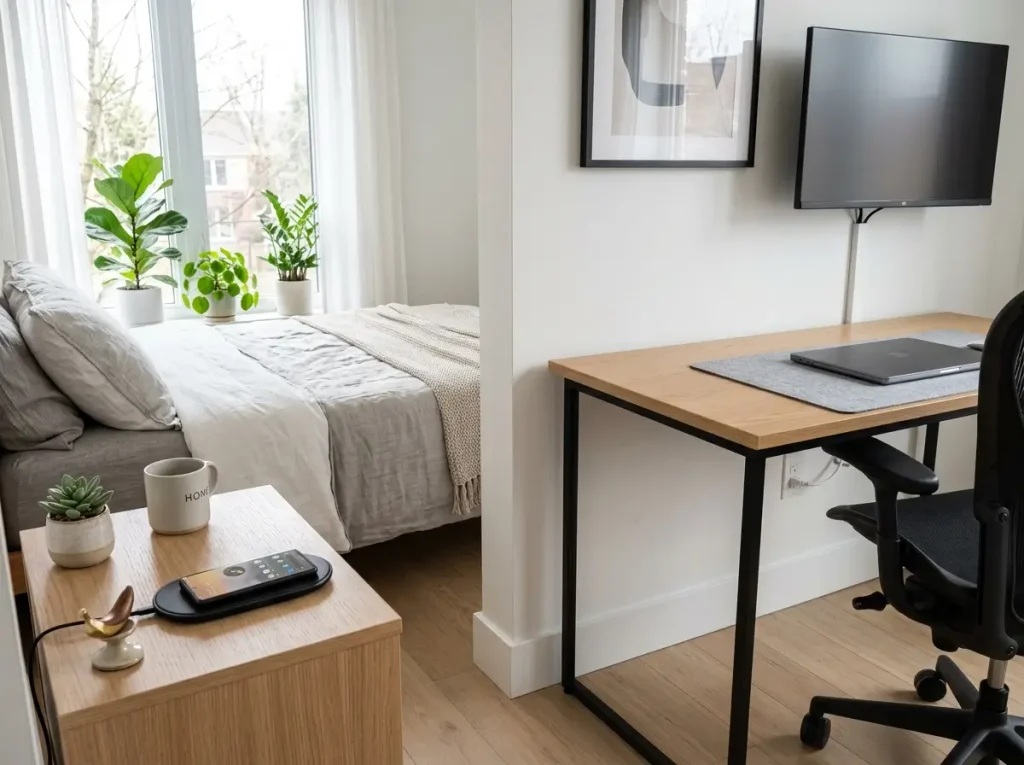
A small guest room and office can quickly transform from a welcoming retreat into a chaotic IT closet if you fail to manage your tech clutter. Monitors, laptop chargers, printers, and desk lamps require a significant amount of wiring to function.
If these cords are left tangling blindly across the desk surface or pooling into a massive nest on the floor, the space instantly loses its hospitality.
When guests walk into a room dominated by black cables and glowing adapters, they feel like they are sleeping in a corporate cubicle rather than a cozy bedroom.
Routing Wires Invisibly
To maintain a clean, restful aesthetic, start by managing the cords directly attached to your workstation.
The goal is to make your daily tech disappear the moment you close your laptop. Use inexpensive, drill-free adhesive cable clips along the back edges and down the rear legs of your desk.
These removable clips allow you to route your monitor cables and charger wires invisibly along the furniture’s frame, guiding them safely down to the floor.
By keeping the desktop entirely clear of wire spaghetti, you eliminate the visual clutter that quickly makes a small guest room and office feel cramped and stressful.
Plus, when it is time to move out, these adhesive strips peel off easily without damaging the finish of your rental furniture.
Hiding the Power Strips Safely
Next, address the tech pooling on the floor. A messy, dust-covered surge protector filled with bulky power adapters is a massive eyesore for any overnight visitor. Invest in a decorative cable management box to completely hide your main power strips.
These simple plastic or wooden enclosures sit neatly on the floor and blend seamlessly into your baseboards, making your tech infrastructure completely disappear from view.
However, when setting up these concealed power strips, you must work safely within the constraints of your apartment’s existing wiring. Older rentals often lack conveniently placed wall outlets.
You should strictly avoid daisy-chaining multiple extension cords across the room to reach a distant plug.
This is a common renter mistake that creates serious tripping hazards for guests navigating the room at night, and it violates basic electrical fire safety guidelines. Instead, always position your heavy electronics near the primary wall outlet during your initial layout planning.
Setting Up a Guest Charging Station
Finally, remember that your visitors will inevitably bring their own tech clutter. A truly hospitable small guest room and office anticipates this need before they even ask.
Provide a dedicated, easily accessible charging station on the nightstand or on a small floating shelf specifically for your guest.
A compact, multi-port USB charger with a universal cable—or a simple wireless charging pad—allows them to plug in their phone, smartwatch, and tablet immediately upon arrival.
By giving them a designated, obvious spot to charge their devices, you prevent them from having to awkwardly crawl under your office desk to hunt for an open socket.
Managing both your daily workflow wiring and your visitor’s tech needs ensures your small guest room and office remains a peaceful, perfectly organized environment at all times.
6. Dual-Purpose Lighting for Work Tasks and Guest Comfort
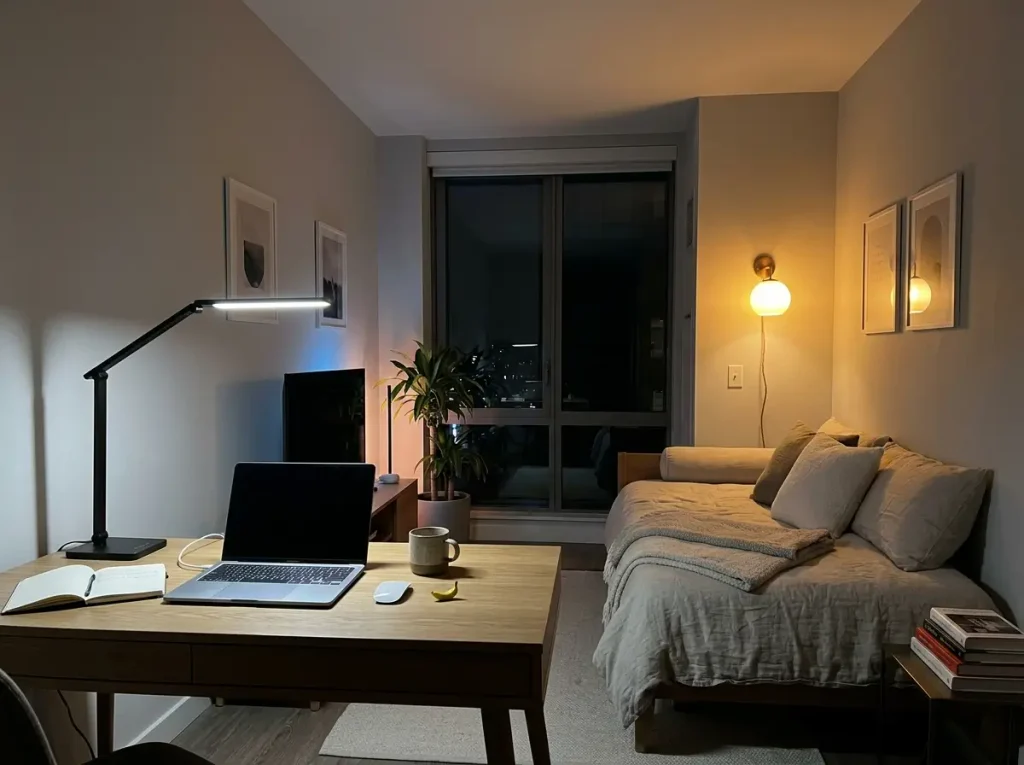
Lighting is often the most overlooked element when designing a small guest room and office. Most apartment rentals come equipped with a single, incredibly harsh overhead dome light that casts unflattering shadows across the entire room.
While this basic fixture might be sufficient for a quick trip into a walk-in closet, relying solely on cheap ceiling lights makes it nearly impossible to separate your daytime productivity from nighttime relaxation.
To successfully blend these two distinct functions, you must learn to layer your lighting. The ultimate goal is to create bright, focused illumination for your desk during the workday, while simultaneously offering warm, highly controllable ambient options for your visitors at night.
Adjustable Task Lighting
When you spend eight consecutive hours staring at a computer monitor, proper desk illumination is critical for preventing painful eye strain and afternoon fatigue.
However, in a small guest room and office, a glaring industrial desk lamp can easily ruin the room’s welcoming hospitality aesthetic.
Instead of settling for a standard, single-hue bulb, invest in a fully adjustable LED desk lamp that features variable color temperatures.
During your busy work hours, you can set the lamp to a cool, daylight-mimicking white to boost focus and productivity.
It is highly beneficial to review the recommended illumination levels for screen work to ensure your temporary desk setup meets established ergonomic visual standards.
When 5:00 PM rolls around, you can simply press a button to switch that exact same lamp to a warm, soft amber setting.
This simple visual shift instantly removes the sterile corporate feel from the room, helping your small guest room and office transition into a cozy, restful environment for the evening.
Drill-Free Bedside Sconces
Next, you must consider the guest’s nighttime experience. Visitors should never have to stumble across a dark room in an unfamiliar apartment just to turn off the main light switch near the door. They absolutely need accessible bedside lighting.
Since hardwiring new electrical fixtures violates nearly every standard lease agreement, plug-in wall sconces are the perfect renter-friendly alternative.
You can mount lightweight, plug-in sconces directly to the drywall beside the daybed using heavy-duty, removable adhesive strips. This completely drill-free method provides high-end, hotel-like hospitality without risking your security deposit.
Finally, tie the entire lighting scheme together with smart LED bulbs. By swapping out your apartment’s standard bulbs for app-controlled smart variants, you can completely alter the room’s atmosphere with a single tap on your smartphone.
You can even set a welcoming, dimmed lighting schedule for arriving guests. Giving yourself the power to change the environment instantly ensures your small guest room and office feels perfectly tailored to whoever is using it at any given moment.
7. The 10-Minute Transition: Switching from Work to Welcome
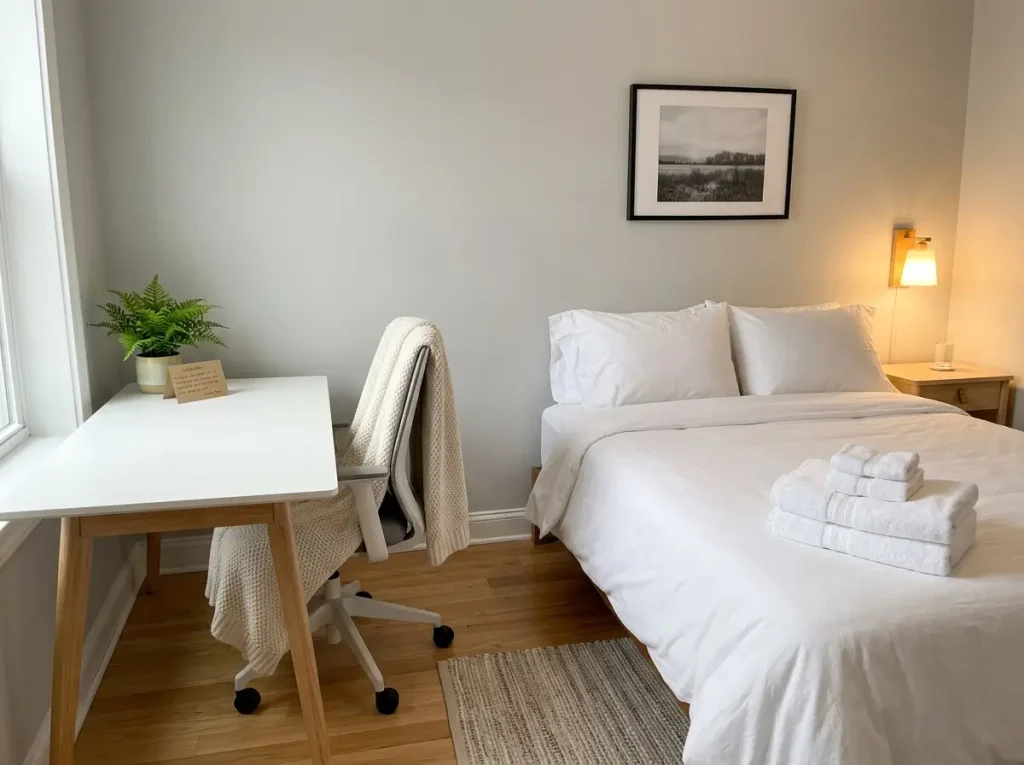
A successful small guest room and office relies heavily on your ability to shift its purpose at a moment’s notice. Hosting visitors should not require a stressful, three-hour deep clean every time family members or friends arrive for the weekend.
If the transition process is too complicated, you will eventually begin to dread having company over. Instead, you need a reliable, step-by-step system to flip the room’s primary function in ten minutes or less.
By executing a quick, deliberate transition, you can instantly erase the visual clutter of your 9-to-5 workday and welcome your visitors with genuine hospitality.
The Desk Clear-Out
When transforming your small guest room and office, you must start with the most obvious stress trigger in the room: your desk surface.
A workspace covered in scattered spreadsheets, glowing monitors, and half-empty coffee mugs immediately signals that the space is a place of labor, not rest.
Your first actionable step is to clear the desktop completely. Store your laptop, loose notebooks, and sensitive work documents inside a lockable, opaque storage bin.
Removing these daily items from plain sight prevents visitors from feeling like they are uncomfortably intruding on your private career space.
Once the work materials are safely hidden away, leave only a single, simple item on the desk surface. A small potted plant, a stylish table clock, or a handwritten welcoming note instantly softens the furniture, making the desk look like a purposeful vanity or a bedroom accent table.
Next, you need to address your seating. A massive, ergonomic rolling chair is a glaring, unavoidable reminder of the room’s daytime corporate function.
If your floor plan permits, swap the heavy office chair for a smaller, stylish accent chair borrowed from the living room.
If moving furniture down the hallway is not a realistic option, push the office chair fully under the desk and drape a heavily textured throw blanket over the backrest to disguise its shape.
Interestingly, these rapid concealment techniques are even more crucial if your rental apartment lacks traditional boundaries.
If your hybrid room does not have a closing door, you can explore our guide on disappearing workspace ideas for open layouts to further camouflage your tech from the main living areas.
Providing Hotel-Like Touches
With the work evidence fully hidden from view, you can immediately focus your remaining minutes on guest comfort.
The ultimate goal is to elevate the hospitality, ensuring your small guest room and office feels like a dedicated luxury bedroom rather than a borrowed corporate cubicle.
- Deploy the sleep surface: Pull out your daybed’s trundle or fully inflate your premium temporary bed, outfitting it with the fresh, crisp linens you stored in your under-bed boxes.
- Prep the closet: Double-check that the bottom third of your closet is completely empty and clear of any rolling utility carts, giving your guests an obvious place to slide their bulky luggage.
- Stage the linens: Lay out a neatly folded stack of fresh bath towels and washcloths directly on the freshly made bed, mimicking the welcoming aesthetic of a boutique hotel.
- Shift the lighting: Turn off the harsh overhead apartment dome light and switch your bedside sconces to a warm, inviting amber glow.
By preparing these small, thoughtful details in rapid succession, you completely change the psychological atmosphere of the space.
Mastering this quick changeover routine is the ultimate secret to maintaining a highly functional, low-stress small guest room and office year-round.
Conclusion
Creating a highly functional small guest room and office doesn’t require knocking down walls or forfeiting your security deposit. By focusing on smart layout planning, modular furniture, and drill-free storage, you can easily host visitors while maintaining a productive daily workspace.
The key is treating the room as an office first, using lightweight, temporary solutions to welcome guests when needed.
Start by assessing your power outlets and mapping out a desk position that hides the bed from your video calls. Once your layout is set, invest in a comfortable, space-saving sleep solution like a daybed.
If you are looking to incorporate even more hobbies into your apartment without causing damage, explore our broader guide on renter-friendly flex spaces for additional inspiration.