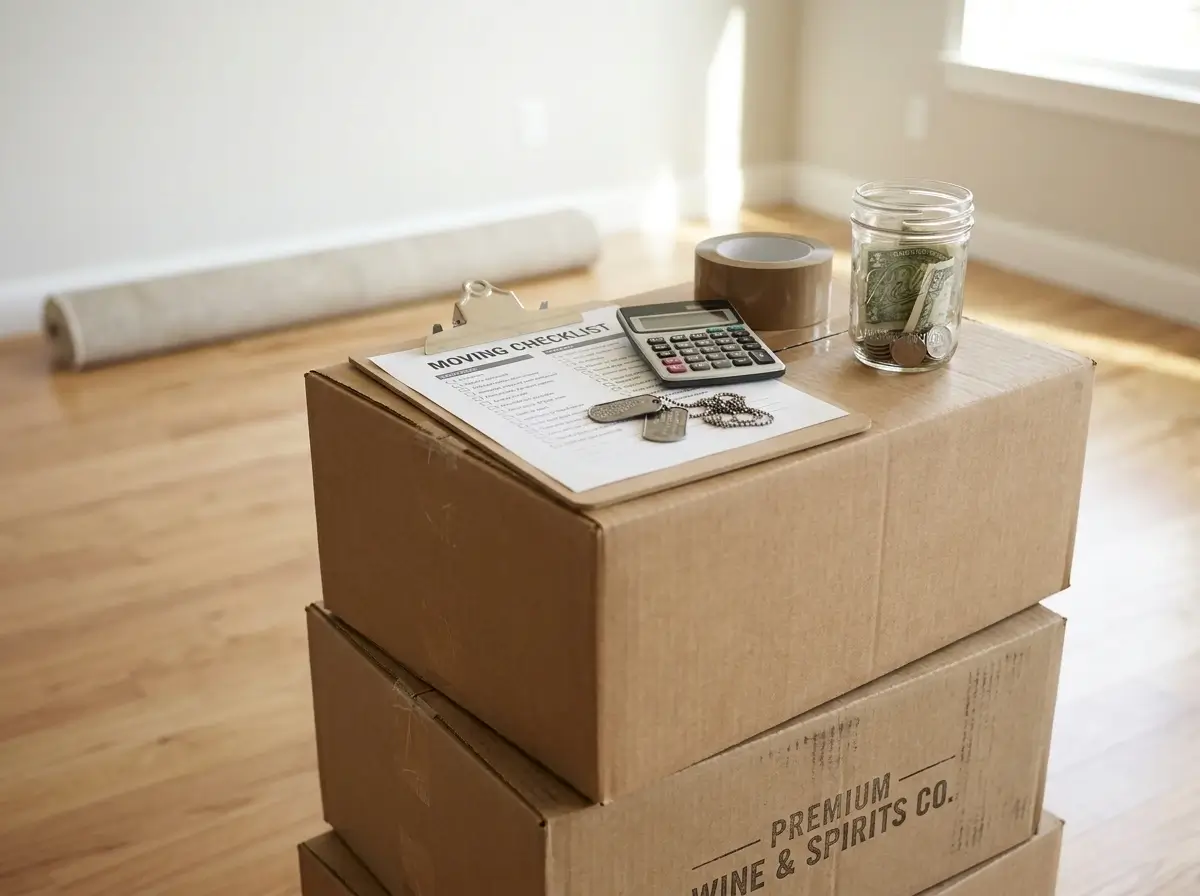
Military moves are notoriously expensive, even when the government foots the primary transportation bill.
In fact, the Military Family Advisory Network reports that a significant majority of military families incur non-reimbursable, out-of-pocket costs during a Permanent Change of Station (PCS).
But you don’t have to start your new assignment in the red.
Strategic preparation is the difference between a costly, chaotic move and a highly efficient relocation.
By applying targeted pcs packing tips on a budget, you can safeguard your household goods, maximize your entitlements, and get on the road without spending a fortune on specialty moving supplies.
Sourcing Free Supplies: The Best PCS Packing Tips on a Budget
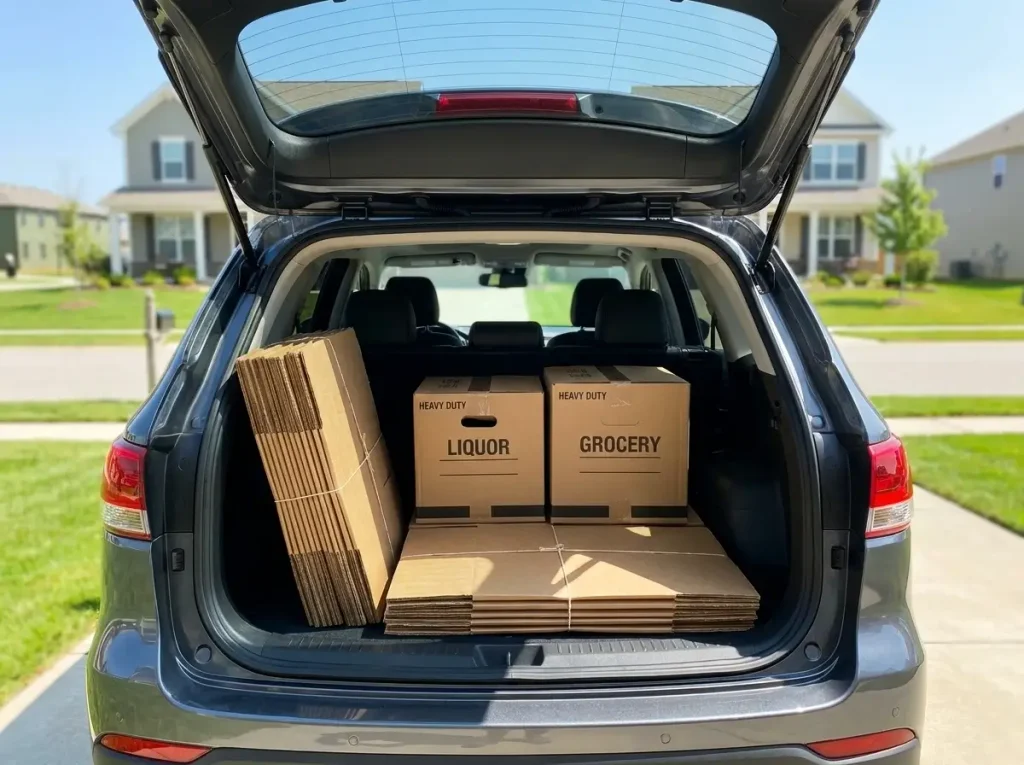
Let’s start with the most obvious budget drain of any relocation: cardboard. If you have ever walked into a retail shipping store to buy materials, you know exactly how quickly those costs add up.
One of the most effective pcs packing tips on a budget is to eliminate the cost of boxes entirely. With a little bit of proactive planning, you should rarely have to pay retail prices for standard moving supplies.
Tapping into Military Community Resources
Military communities are incredibly resourceful, especially during the peak summer moving season. Because families are constantly arriving and departing, there is a continuous cycle of moving supplies changing hands.
Your first stop should always be the base recycling center. Many military installations have dedicated sheds or drop-off points specifically for gently used moving boxes and packing paper.
If the physical recycling center is empty, pivot to digital community networks. Local Facebook spouse pages and neighborhood “Buy Nothing” groups are absolute goldmines for free supplies. A common pattern we see is newly arrived families desperate to clear their garages of flattened boxes.
By timing your request right, you solve their clutter problem while executing one of the smartest pcs packing tips on a budget.
When sourcing from the community, keep these guidelines in mind:
- Set up notifications in local Facebook groups for keywords like “boxes,” “packing paper,” or “bubble wrap.”
- Always offer to pick up the supplies promptly on the owner’s schedule.
- Only accept boxes that are dry, structurally sound, and completely free of pests.
Repurposing Commercial Boxes for Heavy Items
Standard moving boxes are great for clothing and linens, but they often fail under the weight of books, tools, or canned goods. For dense, heavy household items, you need heavy-duty corrugated cardboard.
This is where local businesses become your best asset. Check with local grocery stores, big-box retailers, or liquor stores.
Liquor store boxes, in particular, are structurally ideal for packing. They are designed with reinforced bottoms to hold heavy glass bottles without breaking, making them perfect for your personal library or heavy kitchen gear. Additionally, they are usually uniform in size. Uniform boxes stack neatly in a moving truck or personal vehicle, maximizing your cargo space and preventing dangerous load shifts during transit.
Pro tip: Call the store manager ahead of time and ask which day of the week they receive their major shipments. Arriving right after they stock the shelves guarantees the best selection of clean, dry boxes before they hit the cardboard baler.
Securing High-Ticket Supplies Like Wardrobe Boxes
Not all moving boxes are created equal, and specialty containers can completely derail your moving budget.
Wardrobe boxes—the tall, sturdy containers with built-in hanging bars—are a perfect example. They are incredibly convenient for moving closets directly to a truck, but they can easily cost upwards of $12 to $23 each when purchased new. If you have a large family and need several of these, that becomes a massive out-of-pocket expense.
Instead of buying them, look to neighbors who have recently completed their PCS deliveries. Keep an eye out for moving trucks unloading in your neighborhood or base housing area. Once the transportation service providers finish unloading, families are often left with these bulky wardrobe boxes taking up massive amounts of space in their new living rooms.
A polite knock on the door or a quick message on a neighborhood app can often secure you these premium boxes for free. Applying these proactive pcs packing tips on a budget ensures your money stays exactly where it belongs: in your pocket.
How to Avoid Overweight Fees (And Keep Your Budget Intact)

Exceeding your military weight allowance is one of the fastest ways to drain your bank account during a relocation. Overweight fees are calculated by the pound, and a single unexpectedly heavy shipment can result in a massive bill from the government months after you settle in.
If you want to master pcs packing tips on a budget, you have to master weight management long before the moving trucks pull up.
Know Your Limits First
Before you pack a single box or schedule a yard sale, you need a firm grasp of your exact entitlements.
A common mistake many military families make is assuming their weight allowance is the same as their last move. However, changes in rank, dependent status, or whether your orders are CONUS or OCONUS can drastically alter your limits.
You must understand your specific weight allowance limit to avoid steep penalties. For a deep dive into calculating this, check out our First PCS Move Tips: The 2026 Guide to Surviving Your Initial Relocation.
Checking the current DoD Joint Travel Regulations (JTR) for your specific situation is non-negotiable. Once you have that baseline number, you can accurately gauge how aggressively you need to downsize.
The Ruthless Pre-Move Purge
The golden rule of pcs packing tips on a budget is simple: do not pay to move things you no longer need, use, or want.
Conducting a ruthless pre-move purge is your best defense against surprise weight overages. Start this process months before the packers arrive, taking it one room at a time to avoid feeling overwhelmed. Sort items strictly into keep, sell, donate, and trash piles.
Pay special attention to hidden weight traps that inflate your shipment. Heavy, forgotten items often include:
- Old textbooks, magazines, and physical media.
- Outgrown children’s clothing and baby gear.
- Bulky garage equipment or weightlifting gear that hasn’t been used in years.
Be honest with yourself. If you didn’t unpack a box at your current duty station, you probably don’t need to haul it across the country to the next one.
The Heavy Furniture Equation
Not all furniture is worth its weight in a moving truck. When you are applying pcs packing tips on a budget, re-evaluating your heavy, easily replaceable furniture provides massive leverage.
Take a hard look at dense, inexpensive pieces like particleboard bookshelves, large entertainment centers, or older couches. Particleboard is especially notorious for crumbling during transit. You could easily pay a premium in weight allowance just to move a desk that arrives broken and unusable.
Do the math before you pack. It is often much more cost-effective to sell heavy, generic furniture locally and buy new at your next duty station. The money you earn from a local marketplace sale, combined with the savings of avoiding out-of-pocket weight overages, frequently covers the cost of a brand-new replacement upon arrival.
Creative Padding: Unconventional PCS Packing Tips on a Budget
Buying rolls of bubble wrap and bags of packing peanuts will eat through your moving funds faster than almost anything else. If you are handling a partial DITY or packing your own fragile boxes before the movers arrive, commercial padding is an unnecessary drain on your wallet.
One of the most resourceful pcs packing tips on a budget is to shop your own closets before you ever set foot in a retail shipping store. You already own hundreds of dollars worth of shock-absorbing materials—you just happen to wear them or sleep on them.
Repurposing Soft Goods for Heavy Protection
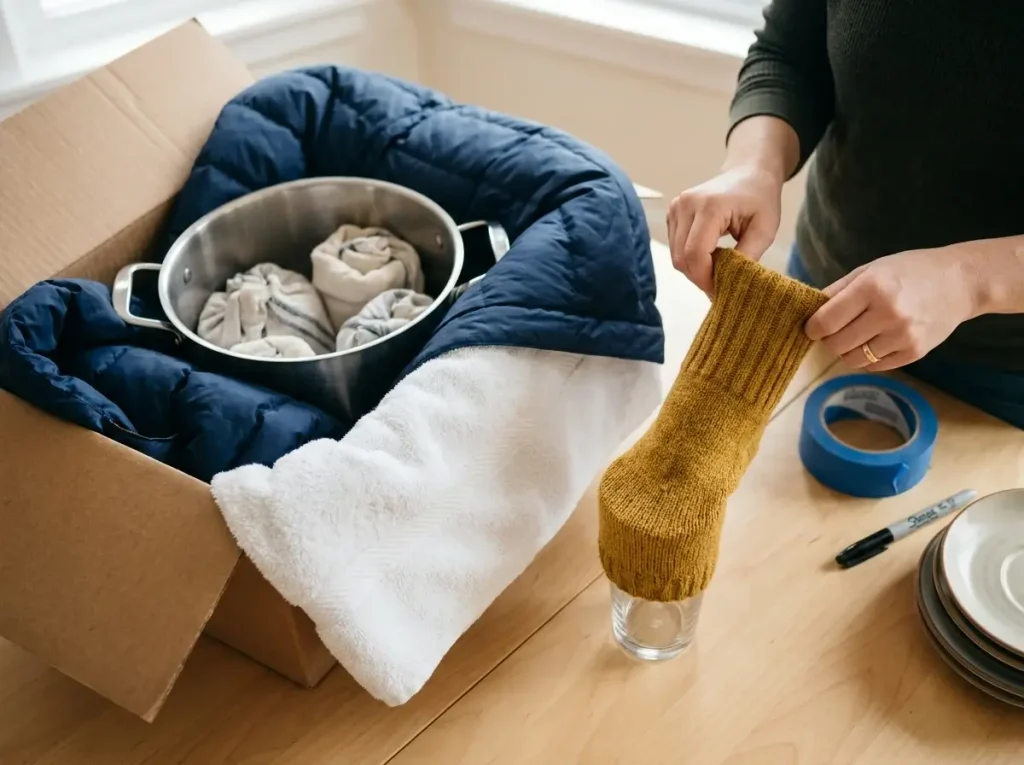
Let’s look at your bulky soft goods. A highly effective strategy is to swap expensive commercial bubble wrap for items you already own: towels, thick winter coats, and spare blankets.
Many families find that heavy winter gear takes up far too much box space anyway. Putting those items to work as protective padding solves two problems at once. Line the bottom and sides of your moving boxes with thick blankets to create a deeply cushioned foundation before adding anything fragile.
Excellent household items to use as free padding include:
- Thick winter coats and puffy jackets.
- Beach towels and plush bath mats.
- Spare bed sheets and heavy comforters.
- Decorative throw pillows.
Wrap larger fragile items—like lampshades, picture frames, or awkwardly shaped electronics—in these thick items. Secure the fabric with a rubber band or a piece of painter’s tape to keep it from unspooling during transit. By utilizing this strategy, you dramatically reduce your reliance on store-bought plastics, executing one of the smartest pcs packing tips on a budget.
The Sock Method for Delicate Glassware
When it comes to smaller breakables, kitchen packing can be incredibly tedious. Instead of buying specialized cardboard cell-dividers for your cups, use clean socks to protect delicate glassware, mugs, and small breakables during transit.
A thick cotton or wool sock provides excellent shock absorption. Simply slide a glass or mug inside a sock, tuck the excess fabric neatly into the opening, and place it snugly in your box.
This prevents your glassware from clinking against neighboring items and causing micro-fractures when the moving truck hits a pothole. Pro tip: Use distinct, brightly colored socks for your most fragile pieces so they stand out clearly when you are unwrapping boxes in your new kitchen.
Nesting to Maximize Space and Safety
Another common mistake when packing kitchens is leaving empty air inside larger items. To maximize your box volume and protect valuables, employ the “nesting” method to safely pack smaller, fragile items inside larger, durable containers.
Think of your kitchen gear like Russian nesting dolls. Wrap your small spice jars or delicate teacups in a kitchen towel, then place them safely inside a heavy-duty crockpot, a large soup pot, or hard-sided Tupperware.
The outer container acts as a rigid, protective shell that shields the fragile cargo inside from crushing forces. Applying these creative pcs packing tips on a budget ensures your delicate items survive the long journey without requiring a costly trip to the packing supply store.
Organizing Your Unaccompanied Baggage (UAB) Economically
When you receive orders that include Unaccompanied Baggage (UAB)—often called an express shipment—you are handed a unique opportunity to drastically reduce your out-of-pocket costs. Your UAB shipment arrives much faster than your main household goods (HHG), bridging the gap between moving out and fully settling in.
To make the most of this allowance, you need strategic pcs packing tips on a budget to ensure you don’t waste money replacing things you already own.
Pack Only the Absolute Essentials
Many families find themselves staring at an empty temporary house or apartment, waiting weeks—or even months—for their main shipment to arrive. A common mistake is treating the UAB like a mini-HHG shipment and filling it with non-essential decor, bulky toys, or off-season clothing.
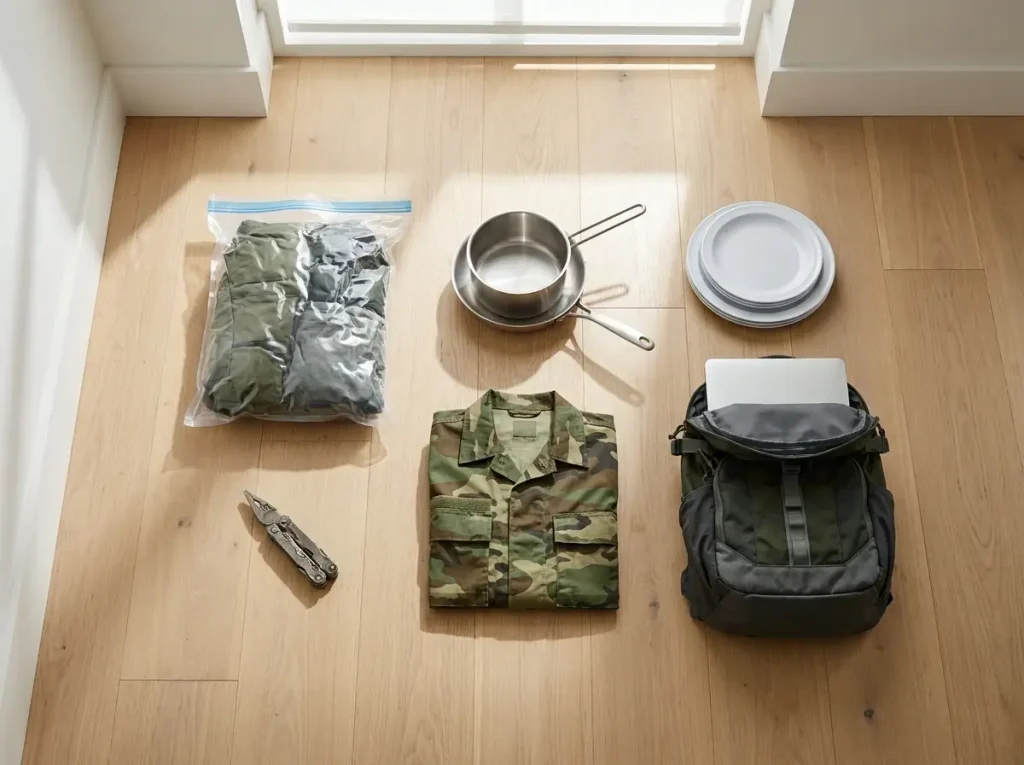
Instead, pack only the absolute essentials in your UAB to eliminate the need to buy expensive, temporary household goods.
Every time you have to run to a local big-box store to buy a cheap coffee maker, a set of basic plates, or a temporary shower curtain, you are draining your moving funds. Curate a strict survival box for your express shipment to avoid these redundant, panic-driven purchases.
Essential UAB items to prioritize include:
- One versatile cooking pot and a basic frying pan.
- A few sets of reusable utensils, plates, and cups.
- Required military uniform items and immediate work gear.
- A basic toolkit for assembling temporary furniture or beds.
Maximizing Volume with Space Bags
UAB shipments are governed by strict weight allowances based on rank and dependents, but physical bulk is often the true limiting factor. You only have so much crate space available before you hit your maximum limits.
UAB by Grade (No Dependents / Unaccompanied PCS)
| Grade | UAB Allowance |
|---|---|
| O-1 to O-3 | 600 lbs net |
| O-4 to O-6 | 800 lbs net |
| O-7 to O-8 | 1,000 lbs net |
| O-9 | 1,500 lbs net |
| O-10 | 2,000 lbs net |
| E-1 to E-8 | 500 lbs net |
| E-9 | 600 lbs net |
| CMSAF | 800 lbs net |
(Source: AFI 24-602V4, Table A4.1)
To get the most out of this shipment without overpaying, utilize vacuum-sealed space bags to maximize the volume of clothing in your UAB allowance. Soft goods like towels, blankets, and cold-weather clothing trap a massive amount of empty air.
By vacuum-sealing these items, you shrink them down to a fraction of their original size without triggering bulky size limits. Investing a few dollars in reusable vacuum bags upfront pays massive dividends compared to the cost of shipping oversized containers. As a bonus, space bags provide an excellent waterproof barrier against mold or moisture during long-haul transit.
Securing Electronics Without Costly Packing Materials
Laptops, tablets, and gaming consoles are fragile, expensive, and critical for keeping your family connected during a long transition. Buying specialized, impact-resistant foam boxes for these devices is a quick way to blow through your moving funds.
Instead of buying specialized foam and custom boxes, keep high-value electronics and chargers in your personal vehicle or carry-on luggage.
By keeping these items in your direct possession, you bypass the need for heavy-duty electronic packing materials entirely. It also ensures that temperature-sensitive items, like lithium-ion batteries and hard drives, aren’t subjected to extreme heat in the back of a moving truck.
Furthermore, relying on your vehicle or carry-on means you won’t have to wait weeks to access vital work laptops or school tablets. Applying these practical pcs packing tips on a budget keeps your expensive devices safe, avoids costly transit damage, and preserves your moving funds for the things you actually need.
Maximizing a Partial PPM With These PCS Packing Tips on a Budget
A Personally Procured Move (PPM), formerly known as a DITY move, offers one of the best opportunities to actually make money during a military relocation. Even if you are utilizing government contractors for the bulk of your household goods, executing a partial PPM can be highly lucrative.
To maximize this benefit, you need to understand how the military calculates your payout: you are reimbursed directly based on the weight you move yourself.
The Profit Strategy: High-Weight, Low-Bulk
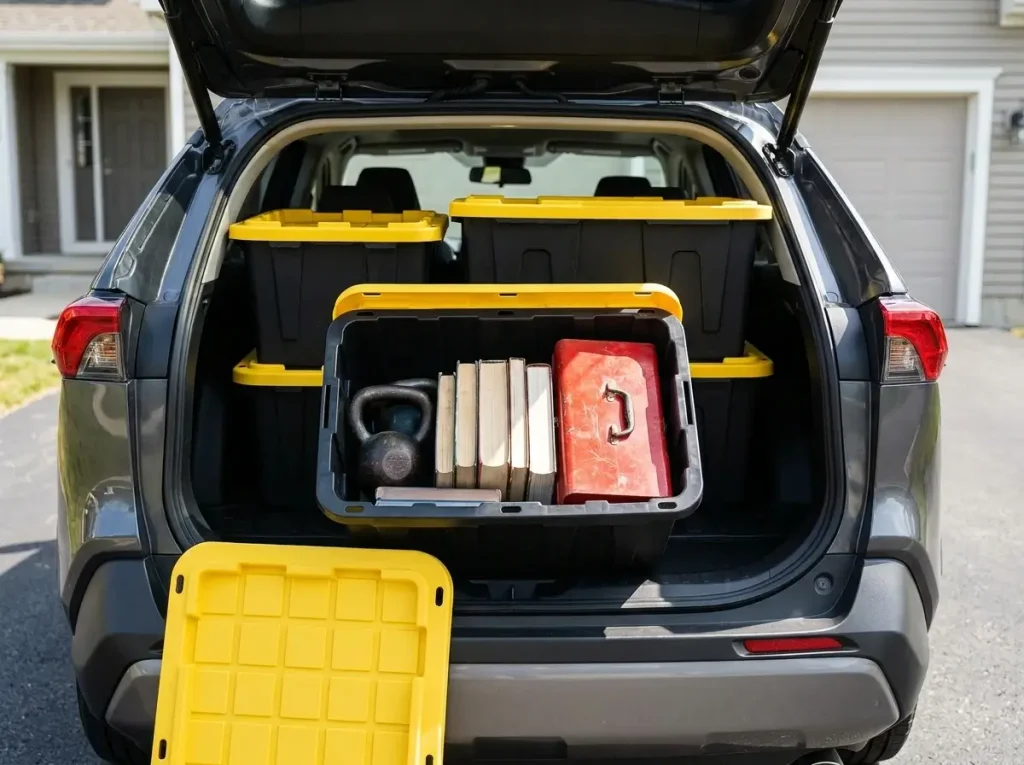
When deploying pcs packing tips on a budget, your overarching strategy for a partial PPM should focus on density. Specifically, you want to explain how packing and transporting high-weight/low-bulk items yourself can yield a profit.
Items that take up very little physical space but add massive weight to the scale are your most valuable assets. By loading these specific items into your own car, SUV, or small utility trailer, you maximize the government payout without needing to rent a massive, expensive commercial moving truck.
Ideal high-weight, low-bulk items to pack in a partial PPM include:
- Dumbbells, kettlebells, and compact weightlifting gear.
- Toolboxes, heavy hardware, and dense garage equipment.
- Hardback books, textbooks, and heavy professional manuals.
- Canned goods and bulk pantry staples.
It is a highly efficient way to turn a mandatory relocation into a profitable endeavor.
Repurposing Storage Totes for Your PPM
When you manage a partial PPM, you are entirely responsible for sourcing the packing materials for that specific portion of the move. Buying dozens of heavy-duty cardboard boxes to safely transport dense items cuts directly into your potential profit margin.
Instead, save money by packing your PPM portion using the heavy-duty plastic storage totes you already use for long-term garage or attic storage. Many families already own rugged plastic bins used for holiday decorations, camping gear, or winter clothing.
Empty those bins out—transferring their lightweight contents to cheaper cardboard for the government movers—and repurpose the heavy plastic for your own transport. Plastic totes are structurally far superior to cardboard, feature built-in handles for easier lifting, and stack securely in the back of a vehicle.
This approach is one of the most effective pcs packing tips on a budget because it completely eliminates the need to buy specialty, heavy-duty moving boxes.
The Non-Negotiable CAT Scale Weigh-In
All the strategic packing in the world won’t matter if your weight tickets are rejected by the base transportation office. A common mistake during PPM moves is relying on uncertified dump scales or private weigh stations that do not provide the mandatory printed documentation.
To ensure you get paid, you must weigh your vehicle empty and full at a certified CAT scale. This is a crucial step to getting reimbursed correctly without wasting money or fuel on rejected, non-certified weigh-ins.
Obtain the empty weight ticket with a full tank of fuel — required by all branches to ensure consistency between weighings, though this is a branch-level administrative standard rather than an explicit JTR mandate.
Make sure you secure the official printed ticket with the scale’s certification stamp before driving away. Mastering this strict weigh-in process is the final, essential component of utilizing these pcs packing tips on a budget to guarantee your partial move genuinely benefits your bottom line.
What NOT to Pack: Cutting Costs Before the Movers Arrive
When preparing for a relocation, what you choose to leave behind is just as important as what you put inside your boxes. Packing items that are risky, heavy, or easily digitized creates unnecessary expenses and logistical headaches.
Knowing what to purge is one of the most overlooked pcs packing tips on a budget. By setting strict boundaries on non-essential items, you protect your household goods and keep your moving expenses low.
Eliminating High-Risk Consumables and Hazardous Goods
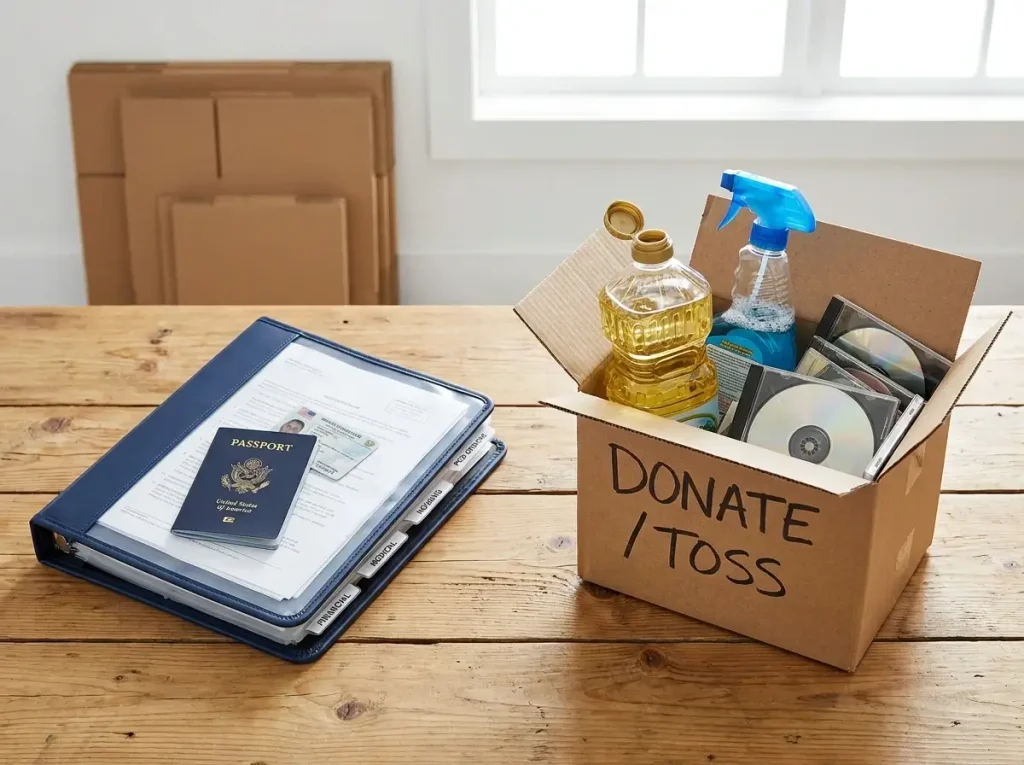
A common mistake during pre-move prep is attempting to save a few dollars by packing opened bottles of cooking oil, cleaning supplies, or half-empty pantry goods.
In reality, trying to transport these items on your own dime is a major budget drain. Government movers will not pack hazardous materials or opened liquids, and hauling them in your personal vehicle frequently leads to leaks that ruin upholstery, clothing, or expensive electronics.
Before the packers arrive, systematically dispose of, consume, or give away:
- Opened pantry staples, spices, and condiments.
- Liquid cleaning agents, bleach, and aerosol cans.
- Paints, lighter fluid, motor oil, and propane tanks.
Instead of spending money on plastic tubs to transport opened consumables, host a “pantry challenge” week to eat through your cupboards or donate sealed goods to a local food pantry. Replacing a $4 bottle of cooking oil at your next duty station is far cheaper than paying to clean or replace a stained sofa.
Digitizing Bulky Physical Media
Paper and physical media are deceptively heavy. Stacks of old DVDs, CD collections, tax returns from a decade ago, and reference binders add considerable weight to your overall shipment.
To save substantial weight and physical space, spend time digitizing your media before packing day. Convert home videos and music collections to external hard drives or secure cloud storage.
Scanning old financial records, manuals, and school projects eliminates the need to haul heavy plastic file cabinets across the country. Applying these forward-thinking pcs packing tips on a budget reduces your total weight footprint, helping you stay well beneath your authorized weight limits.
Protecting Vital Records from the Moving Truck
Never let your essential identification, legal files, or official orders end up in the back of a moving van.
Ensure all critical documents are removed from the shipment and organized separately in your personal custody. If a moving company misplaces a box containing original birth certificates, Social Security cards, or vehicle titles, you will face steep administrative fees and expedite costs to replace them—not to mention weeks of stressful administrative delays.
Keep these irreplaceable records in your personal vehicle or carry-on luggage:
- Original birth certificates, marriage licenses, and passports.
- Social Security cards and military IDs.
- Vehicle titles, registration papers, and insurance policies.
- Official military orders and service records.
For a comprehensive breakdown of how to structure these essential files so nothing slips through the cracks, refer to our guide on The Complete Master Checklist of What to Put in a PCS Binder.
Keeping these documents safe in your own hands is one of the easiest, zero-cost pcs packing tips on a budget that prevents expensive emergency replacements down the road.
Conclusion
A budget-friendly PCS is entirely possible with a bit of resourcefulness and early planning.
By sourcing free materials, utilizing items you already own for padding, and aggressively purging excess weight, you protect both your belongings and your bank account.
The key is to start early.
What are your go-to strategies for keeping out-of-pocket moving costs down? Share this guide with a fellow military family prepping for their next set of orders to help them save, too!