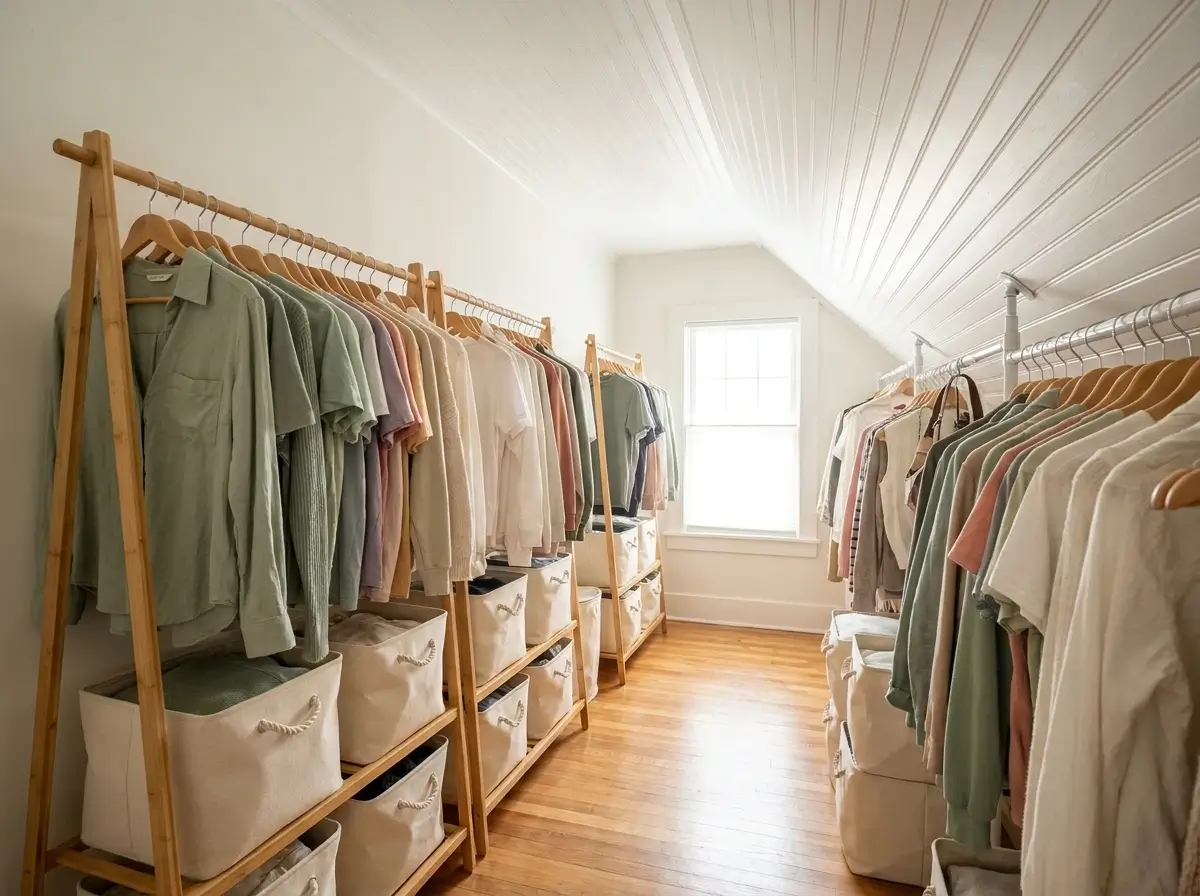
Moving into a top-floor unit often means dealing with charming—but highly impractical—architecture.
A common mistake renters make is trying to force standard, bulky bedroom furniture under awkward, sloping rooflines. Instead of fighting the angles, you need adaptable solutions that work with the pitch of your room.
If you are tired of living out of suitcases, exploring small attic closet ideas can completely change how your room functions. Because you cannot build permanent walls or drill heavy hardware into a landlord’s ceiling, a creative approach is essential.
In this guide, we cover practical, non-permanent strategies to house your wardrobe. We will look at freestanding racks, modular cubby systems for tricky eaves, and tension-rod setups that take minutes to install.
Whether you have deep dormers or low clearance, these damage-free methods will help you reclaim your floor plan without risking your security deposit.
Freestanding Wardrobes: The Foundation of Small Attic Closet Ideas
The Benefits of Covered Garment Racks
When you move into a top-floor unit, the lack of traditional built-ins can feel overwhelming. You might be wondering how to create a functional wardrobe without building actual walls or losing your security deposit.
This is where freestanding wardrobes become the absolute foundation of your setup.
Implementing the right small attic closet ideas means shifting your mindset from permanent construction to adaptable furniture. For renters, freestanding wire or heavy-duty bamboo garment racks are the perfect starting point.
They require zero drilling, often assemble in under twenty minutes, and instantly give you hanging space where none existed before. Wire shelving alternatives are particularly great because they let light pass through, keeping your room feeling airy.
By consolidating all your hanging clothes onto one highly functional rack, you can easily maximize space and storage across the rest of your open floor plan, leaving room for a desk or a cozy seating area.
Measuring Your Apex
Slanted ceilings make vertical space a precious commodity. Before you buy any portable clothing rack, you must understand the unique geometry of your roofline.
The key to successful small attic closet ideas is utilizing your apex height—the highest point in the room where the slanted ceilings peak.
To get this right, follow a few simple steps:
- Find the peak: Locate the tallest center point of your ceiling.
- Measure downward: Drop a tape measure from that ceiling peak straight down to the floor.
- Determine usable width: Measure how wide this tall center channel is before the roof pitch becomes too low for standard clothing hangers to fit.
Placing your tallest garment racks squarely in the apex ensures your longest items, like maxi dresses and winter coats, clear the floor without dragging. A common mistake renters make is buying a rack that is simply too wide.
When a rack is too wide for the apex, you are forced to pull it forward away from the wall to avoid the ceiling slant, which immediately eats up your valuable walking space.
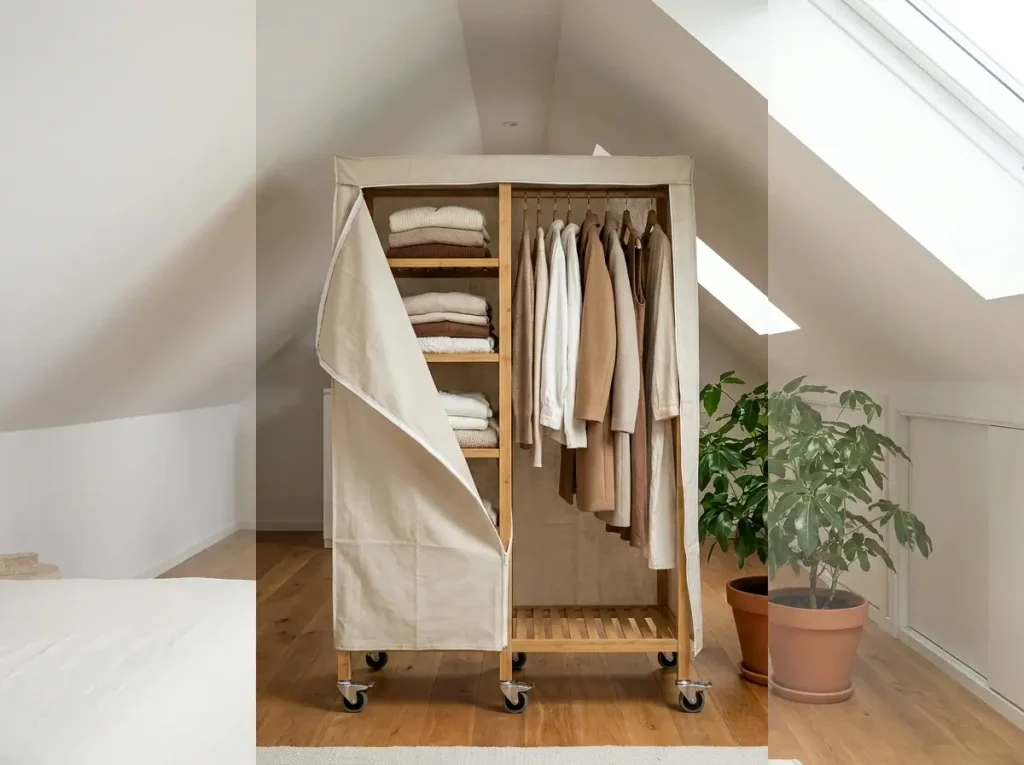
The Benefits of Covered Garment Racks
Top-floor apartments and converted lofts are notoriously prone to accumulating dust, especially in older buildings where the air circulation might not be optimal. If you are exploring durable small attic closet ideas, you must consider how to protect your daily wear.
This is why covered clothes racks are a lifesaver. Slipping a breathable fabric cover over your freestanding wardrobe offers excellent attic dust protection.
Beyond cleanliness, it instantly hides your garments, dramatically reducing visual clutter in a tight room. A solid, neutral-colored cover acts almost like a faux wall, making the space feel much tidier.
Another massive advantage for renters and frequent movers is mobility. When selecting your wire or bamboo racks, always prioritize models with locking casters. Wheeled racks offer incredible flexibility for a temporary closet setup.
If you realize your current layout isn’t working, you can simply unlock the wheels and roll your entire closet to a different wall.
Furthermore, when your lease eventually ends, rolling your organized wardrobe right up to your moving boxes makes the entire relocation process stress-free.
Ultimately, the best small attic closet ideas rely on this kind of modular flexibility. You do not need a carpenter or permanent hardware to create a highly functional wardrobe under a slanted roof.
Utilizing Tension Rods Between Slanted Ceilings and Knee Walls
The Mechanics of Heavy-Duty Tension Rods
When mapping out small attic closet ideas, you will inevitably hit the lowest point of your slanted ceiling. This area, where the roofline meets the knee wall, often feels entirely useless for hanging clothes.
However, with the right approach, you can transform this awkward wedge into highly functional storage.
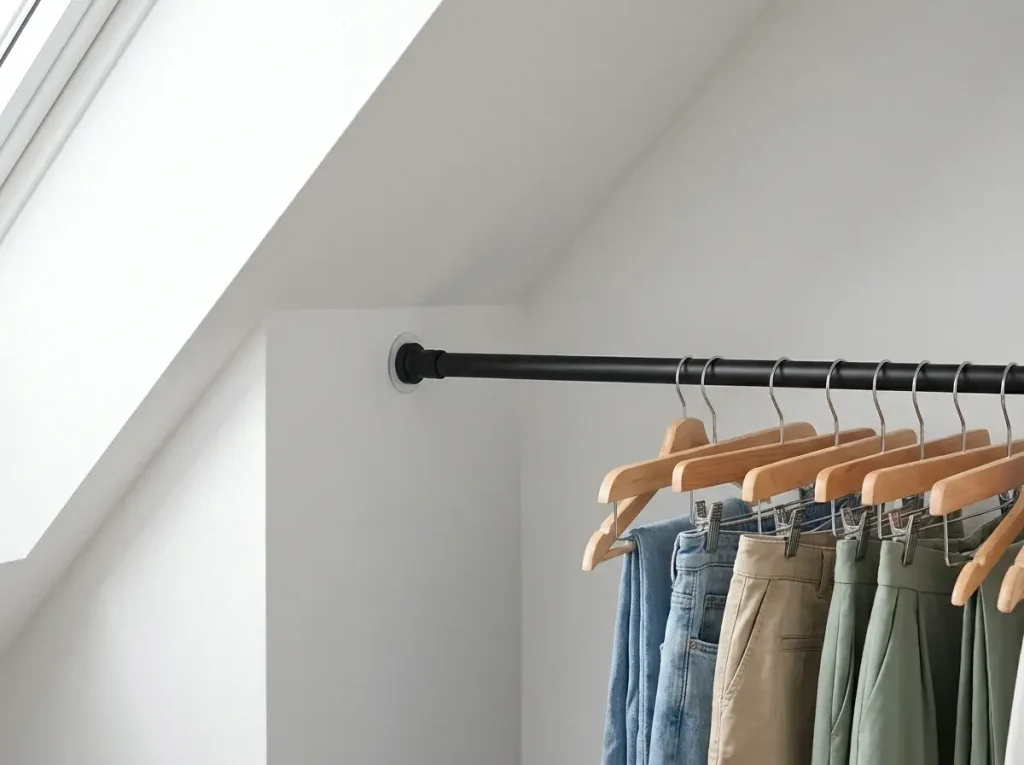
Instead of leaving this valuable floor plan empty, you can implement one of the most drill-free small attic closet ideas available: heavy-duty tension rods. These simple devices allow you to create customized hanging space without touching a hammer or drill.
Because you are simply using pressure to hold the rod in place, it is a completely renter-safe solution.
Standard shower curtain rods will not survive the weight of a daily wardrobe. If you want your small attic closet ideas to actually last, you must invest in heavy-duty tension rods specifically designed for closets or room dividers.
These robust rods use a strong internal spring mechanism combined with rubberized end caps. When twisted tightly into place, the pressure grips the parallel surfaces securely.
To make this work under a slanted roof, you need two flat, opposing vertical surfaces. Usually, this means wedging the rod between two existing dormer walls or a knee wall and an adjacent flat surface.
When installing your rod, extend it about an inch wider than the opening, then compress the spring to slide it into position. This ensures a rock-solid grip that won’t collapse when you slide hangers back and forth.
Safely Wedging Rods Without Wall Damage
What happens if your slant is too steep, or you don’t have two parallel walls close enough together? A clever workaround is to wedge the tension rod between a short knee wall and a sturdy, heavy piece of furniture, like a solid wood bookcase or a low dresser.
This strategy creates an instant closet exactly where you need it. However, weight limits are absolutely critical to monitor to prevent wall damage. Overloading a tension rod can cause it to slip, potentially scuffing the paint or denting the drywall.
Always check the manufacturer’s maximum weight capacity, and stay at least five pounds under that limit to be safe.
To further protect your landlord’s paint, you can place a small square of non-slip shelf liner or a flat silicone pad between the rod’s end cap and the drywall. This simple trick distributes the pressure more evenly and prevents ugly friction marks when it is time to move out.
If you need a wider variety of storage beyond just hanging garments, you can seamlessly integrate other non-permanent containers. For a deeper dive into maximizing these tricky lower areas, explore these closet hacks for low knee walls.
Ideal Garments for Low-Hanging Rods
Because tension rods in an attic will naturally sit closer to the floor, you have to be strategic about what you hang on them. Long dresses and winter coats will simply drag on the ground, creating a wrinkled mess.
Instead, designate this low-clearance zone strictly for shorter garments. These rods are perfect for pants folded neatly over hangers, skirts, shorts, and folded scarves.
If your wardrobe consists of heavy denim or thick woolen trousers, keep an eye on the center of the rod. A slight bow in the middle means you have exceeded the safe weight limit and need to remove a few items immediately.
Organizing your shorter clothing items in the lowest part of the room is a cornerstone of the best small attic closet ideas.
By grouping all your half-length garments together on a tension rod, you free up the taller, more valuable apex space for your longer clothing. This simple zoning trick makes the entire room feel larger, more organized, and perfectly tailored to your everyday needs.
Modular Cubbies for Easy Renter Relocation
Staggering Storage to Match the Pitch
When you live on the top floor, simply getting furniture into your apartment is half the battle. Navigating a heavy, solid wood dresser up a tight, twisting flight of stairs is often a nightmare for renters.
A common mistake is buying standard bedroom furniture only to realize it cannot make the turn at the top of the stairwell.
If you are researching practical small attic closet ideas, you must prioritize lightweight materials that will not break your back or scuff the landlord’s walls. This is where modular cubbies become an absolute lifesaver for folded clothing and accessories.
Sloping ceilings make traditional rectangular furniture impossible to place flush against the wall. The sharp angles of a pitched roof will push a standard dresser several feet into the middle of the room.
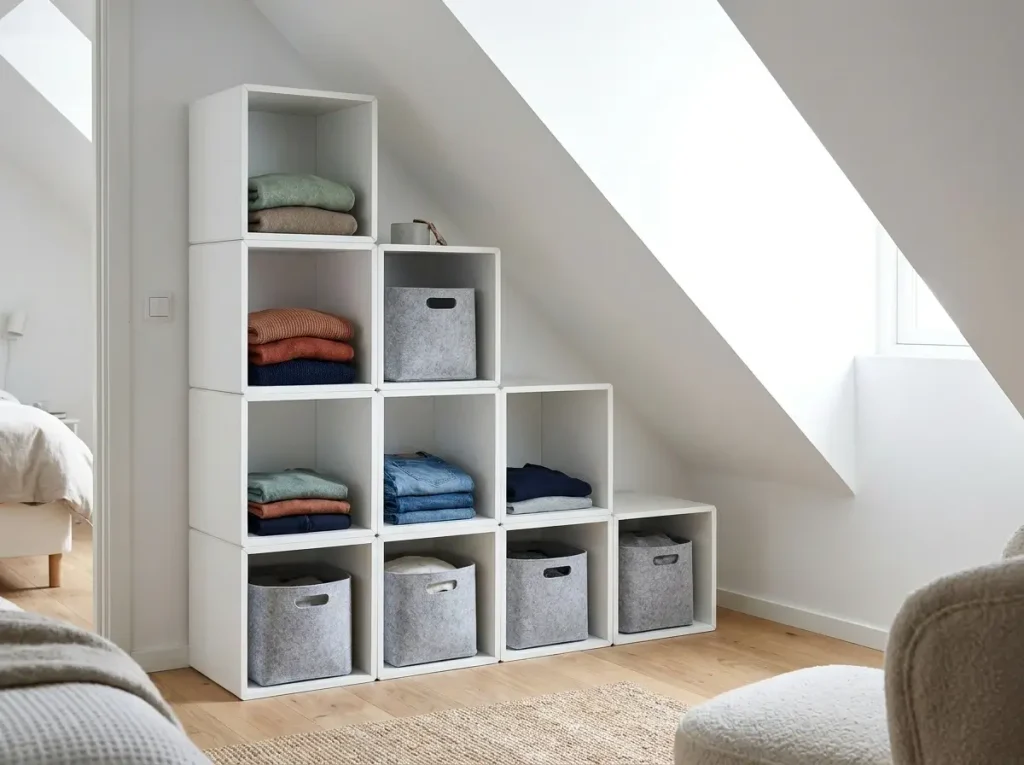
Instead of wasting that valuable angled floor space, you can use stackable, modular storage cubes. The beauty of these interlocking systems is that you can build them in a customized, staggered formation.
Start with three or four cubes stacked vertically near the highest point of your slant. As the ceiling dips downward, drop the stack to two cubes, and finish with a single cube at the lowest edge near the knee wall.
This stair-step layout is one of the most effective small attic closet ideas because it mimics the roofline perfectly without wasting an inch of vertical space. Fabric drawers, foldable boxes, or lightweight plastic bins can easily slide right into these structured cubes.
These soft bins are perfect for holding your folded t-shirts, bulky sweaters, and delicate undergarments while keeping them completely hidden from view.
Easy Disassembly and Seasonal Sorting
For frequent movers, the thought of lugging bulky bedroom sets from apartment to apartment is exhausting. By focusing your small attic closet ideas around modular wire or plastic systems, moving day becomes incredibly simple.
When your lease ends, these lightweight cubes can be popped apart and disassembled in mere minutes.
They pack down entirely flat, easily fitting into a single cardboard box. If you are looking for other ways to make living under the eaves painless, incorporating lightweight decor for easy stairway transport will save you a lot of physical strain on moving day.
Beyond just moving logistics, modular cubbies help you organize your daily morning routine. Because the lowest cubes require crouching or kneeling to access, you should be strategic about what goes inside those specific bins.
Store your out-of-season clothing, like heavy winter scarves or summer swimsuits, in the bottom, harder-to-reach cubbies. Keep your daily wear in the higher, eye-level cubbies where you can grab them quickly and comfortably.
This simple sorting strategy reduces daily frustration and keeps your room highly functional. The most successful small attic closet ideas are those that adapt to both your restrictive architecture and your lifestyle, all while protecting your security deposit.
Brilliant Small Attic Closet Ideas for Lighting Dark Eaves
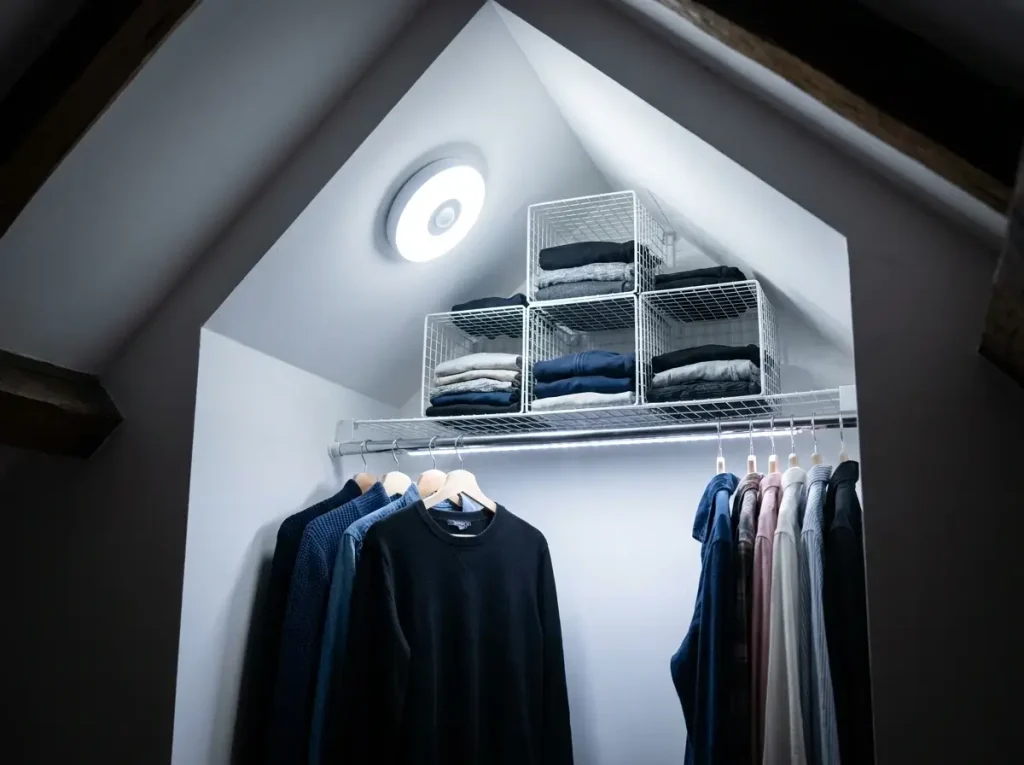
When brainstorming small attic closet ideas, renters often focus entirely on hanging space and forget one crucial element: visibility.
Deep attic eaves and angled rooflines are notoriously dark. Because these areas were originally designed for structural support rather than daily living, they rarely feature hardwired overhead lighting.
Getting dressed in a shadowy corner makes it nearly impossible to distinguish a navy blue sweater from a black one. A common mistake is assuming you have to live with this daily frustration or hire an expensive electrician to run new wiring.
Instead, the most practical small attic closet ideas rely on wireless, rechargeable technology to brighten these shadowy corners. When a tight, angled space is well-lit, it naturally feels larger, less cramped, and significantly more inviting.
Motion-Sensor Puck Lights
If you have set up modular cubbies or low shoe racks under a steep pitch, rechargeable LED puck lights are an essential addition. These small, lightweight discs can be mounted directly onto the slanted ceiling right above your folded clothes.
Look for models equipped with motion sensors. When you reach into the dark eave to grab a shirt on a dark winter morning, the light instantly clicks on, entirely hands-free.
Many modern puck lights feature magnetic bases, which are brilliant for renters. You simply attach the adhesive metal plate to the ceiling once, and pull the light down magnetically when it needs a quick USB charge.
Because protecting your security deposit is paramount, always use high-quality, damage-free adhesive strips to mount the metal plates. Avoid cheap foam tapes that can rip the drywall paper or peel the landlord’s paint when it is time to move out.
Battery-Operated Strip Solutions
For your hanging garments, illuminating the entire width of your clothing rack is a much better strategy. Integrating proper, wide-spanning lighting elevates your small attic closet ideas from a makeshift storage pile into a functional, custom-feeling wardrobe.
Battery-operated LED strip lights are highly flexible and perfect for awkward, non-standard spaces.
You can adhere these thin strips directly along the underside of a heavy-duty tension rod. As they shine downward, they illuminate your hanging shirts and pants perfectly, mimicking the look of a high-end closet rod.
Alternatively, you can run a strip of lights right along the baseboard or the lowest edge of the knee wall. This creates a gentle floor-level wash of light, helping you easily locate shoes or storage bins pushed into the deepest recesses of the slant.
Comparing Your Temporary Lighting Options:
- Puck Lights: Best for targeted, bright light over modular cubbies and shelves. Pros: Motion activation and magnetic recharging. Cons: Can cast harsh shadows if placed too close to garments.
- Strip Lights: Best for broad, even lighting over tension rods and hanging clothes. Pros: Flexible placement and widespread glow. Cons: Usually requires manual switching and frequent battery replacement.
When selecting your LEDs, always opt for a “daylight” or “cool white” color temperature. Warm, yellow lights distort the color of your fabrics, while daylight bulbs give you an accurate reflection of your wardrobe.
These bright, efficient additions prove that the best small attic closet ideas do not require an electrician or permanent structural changes to your rental.
Repurposing Dormer Windows as Open Storage Nooks
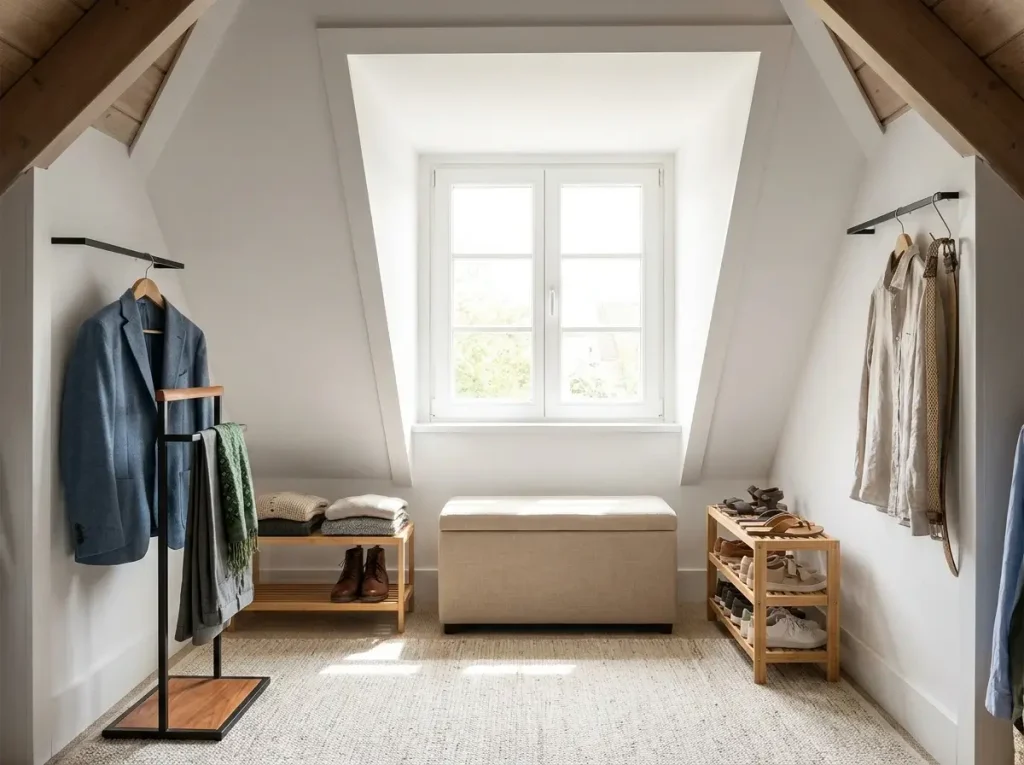
A common mistake renters make is viewing dormer windows only as sources of light, completely ignoring their structural storage potential. A dormer recess naturally creates a distinct architectural alcove.
If you lack a traditional wardrobe, treating this recess as a natural “closet” frame is one of the most clever small attic closet ideas you can implement.
Instead of letting that squared-off square footage go to waste, you can actively incorporate it into your daily dressing routine.
Because natural light is usually scarce under a pitched roof, setting up your primary dressing area right inside the dormer allows you to easily distinguish clothing colors, saving you from relying entirely on battery-operated puck lights every morning.
Treating the Recess as a Natural Closet Frame
Start by looking at the space directly beneath the windowsill. This low zone is incredibly valuable if used correctly. To maximize this alcove, consider these non-permanent storage additions:
- Low Shoe Racks: Placing low, stackable shoe shelves right under the glass utilizes floor space without blocking the sunlight or the view.
- Storage Ottomans: A cushioned storage ottoman is particularly useful. You can sit on it while putting on your shoes, and lift the lid to access chunky sweaters, extra blankets, or off-season accessories.
- Woven Baskets: If your dormer features a small built-in ledge, you can utilize the space by placing lightweight, foldable fabric baskets directly on top for your folded scarves and belts.
This simple approach is a cornerstone of functional small attic closet ideas because it serves dual purposes in a tight footprint. Next, look at the vertical side walls flanking the dormer window.
These short, flat walls are often the perfect width for freestanding valet stands or narrow clothing trees.
A freestanding wooden or metal valet stand can hold a jacket, a pair of trousers, and your daily accessories all in a footprint of less than two square feet.
By placing a valet on each side, you create an open, boutique-style display for tomorrow’s outfit or heavy coats. Once your practical storage is firmly in place, you can soften the rigid edges by blending it with broader decorating ideas for dormer windows.
Safety First: Keeping Egress Clear
While it is tempting to cram as much storage into these alcoves as possible, you must always prioritize safety.
One of the most critical aspects of planning your small attic closet ideas is ensuring you do not block emergency egress routes. Most building codes require at least one operable window in a bedroom to serve as a fire escape.
Never place tall, heavy clothing racks directly in front of the glass. Not only does this pose a severe safety risk in an emergency, but it also blocks vital natural ventilation.
Top-floor apartments and attics can become incredibly hot and stuffy. Blocking the airflow with a solid wall of hanging clothes will trap moisture, encourage musty odors, and potentially damage your wardrobe over time.
Remember that any storage placed in front of an operable window, like a small ottoman, must be lightweight and easily movable so it can be pushed aside in seconds if an emergency occurs.
By keeping the central window clear and focusing on the lower bounds and side walls of the recess, you turn a quirky architectural feature into a highly functional storage zone.
Smart small attic closet ideas are all about working in harmony with your room’s natural layout, maximizing everyday utility without ever sacrificing your safety or sunlight.
Vertical Shoe Racks: Essential Small Attic Closet Ideas for Footwear
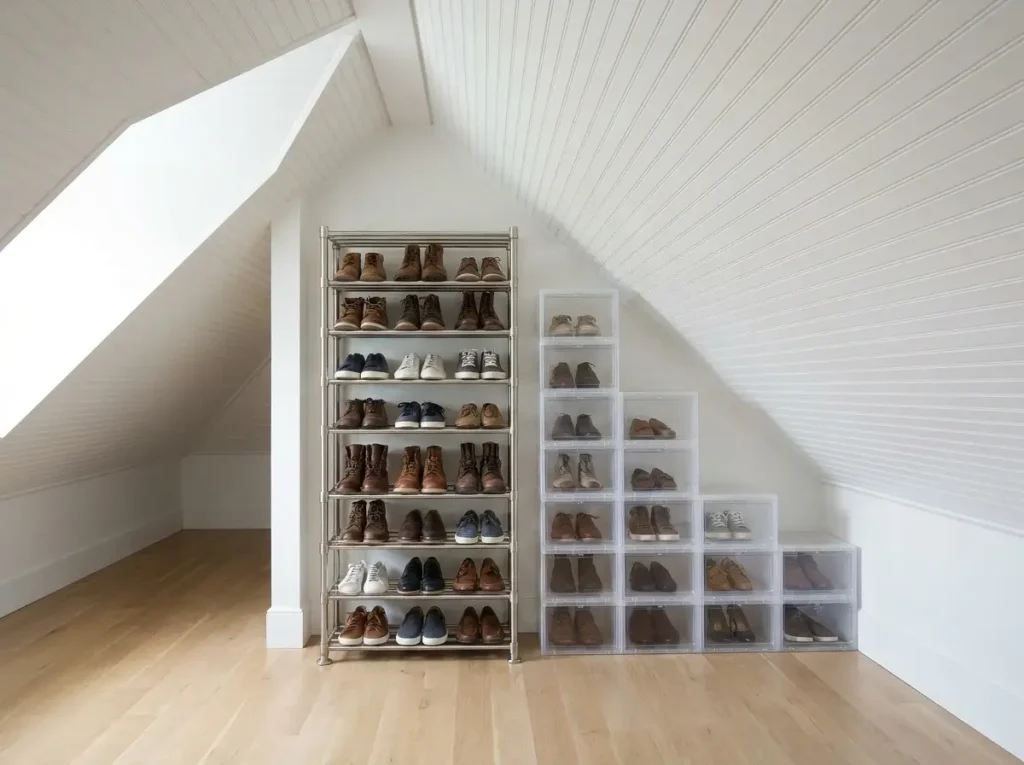
When you are piecing together your wardrobe layout, footwear is often the final, most frustrating puzzle piece. Piles of shoes left on the floor quickly consume your limited walking space.
In a low-clearance room where you already have to duck to avoid slanted ceilings, tripping over scattered sneakers becomes a genuine daily hazard.
Solving the footwear dilemma is a critical component of the best small attic closet ideas. If you only focus on hanging your clothes, your room will still feel cluttered and chaotic on the ground level. The goal is to lift your shoes off the floor and utilize the vertical height you do have.
Maximizing the Apex
Instead of spreading your footwear out horizontally, look for ways to stack them vertically. Flat, wide shoe racks will push too far into the center of your room, eating up the exact floor space you need for navigating your daily routine.
This is where tall, narrow, freestanding shoe trees shine. Because these metal or wire towers have a tiny footprint—often less than a square foot—they are perfect for tight corners.
Place your tallest vertical shoe tree directly under the apex of your ceiling. By placing it at the highest point of the pitch, you can stack dozens of pairs upward without hitting the roofline.
Implementing vertical solutions is one of the most effective small attic closet ideas for renters. These spinning trees or leaning racks require absolutely no drilling, making them completely safe to use without risking your security deposit.
Top 3 Renter-Friendly Shoe Organizers
If you want to keep your footprint completely clear, consider these three damage-free methods:
- Over-the-Door Organizers: If your attic apartment features a traditional, full-sized entry door, hang a fabric pocket organizer over the back. This instantly houses twelve to twenty-four pairs of shoes without using a single inch of floor space.
- Freestanding Shoe Trees: As mentioned, these spring-loaded or heavily weighted vertical poles hold shoes in a spiral, maximizing your ceiling height perfectly.
- Stackable Drop-Front Boxes: Clear plastic boxes that stack securely like building blocks. You can arrange them in a stair-step pattern to perfectly match the downward angle of your knee wall.
Off-Season Rotation
Even with the best vertical racks, keeping your entire year’s worth of footwear out at once is a common mistake.
A visually cluttered display makes the room feel much smaller and more cramped than it actually is. To truly master your small attic closet ideas, you must get comfortable with off-season rotation.
When summer arrives, heavy winter boots should not be taking up valuable space on your primary shoe rack. Instead, transition these bulky off-season items into soft, zippered bins. You can easily slide these flat containers completely out of sight.
Pushing off-season shoes beneath your mattress or integrating them into creative bedside storage clears up your main wardrobe area immediately.
By rotating your footwear twice a year, your daily dressing zone remains functional, spacious, and perfectly organized. Maintaining this discipline ensures your small attic closet ideas remain practical and uncluttered all year round.
Rolling Carts: Flexible Small Attic Closet Ideas for Deep Eaves
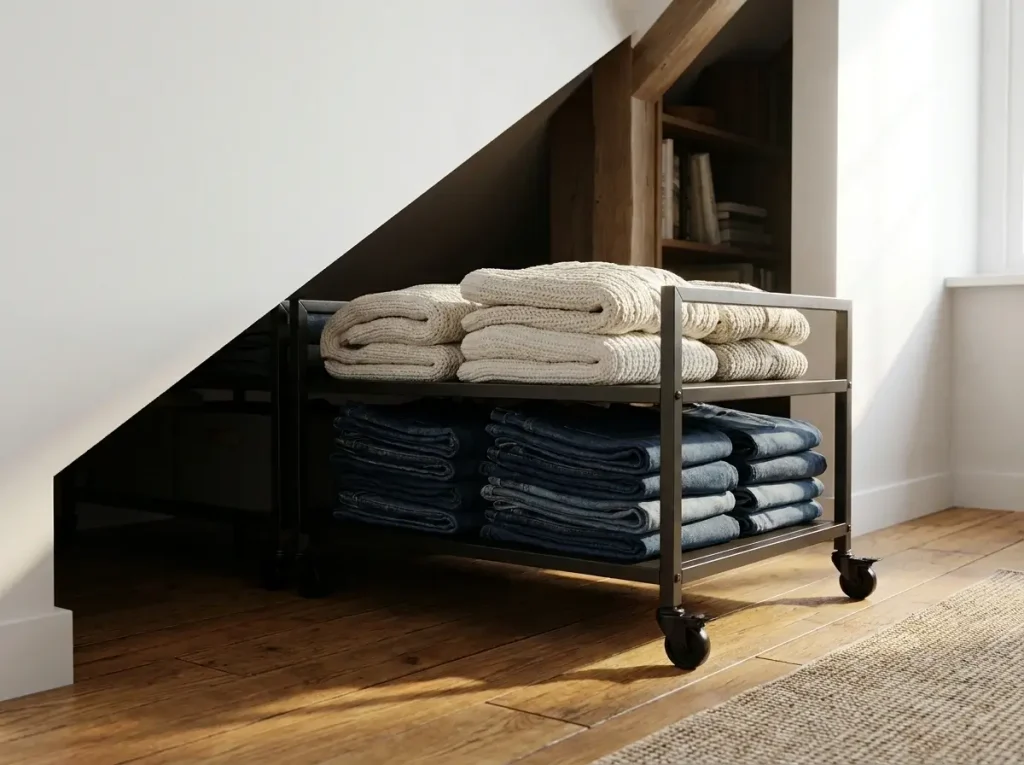
When evaluating the footprint of a top-floor apartment, you will quickly notice that the deepest eaves are often completely wasted floor space. The pitch of the roof creates extreme angles near the floorboards where it is literally impossible to sit up, let alone stand.
Because tension rods and modular cubbies cannot squeeze into these tiny, triangular gaps, this low-clearance zone usually becomes a dusty trap for random, forgotten boxes.
However, ignoring this square footage is a massive mistake when you are working with a tight layout. If you want to maximize every single inch of your floor plan, your small attic closet ideas must include a practical strategy for these difficult pockets.
Pull-Out Access for Deep Knee Walls
Crawling on your hands and knees just to find a pair of jeans is not a sustainable morning routine. The secret to utilizing deep knee walls without creating an ergonomic nightmare is bringing the storage out to you.
This is exactly where low-profile rolling carts become incredibly valuable.
Before purchasing a cart, take careful measurements of the lowest vertical drop where your ceiling slant meets the floor or the knee wall.
You want a heavy-duty cart that clears the slant by at least two inches when fully loaded, ensuring your clothes do not rub against the drywall and leave marks.
By loading these rolling carts with folded garments, you create a mobile drawer system that lives safely tucked away in the shadows.
When you need to get dressed, simply pull the cart out into the standing, high-clearance area of your room. Once you have made your selection, gently roll it right back into the eaves.
This simple pull-out access completely changes how you interact with your space. The most innovative small attic closet ideas do not force you to contort your body to fit the architecture of the room; they adapt the room to fit your natural, everyday movements.
You get all the organizational benefits of custom built-in drawers without spending a dime on construction or risking your security deposit.
Choosing the Right Carts and Garments
When shopping for these mobile units, stability is just as important as size. Older top-floor apartments and loft conversions are notorious for having sloping or uneven hardwood floors.
Always select carts equipped with durable locking casters to prevent your wardrobe from slowly drifting across the room overnight.
Because you are storing items low to the ground and in areas prone to dust, this is not the place for delicate silks or hanging items. Instead, use these rolling shelves for your most robust clothing.
To keep things perfectly organized, here are the best garments to store flat on low-profile rolling carts:
- Heavy Denim: Jeans stack beautifully and will not wrinkle when folded tightly on a flat metal shelf.
- Bulky Winter Sweaters: Thick knits take up too much premium space in eye-level cubbies, making deep eave carts their ideal home.
- Winter Gear: Scarves, thick gloves, and thermal base layers are perfect for these low zones, especially since they are not accessed daily year-round.
By combining these mobile carts with your freestanding racks and tension rods, you effectively conquer every challenging angle of the roofline. You no longer have to look at the deep, dark corners of your apartment as dead space.
Instead, they become a hidden, highly functional extension of your wardrobe.
Truly mastering your small attic closet ideas means recognizing the storage potential in every awkward nook. Ultimately, combining all these modular, non-permanent pieces allows you to build a cohesive, renter-friendly wardrobe absolutely anywhere in your apartment.
Applying these flexible small attic closet ideas ensures you never have to choose between a full closet and a clear walking path again.
Conclusion
Figuring out how to organize your clothes under slanted ceilings does not require a contractor or a lost security deposit. By embracing adaptable small attic closet ideas, you can build a wardrobe that works with your unique roofline instead of fighting it.
Whether you rely on heavy-duty tension rods, rolling carts, or covered freestanding garment racks, the secret is keeping your storage modular, lightweight, and entirely movable. Ready to tackle the rest of your top-floor apartment?
Head over to our complete guide to organizing a small loft footprint for more ways to optimize your home.
Start by measuring the highest peak of your ceiling today, and build your new renter-friendly closet from the top down.
1 thought on “Clever Small Attic Closet Ideas for Renters with Slanted Ceilings”