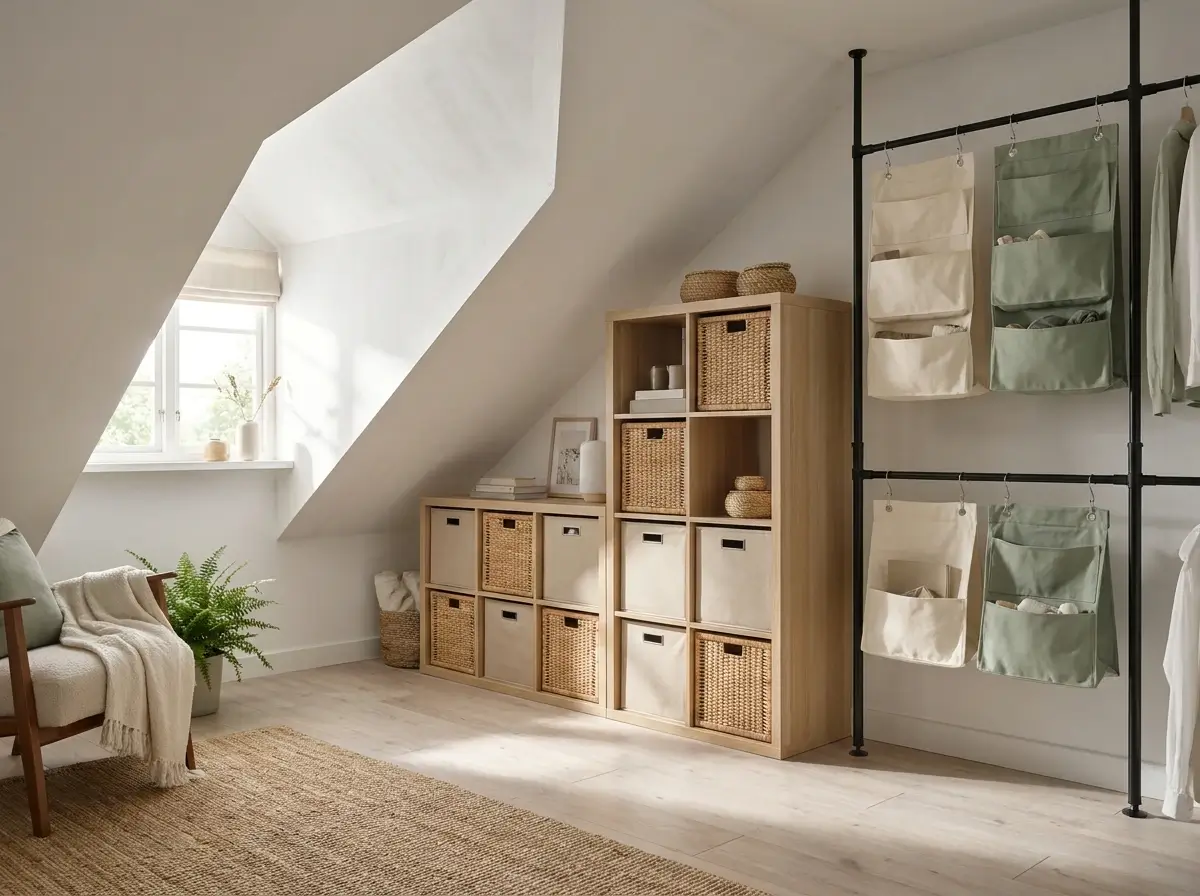
Moving into a home with a tiny attic often feels like winning a space lottery—until you realize you aren’t allowed to drill into those awkward slanted ceilings.
When you rent, traditional built-in cabinets and custom shelving simply aren’t an option. Instead, you are left staring at low knee walls and weird angles, wondering how to unpack.
A common mistake renters make is stacking cardboard boxes directly against the drywall, leading to scuffs, poor ventilation, and wasted space.
Fortunately, you can optimize every inch of those awkward eaves using freestanding and modular solutions.
In this guide, we will walk through the most effective small attic storage ideas that require zero tools, keep your belongings accessible, and most importantly, protect your security deposit.
We’ll explore freestanding racks, slide-out bins, and vacuum-sealing tricks to finally get your seasonal gear organized.
Assessing Your Space for Small Attic Storage Ideas

Before you start shopping for bins and boxes, you need to understand the physical limits of your sloped roof. Moving into a rental with an extra overhead room is exciting, but jumping straight into buying organizers usually leads to frustration.
To make the most of your small attic storage ideas, you must first assess the unique angles and structural quirks of the room. Attics are not perfect squares. They have sharp angles, low clearances, and sometimes questionable flooring.
Taking a few minutes to evaluate the space prevents you from hauling heavy boxes upstairs only to realize they do not fit.
Finding the Lowest Clearance Zones
The most awkward part of any pitched roof is the knee wall. This is the short vertical wall where the slanted ceiling finally meets the floor.
In many rentals, this clearance might only be two or three feet high. Because you cannot stand in these areas, they are often left completely empty. However, these low zones are the perfect real estate for deep, long-term storage.
When brainstorming your small attic storage ideas, designate these knee-wall areas strictly for items you rarely need. Measuring the exact height and depth of these low zones is crucial before you buy any freestanding units or slide-out bins.
You also need to evaluate the floor load capacity, especially in older rental homes. Not every attic floor is built to support massive amounts of weight.
A common mistake is hauling dozens of heavy book boxes into an unreinforced attic. If the floorboards creak excessively or seem thin, stick to storing lightweight items like seasonal clothing and holiday decor.
When in doubt, check with your landlord about what the floor can safely hold.
Mapping Your Walkable Aisle
Once you know where your lowest walls are, it is time to create a simple paper floor plan. The goal here is to establish a clear, unobstructed path right down the middle of the room.
Mapping out your walkable center aisle is critical for safety and accessibility. Because the highest point of the ceiling is usually right in the center, this is the only place you can stand upright. You never want to block this central vein with boxes.
With your center aisle drawn out, divide the remaining floor space into two categories: active storage and passive storage.
Active storage is for things you access weekly or monthly, like craft supplies or off-season jackets. These items should live near the entrance or along the edges of your walkable aisle.
Passive storage is for items accessed yearly, like tax documents or holiday ornaments. These belong tucked deep under the slanted eaves.
By separating these two zones, your small attic storage ideas become much more functional. You will never have to crawl over a pile of winter coats just to find a roll of packing tape.
If you want broader advice on maximizing your loft layout creating dedicated zones is always the best first step. Structuring the floor plan correctly ensures your attic feels like an organized extension of your home, rather than a cluttered dumping ground.
By respecting the unique geometry of the roof, your small attic storage ideas will be both safe and highly effective.
Freestanding Shelving Racks Over Built-Ins
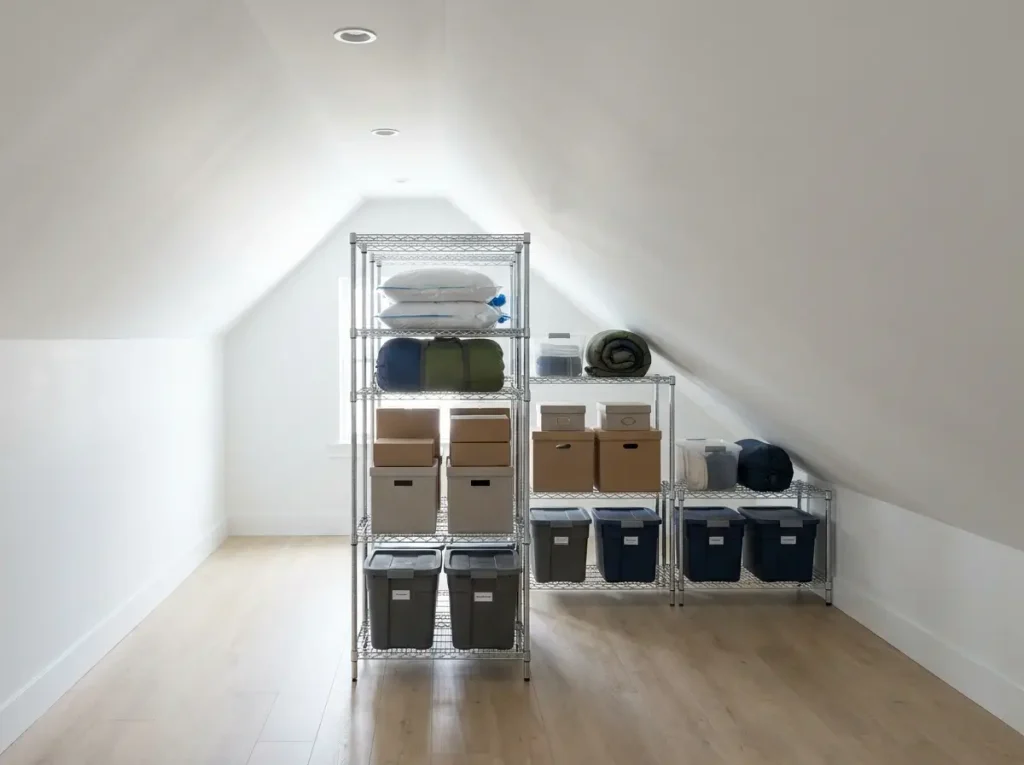
When exploring small attic storage ideas, the most common roadblock for renters is the inability to build custom cabinets. Slanted ceilings practically beg for built-in shelves, but drilling into the drywall usually means forfeiting your security deposit.
Instead of risking damage to your rental, heavy-duty metal wire shelving is your best alternative. Freestanding wire racks are one of the most versatile small attic storage ideas because they require absolutely no wall anchors to remain stable.
They give you the vertical organization of a custom closet while remaining completely removable when your lease ends.
Staggering Rack Heights
A common mistake people make is buying one massive shelving unit and trying to shove it against a slanted wall. Because of the pitched roof, a tall, standard rack will waste precious floor space by sitting too far out toward the center of the room.
To maximize your small attic storage ideas, staggering your shelf heights is a game-changer. You can buy modular wire shelving units that allow you to customize the height of the individual poles.
By placing a tall shelf near the center of the room where the ceiling peaks, and a much shorter unit right next to it where the roof slopes down, you create a customized, stepped layout.
- Match the pitch: Buy units in varying heights, such as 72 inches, 48 inches, and 36 inches.
- Push them back: This step-staggered approach allows you to slide the shorter units much deeper into the eaves.
- Reclaim the aisle: Pushing the shelves back keeps your walkable center aisle completely clear and safe.
This strategy mimics the look and function of permanent built-ins without requiring a single screw or power tool.
Maintaining Attic Airflow
Incorporating heavy-duty wire shelves into your small attic storage ideas also solves a hidden problem: poor ventilation. Older rental homes often have poorly insulated or unventilated upper floors.
When you stack solid plastic bins or large cardboard boxes directly against the drywall, you trap moisture. Over a few hot summers and cold winters, this lack of airflow can cause musty smells or even mildew to form on your belongings.
Wire racks feature an open grid design that allows air to circulate freely around every single box.
- Keep things elevated: The bottom shelf raises your storage bins a few inches off the floor, protecting them from potential roof leaks or dust buildup.
- Let items breathe: The gaps in the metal grid prevent trapped humidity from ruining stored seasonal clothing, holiday decorations, or paper goods.
Securing Units Safely Without Anchors
Because you cannot use standard metal wall anchors, structural stability must be your top priority. An unanchored shelf can become a dangerous tipping hazard if loaded incorrectly.
Always place your absolute heaviest items—like boxes of books, dense winter gear, or metal tools—on the very bottom shelf. Keep the middle shelves for medium-weight bins, and reserve the top racks exclusively for lightweight items like spare pillows, sleeping bags, or empty luggage.
Creating a heavy, low center of gravity ensures your freestanding shelves remain perfectly stable, giving you peace of mind while keeping your rental entirely damage-free.
Maximizing the Eaves with Slide-Out Storage Bins
The eaves are often considered the Bermuda Triangle of the rental home. The space where the slanted ceiling drops down to meet the floor is usually too low for standard boxes and too deep to reach comfortably.
When looking for effective small attic storage ideas, maximizing these awkward deep corners is absolutely essential. Leaving this dead space empty is a waste of your square footage, but shoving random loose items back there guarantees you will never see them again.
The simplest solution is to mimic the functionality of a dresser drawer, right on the floor. By using slide-out bins, you can utilize every single inch of those low-clearance zones without ever having to crawl into a dusty, cramped corner.
Choosing the Right Bin Profile
A common mistake renters make is trying to force tall, square cardboard boxes into the triangular wedge of the eaves. Cardboard not only wastes space due to its bulky shape, but it also acts like a sponge for moisture.
Older rental attics are notorious for seasonal humidity fluctuations, and damp cardboard can quickly ruin your stored belongings. Instead, opt for long, shallow under-bed storage boxes.
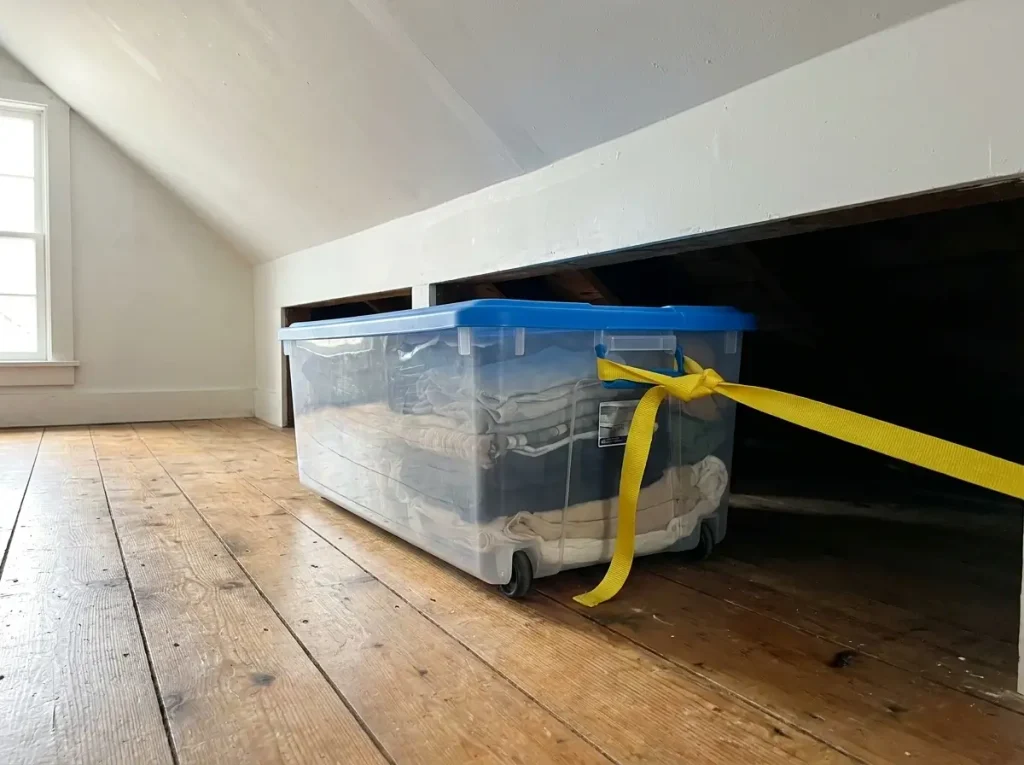
These are among the most practical small attic storage ideas because their low profile perfectly matches the sharp, descending angle of the roof. You will want to specifically choose hard plastic bins equipped with small rolling wheels.
Rolling bins glide easily over rough plywood or uneven attic floorboards, making heavy retrieval completely effortless.
To keep your belongings visually organized, group items by holiday or season using a color-coded bin system. You might use orange bins for autumn decor, red bins for winter holidays, and clear bins with blue lids for summer camping gear.
Implementing these clever small attic storage ideas means you never have to guess what is hidden in the dark back corners of the room.
While these low, rolling bins are excellent for bulky seasonal decor and spare winter blankets, they are not always ideal for daily wardrobe items. If you are trying to organize everyday shoes under the eaves, you will want to explore specialized modular storage solutions for footwear.
Creating Pull-Tab Systems
Even with smooth-rolling bins, reaching into the deepest, darkest part of the eaves can still be a literal pain in the neck. The lowest point of the ceiling often forces you onto your hands and knees just to grab a handle.
To avoid this uncomfortable crawling, you can create a simple pull-tab system for your storage containers. By attaching a thick rope, a nylon strap, or a sturdy ribbon to the front handle of each bin, you instantly upgrade your small attic storage ideas into a highly accessible, pain-free system.
- Measure the depth: Ensure your pull-string is long enough to easily reach the edge of your upright walkable aisle.
- Secure the knot: Tie the string firmly around the molded plastic handle of the rolling bin, double-knotting it for heavier loads.
- Pull and slide: When you need an item, simply stand in the taller center aisle, grab the string, and effortlessly pull the bin out from the shadows.
This low-effort retrieval trick transforms the most frustrating part of your rental attic into highly functional, damage-free storage. You keep your knees clean, your belongings safe from attic moisture, and your limited floor space fully optimized.
Clever Small Attic Storage Ideas Using Vacuum-Sealed Bags
When it comes to outfitting a tiny overhead room, bulky soft goods are often the biggest space hogs. Spare pillows, thick winter duvets, and fluffy sleeping bags can consume a massive amount of premium square footage.
If you just toss these items into standard cardboard boxes, you will run out of floor space almost immediately. This is where compression becomes your best friend.
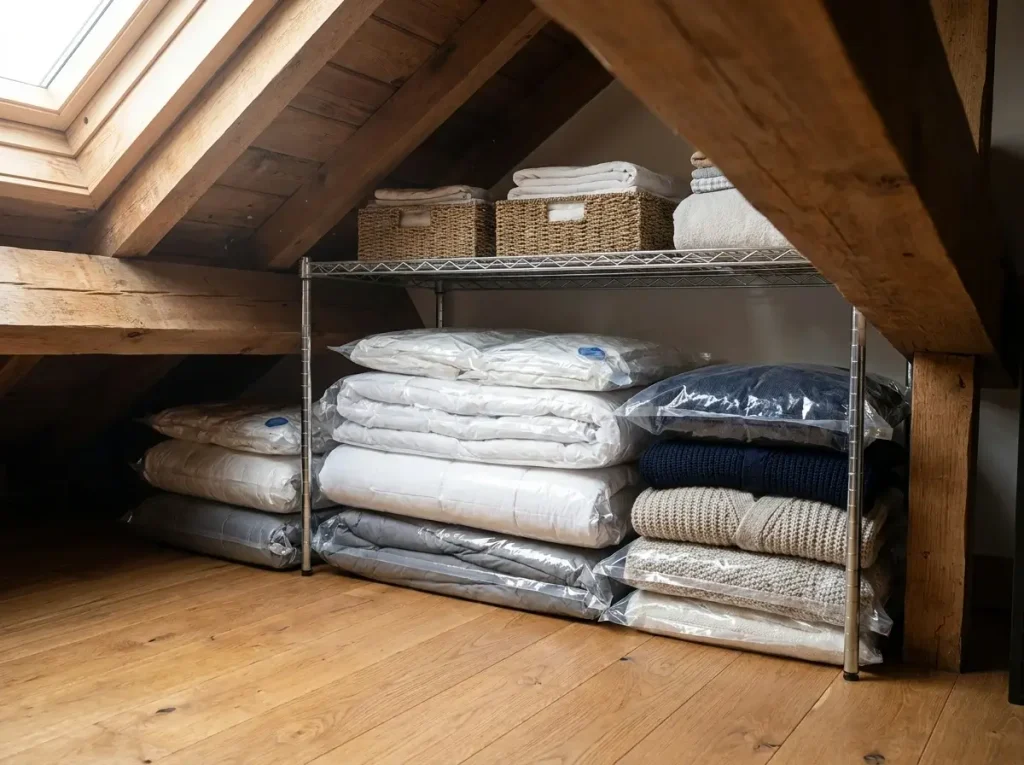
Using heavy-duty vacuum-sealed bags is one of the most transformative small attic storage ideas available to renters. By sucking the excess air out of your bulky linens, you can shrink their physical footprint by up to eighty percent.
Shrinking Down Winter Bulks
The mechanics of vacuum-sealing are incredibly straightforward and require no special tools other than your standard household vacuum cleaner. You simply fold your heavy winter coats or guest bedding, place them inside the plastic sleeve, and attach the vacuum hose to the one-way valve.
In a matter of seconds, a towering stack of down-alternative comforters compresses into a flat, rigid pancake.
Once flattened, these bags become incredibly versatile. Because they are so thin, they can slide smoothly beneath your freestanding metal racks or tuck neatly behind low furniture.
Integrating this method into your small attic storage ideas allows you to completely reclaim your walkable center aisle. Instead of tripping over massive bins of winter gear, your bulky soft goods become entirely unobtrusive.
Defending Against Attic Dust and Pests
Beyond just saving space, vacuum bags serve a critical protective function. Older rental attics are notoriously dusty, and drafty eaves can sometimes invite unwanted humidity or pests.
- Airtight protection: The thick plastic seal keeps out microscopic dust particles that normally settle deep into fabric fibers.
- Moisture barrier: An airtight bag prevents the damp, musty smell that often ruins clothing stored in unfinished or uninsulated spaces.
- Pest deterrence: Moths and silverfish cannot chew through the heavy-duty plastic, keeping your favorite seasonal sweaters completely safe.
Using airtight bags is easily one of the most protective small attic storage ideas for anyone living in an older rental home. It guarantees that when winter rolls back around, your coats and blankets will smell just as fresh as the day you packed them away.
What Not to Vacuum Seal
While compression bags are incredibly useful, a common mistake is assuming that absolutely every soft good should be vacuum-sealed. Certain fabrics and materials actually need to breathe to maintain their structural integrity over long periods.
Before you seal up your entire winter wardrobe, it is important to know what should be left out.
- Delicate heirlooms: Never vacuum-seal vintage wedding dresses or fragile antique quilts, as the intense pressure can permanently crease or snap old threads.
- Genuine leather and suede: These natural materials require continuous air circulation to prevent cracking and drying out over time.
- Certain natural down feathers: While synthetic down bounces right back, the sharp quills of genuine down feathers can break under heavy compression, ruining their fluffiness.
For these sensitive items, swap the plastic vacuum bags for breathable cotton garment bags. You can place these uncompressed bags gently inside a vintage trunk or rest them on the top tier of your wire racks.
By being selective about what you compress, your small attic storage ideas will protect your most delicate belongings just as effectively as they maximize your floor plan.
Repurposing Vintage Trunks as Dual-Purpose Decor
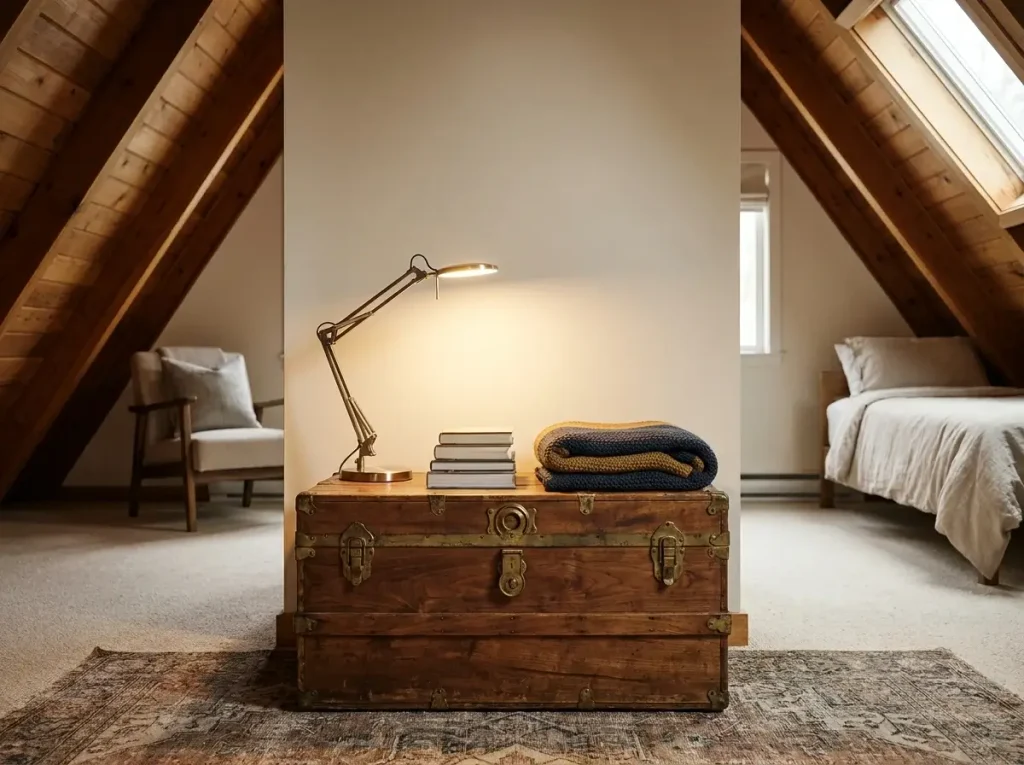
Not every rental attic is used exclusively as a hidden storage closet. In many homes, this extra overhead space doubles as a home office, a creative studio, or a cozy guest bedroom.
When your unfinished room also serves as a living area, standard clear plastic bins can quickly ruin the aesthetic. No one wants to relax in a room that feels like a commercial storage unit.
If you want your room to feel inviting, incorporating multi-functional furniture is one of the most stylish small attic storage ideas you can implement. A heavy, flat-topped vintage trunk offers the perfect blend of high-capacity storage and beautiful room decor.
These heavy-duty pieces allow you to hide your clutter in plain sight, completely transforming the vibe of your pitched roof space.
Concealing Sentimental Items
When organizing a multi-use room, you have to be strategic about what remains visible. While everyday tools or craft supplies might look okay on an open wire rack, highly personal or fragile belongings need better protection and privacy.
Vintage storage trunks are exceptional small attic storage ideas for safeguarding delicate belongings. Their sturdy, hard-shell construction provides excellent dust protection for sentimental item storage, such as old photo albums, childhood keepsakes, or expensive hobby materials.
Unlike cardboard boxes that can sag or clear bins that look visually cluttered, a heavy trunk keeps your memories completely out of sight.
- Reliable security: Many antique or reproduction trunks feature heavy latches that keep the lid tightly shut, offering mild protection against drafty windows.
- Minimalist decluttering: Hiding visually noisy items inside a beautiful piece of furniture instantly calms the room’s overall energy.
- Sturdy protection: A thick wooden or metal exterior prevents accidental crushing if a heavier box shifts or tips over nearby.
By concealing your most treasured items within a gorgeous piece of decor, your small attic storage ideas become a seamless part of your interior design.
Trunk Placement Strategies
Finding the right spot for a large piece of furniture under an A-frame roof requires a bit of spatial planning. Because you cannot easily push tall furniture against a low knee wall, you must rely on the gable walls.
The gable walls are the flat, vertical walls at the far ends of your attic where the ceiling headroom is at its absolute highest. Placing a flat-topped trunk against these walls ensures you have plenty of room to open the heavy lid without banging it into the slanted ceilings.
Once placed, these trunks excel at dual-purpose functionality. A sturdy, flat-topped trunk placed against a gable wall can easily double as a charming seating bench, a low coffee table, or even a TV stand.
If you are utilizing your rental space for sleeping guests, these trunks offer an incredibly smart way to handle bedside storage without traditional nightstands. You can rest a reading lamp and a book on top, while storing spare winter blankets and guest pillows securely inside.
By choosing decor that actively works to hide your clutter, your small attic storage ideas will elevate the room from a dusty drop zone into a truly beautiful, livable space.
Pegboards and Over-the-Door Organizers for Attic Doors
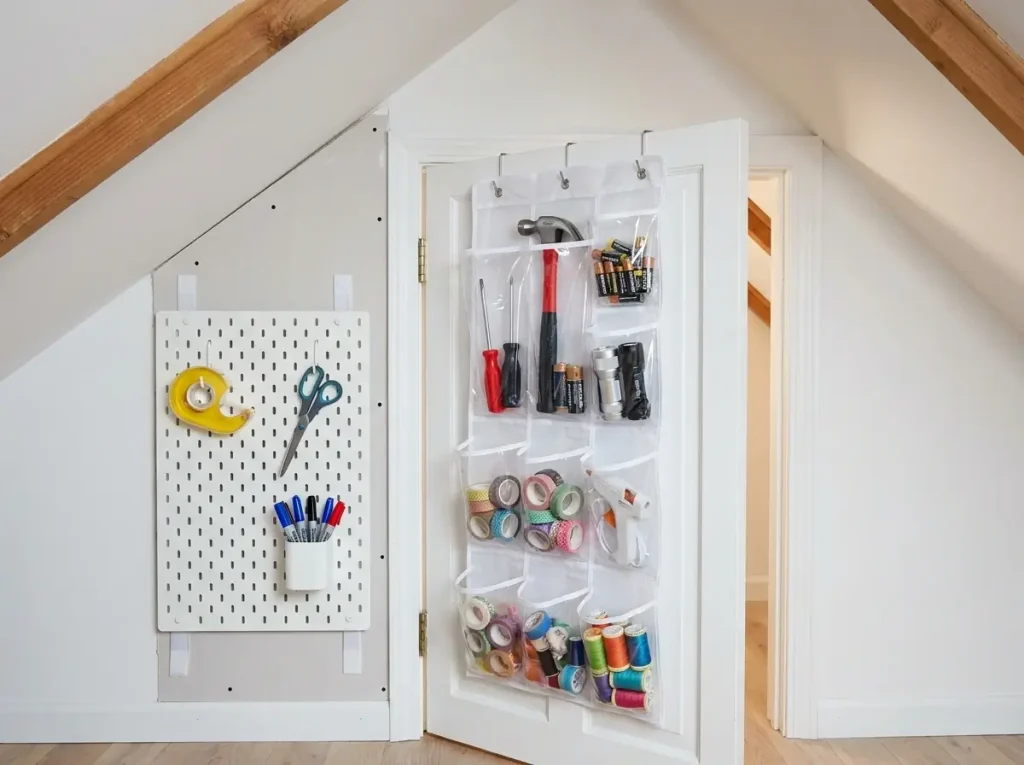
Slanted ceilings rob you of the one thing every organized room needs: vertical wall space. When you cannot hang traditional shelves or heavy cabinets, you have to look for alternative flat surfaces to hold your smaller items.
This is where the entryway itself becomes an invaluable asset. When exploring small attic storage ideas, maximizing the back of the entry door is one of the smartest moves a renter can make. It is a completely blank canvas that requires zero drilling to optimize.
Maximizing the Entry Door
Most rental attics only have one true vertical surface—the door you use to walk inside. Instead of leaving this premium space blank, you can easily transform it into a high-utility drop zone.
Hanging a clear, over-the-door shoe organizer on the inside of the attic door is a brilliant, budget-friendly hack. However, instead of filling it with footwear, use those clear plastic pockets to hold your loose utility items. This is the perfect spot to stash small hand tools, spare batteries, flashlights, and extra craft supplies.
When you are searching for practical small attic storage ideas, keeping these tiny items out of your large floor bins is crucial. It prevents them from getting permanently lost at the bottom of a heavy box.
Because the organizer pockets are entirely clear, you can instantly see exactly what you have without digging around in the dark. It keeps your emergency supplies and utility gear accessible the very second you open the door. Plus, over-the-door hooks simply slide right over the top of the door frame, meaning you will not leave a single mark on the rental property.
Renter-Safe Adhesive Strips
If your attic has a small patch of flat drywall—like the gable walls at either end of the room—you can still create a functional wall station without reaching for a drill. Using renter-friendly adhesive hooks to mount a lightweight plastic pegboard is one of the most effective small attic storage ideas for keeping your workspace tidy.
A common mistake renters make is hauling packing tape, permanent markers, and scissors upstairs every single time they need to label a new box. Inevitably, those supplies get left behind and scattered across the attic floor. By setting up a damage-free pegboard right near the entrance, you create a permanent, dedicated packing and labeling station.
Simply press heavy-duty adhesive strips onto the flat gable wall, let them cure according to the package directions, and hang your lightweight pegboard. This modular setup allows you to store:
- Packing supplies: Keep tape dispensers and scissors ready to go on small hooks.
- Labeling tools: Store permanent markers and sticky labels securely in small hanging cups.
- Lightweight hardware: Hang spare keys, measuring tapes, and small screwdrivers on individual pegs.
This ensures you always have the right tools on hand when you need to pack away seasonal decor or unpack a heavy bin. By utilizing these clever, vertical-focused small attic storage ideas, you keep your valuable floor space completely clear while keeping your most-used tools perfectly organized and within arm’s reach.
Brilliant Small Attic Storage Ideas for Safely Boxing Seasonal Decor
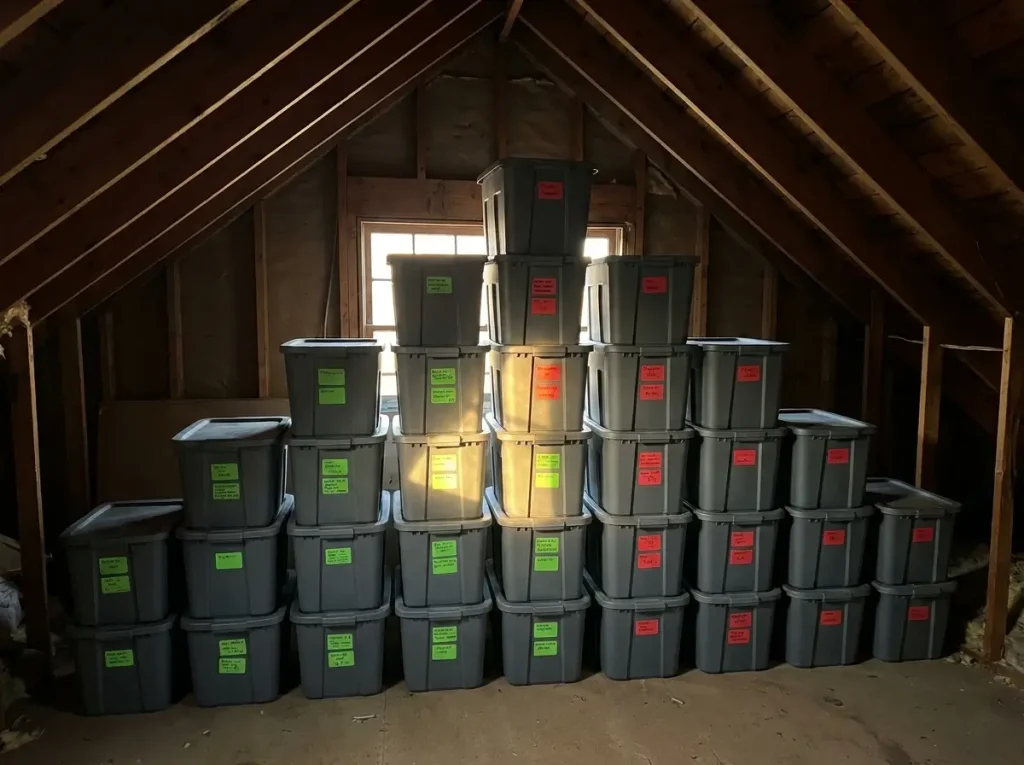
Packing up your holiday decorations and seasonal gear usually means dealing with a massive mountain of boxes. However, tossing random, mismatched cardboard boxes into an unfinished space is a recipe for disaster.
When dealing with slanted ceilings and awkward structural angles, stability is incredibly important. One of the most critical small attic storage ideas you can master is learning how to safely stack your belongings in an un-reinforced space.
If you stack things poorly against a low wall, you risk a dangerous avalanche of boxes the next time you go hunting for a specific holiday prop.
The Pyramid Stacking Technique
To prevent boxes from tipping over, standardizing your container sizes is the very first step. When you use a random assortment of shopping bags, tall wardrobe boxes, and shallow bins, they will never nest together securely.
Standard, uniform bins lock together perfectly, eliminating the wobble that causes stacks to lean over time. When considering your small attic storage ideas, it is also wise to avoid soft-sided bags or flimsy cardboard that can easily crush under pressure. Hard plastic totes with deeply recessed lids are ideal because they are engineered to lock safely into one another.
Once your boxes are uniform, you can implement a foolproof method: the pyramid stacking technique. Because you are dealing with an A-frame or pitched roof, your storage stacks should mirror that exact architectural shape.
Start by creating a wide, stable base against the lowest part of the knee wall. Apply the golden rule of safe packing: heavy on the bottom, light on top.
Your densest boxes—like heavy ceramic holiday villages or dense winter books—must form the solid foundation. As you stack upward, step each subsequent box slightly inward toward the center of the room, matching the ascending angle of the ceiling.
This pyramid shape naturally distributes the weight and perfectly follows the slant of the roof. It maximizes your vertical footprint while keeping everything structurally sound and renter-safe.
Smart Labeling for Low Ceilings
Even with a perfectly stable pyramid stack, retrieving specific items can quickly become frustrating if you cannot find what you need. Because the deep eaves often force you to crouch or crawl, traditional labeling methods simply do not work.
If you only stick a label on one side of a box, there is a very high chance that side will be hidden facing a wall. To truly optimize your small attic storage ideas, you have to change how you visually categorize your containers.
You must apply bright, highly legible labels to both the tops and multiple sides of every single box. This simple trick ensures that no matter how the bin is rotated or where it is positioned in the stack, you can instantly read its contents from a low, crawling position.
Using a thick black marker on a brightly colored adhesive label makes it much easier to spot in dim attic lighting. For example, use neon green labels strictly for summer camping gear and bright red labels for winter holidays.
By combining smart stacking geometry with highly visible, multi-sided labeling, your small attic storage ideas will successfully transform a chaotic pile into a perfectly organized seasonal archive.
Conclusion
Maximizing a cramped, sloped space as a renter doesn’t mean you have to live out of messy piles or risk losing your deposit over drilled holes.
By leaning into clever small attic storage ideas—like freestanding metal racks, low-profile rolling bins, and vacuum-sealed bags—you can organize your seasonal belongings with ease.
Remember to measure your floor space, respect the angles of your eaves, and standardize your storage boxes for safe, efficient stacking.
Ready to get started? Take 10 minutes today to sketch out a rough floor plan of your attic, identifying your lowest knee walls and your main walking path.
If you are looking to further optimize the rest of your open-plan home, check out our broader guide on how to maximize space and storage.