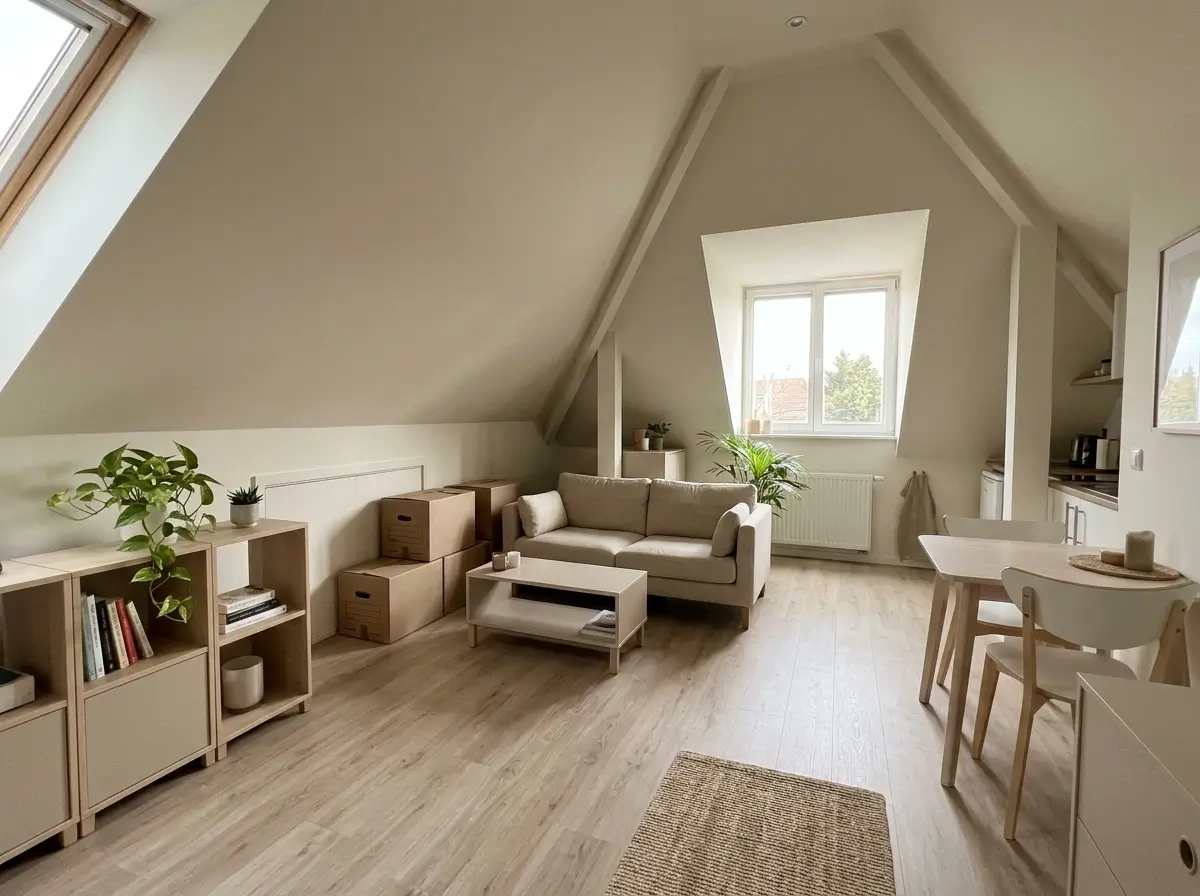
Moving into a top-floor rental often feels like uncovering a hidden gem, but figuring out how to arrange your life under a pitched roof is a unique challenge.
Slanted ceilings, narrow stairwells, and single windows require a strategic approach, especially if you move frequently.
A common mistake is treating an attic layout like a standard box apartment, which quickly leads to cramped corners and blocked walkways.
Instead, successful top-floor living relies on lightweight, adaptable solutions that work with the architecture rather than fighting it.
In this guide, we will explore practical small attic apartment ideas tailored specifically for renters.
From managing the inevitable temperature fluctuations to choosing modular furniture that won’t break your back on moving day, these drill-free strategies will help you build a comfortable, highly functional home that is ready to pack up whenever you are.
Essential Layout Planning for Small Attic Apartment Ideas
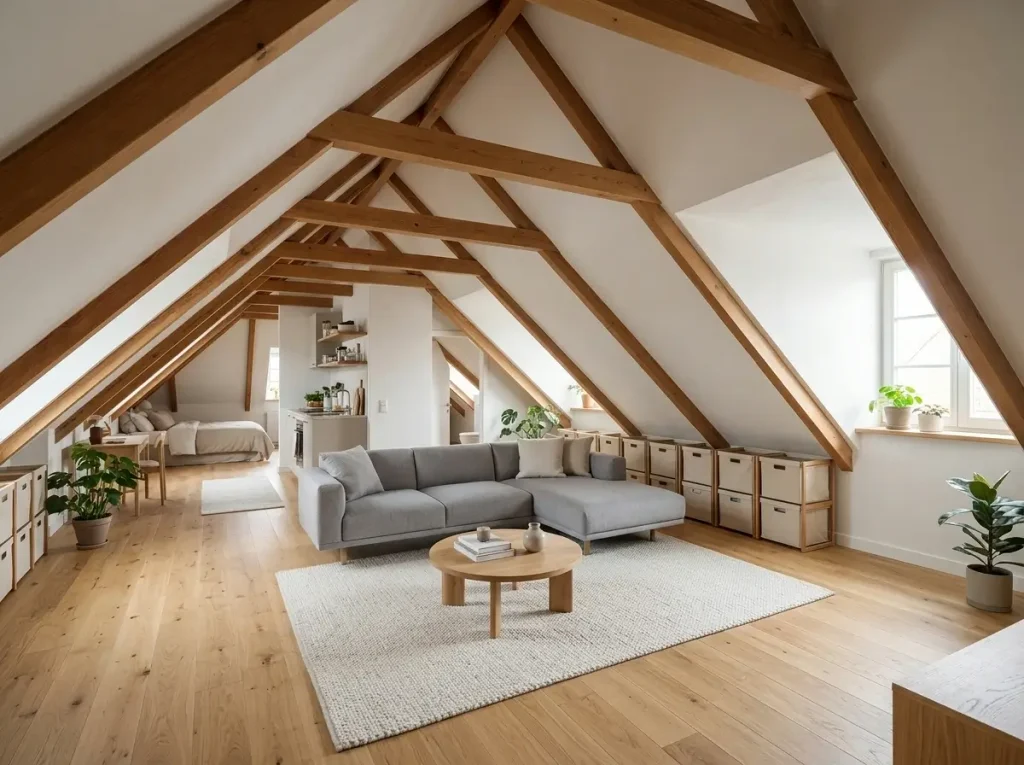
Moving into a top-floor rental presents an exciting design challenge. The unique architecture gives the space character, but those charming angles can quickly become a headache on moving day.
If you treat a pitched-roof layout like a standard rectangular apartment, you will likely end up with blocked walkways and cramped corners.
One of the most foundational small attic apartment ideas is to completely map out your floor plan before you start unboxing heavy furniture.
By understanding how to work with your ceiling heights rather than against them, you can create a rental home that feels expansive and flows naturally.
Mapping Your Ceiling Clearances
The biggest mistake frequent movers make in a top-floor unit is ignoring the ceiling height map. In a standard apartment, every square foot of floor space has the same vertical clearance. In an attic, your vertical space dictates exactly where life can happen.
Before arranging your layout, physically walk the room and mentally divide it into distinct height zones.
- Identify your traffic areas: Your main pathways from the stairwell to the living area and bedroom must be placed in the highest ceiling zones. You should never have to duck to walk across your own apartment.
- Locate your sitting areas: The spaces where you will be seated—like your sofa, desk, or bed—are perfect for the mid-height sloped sections.
- Keep dormer windows clear: It is tempting to push a large piece of furniture into a dormer cutout, but you must keep dormer windows completely unobstructed. This ensures you receive the maximum amount of natural light possible, which is crucial for making a tight space feel open.
When exploring small attic apartment ideas, mapping out these specific zones ensures that you do not accidentally place a high-traffic hallway right under a low beam.
The Float Technique
Once you know your height zones, it is time to place your furniture. The natural instinct is to push sofas and media consoles flush against the walls to open up the center of the room. However, in an attic with low knee walls, this is a recipe for disaster.
Pushing furniture directly against a slanted wall often causes friction damage to the drywall. As a renter trying to protect a security deposit, you want to avoid this completely. Instead, use the float technique.
Floating your furniture simply means pulling your sofa, chairs, and tables away from the low knee walls and centering them closer to the middle of the room.
- Create storage corridors: Pulling the sofa three feet away from a low wall creates a hidden “corridor” behind it. You can use this hidden space to stack moving boxes, tuck away suitcases, or hide seasonal gear out of sight.
- Establish a strong center: The most effective small attic apartment ideas embrace this central gravity. By anchoring your living space in the middle of the room, you naturally utilize the highest ceiling clearance.
If you want to maximize your overall loft space, you have to stop relying on your perimeter walls.
By applying these structural small attic apartment ideas to your layout, your rental will immediately feel intentional, comfortable, and easy to navigate.
Managing Temperature and Airflow in Your Rental
Living on the top floor means you are subjected to a simple law of physics: heat rises. If you are exploring small attic apartment ideas, temperature control is likely at the top of your priority list.
Without a strategic approach, an attic rental can quickly turn into a sauna during the summer months.
Because you are renting, you cannot simply tear into the drywall to install new HVAC ducts or rewire the electrical panel for a heavy-duty mini-split system. Instead, you need drill-free, renter-owned solutions that effectively manage the climate without violating your lease.
Portable Cooling Solutions
When central air conditioning is not an option, a portable air conditioner is your best line of defense. However, not all units are created equal.
A common mistake renters make is buying the cheapest single-hose unit available. Single-hose units push hot air out of the window, but they also create negative pressure inside the apartment.
This negative pressure actually pulls hot, unconditioned air in through the cracks around your doors, floors, and baseboards, forcing the machine to work twice as hard.
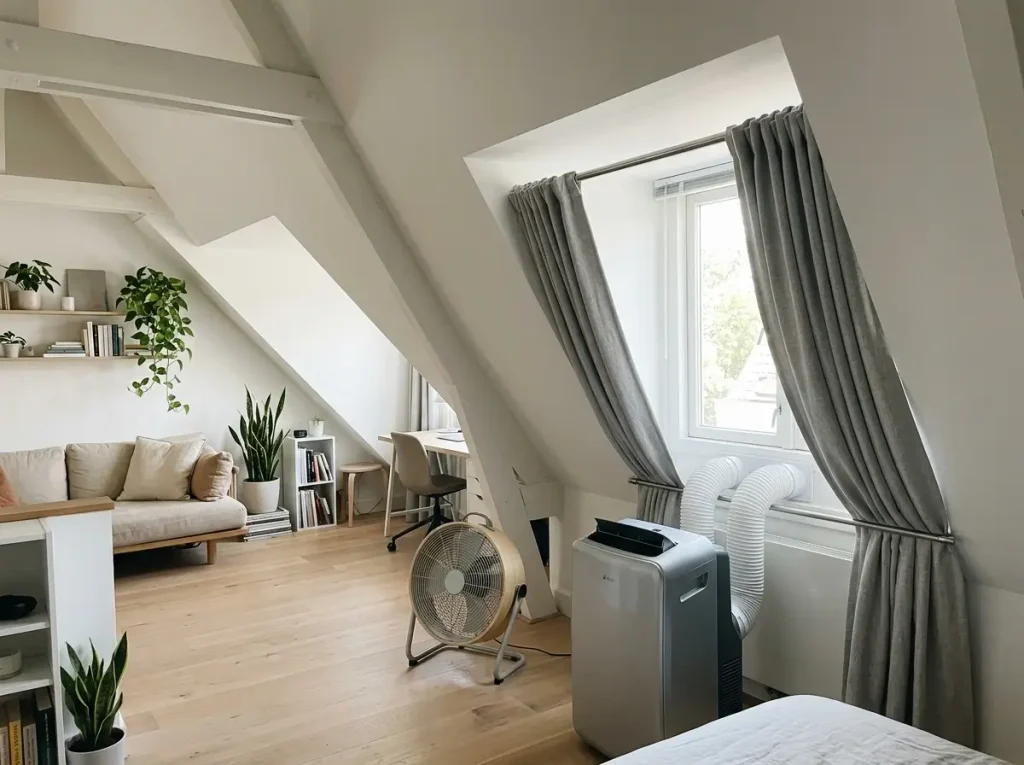
If you are investing in small attic apartment ideas that actually work, opt for a dual-hose portable air conditioner instead.
These units pull air from the outside to cool their internal compressor, making them significantly more efficient for hot top-floor layouts.
Before purchasing, it is wise to consult the energy efficiency guidelines for portable air conditioners to ensure you choose a unit that is properly sized for your square footage and will not cause your summer utility bills to skyrocket.
Even with an AC unit, stagnant hot air is the enemy of a comfortable attic. You must strategically place oscillating floor fans to keep the conditioned air moving.
- Aim fans toward the stairs: Position a high-velocity fan near your AC unit to push the cooled air across the room and encourage hot air to fall down the stairwell.
- Maintain an airflow loop: If your rental has interior doors separating the bedroom, keep them open to maintain a continuous, unbroken path for the air.
- Use the exhaust trick: Place a box fan pointing out of a dormer window during the cooler evening hours to actively pull trapped daytime heat out of the apartment.
Thermal Window Treatments
Dormer windows are charming architectural features that provide essential light, but they also act like magnifying glasses for afternoon sunlight. The most effective small attic apartment ideas involve stopping that heat before it ever has a chance to enter the room.
Since drilling into the unique, angled window frames is usually prohibited by landlords, heavy-duty tension rods are your best friend. Install a thick tension rod across the dormer cutout and hang high-quality, blackout thermal curtains.
These specialized curtains feature an insulated backing that drastically reduces solar heat gain. By pulling the curtains closed during the hottest part of the afternoon, you can drop the ambient temperature of your living space by several degrees.
Implementing these climate-focused small attic apartment ideas ensures that your top-floor retreat remains a comfortable, livable sanctuary year-round, all without risking your security deposit.
Small Attic Apartment Ideas for Modular Living Rooms
Decorating a living room in a top-floor rental requires a major shift in perspective. If you try to drag your standard, bulky furniture up those narrow stairs, you are going to face immediate regret on moving day.
When brainstorming small attic apartment ideas, your primary goal for the living room should be ultimate flexibility. You have to select pieces that work in harmony with the awkward sloped walls rather than fighting against them.
Rethinking Traditional Sofas
Traditional high-back sofas almost always fail in attic layouts. Their tall profiles push them awkwardly into the center of the room, eating up your valuable high-clearance traffic zones.
If you try to push a high-back sofa against a slanted ceiling, you lose several feet of usable floor space behind it. It simply does not work well in a footprint defined by low knee walls.
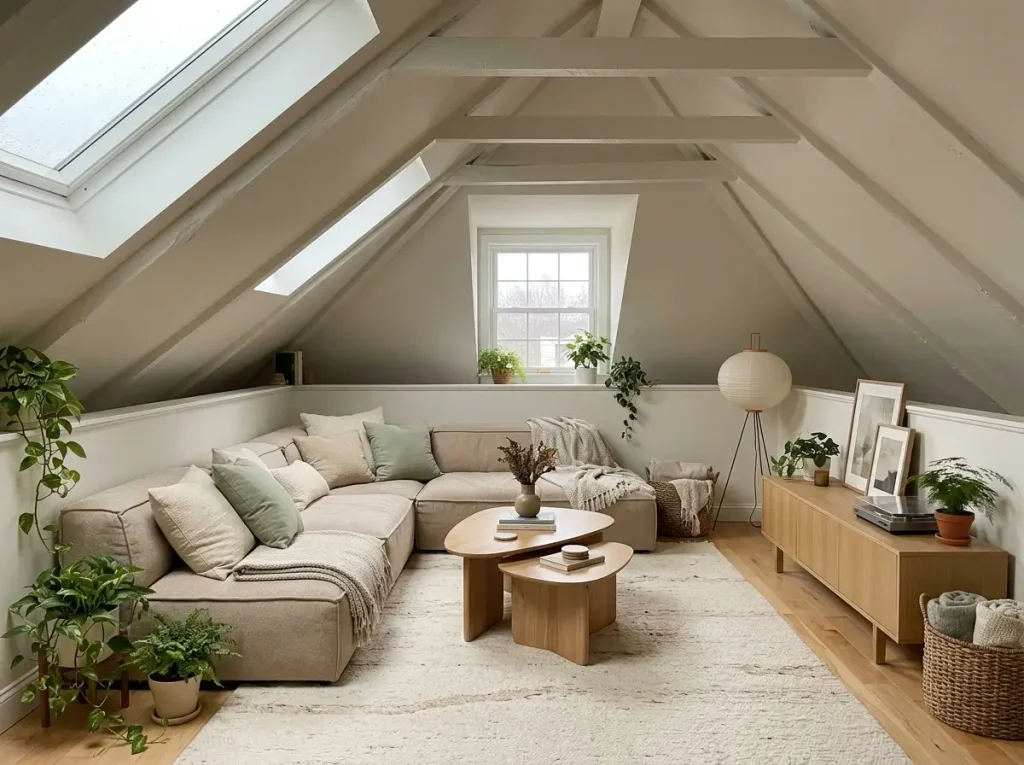
Instead, the most successful small attic apartment ideas revolve around modular, floor-level seating. By lowering the furniture, you instantly change the scale of the entire room.
Modular and Floor-Level Seating
Think about utilizing pit sectionals, thick floor cushions, or low-slung modular pieces. Because these seats sit much closer to the ground, they can be tucked much further back under the slanted eaves without scraping the drywall.
This setup effectively tricks the eye. Lowering your seating arrangement visually expands the distance between the floor and the ceiling, making a cramped room feel significantly taller.
If you need more inspiration on this visual trick, review our dedicated guide on decorating ideas for low ceilings.
Beyond aesthetics, modular pieces are a frequent mover’s dream. Instead of wrestling a massive, rigid three-seater sofa down a steep, narrow staircase when your lease ends, you can simply break the sectional apart into manageable, lightweight squares.
Smart Surfaces and Media Consoles
Once your seating is dialed in, you need to address your flat surfaces. Large, heavy coffee tables are notorious for blocking traffic flow and causing bruised shins in tight spaces.
One of our favorite small attic apartment ideas is to swap a bulky coffee table for a set of nesting tables. Nesting tables condense down to the footprint of a single side table for your daily routine, which keeps your primary walkways clear.
When you host friends, you can instantly pull them apart to hold drinks, snacks, or board games.
For your entertainment setup, utilize the absolute lowest walls in the apartment. Low-profile media consoles are perfect for tucking neatly against knee walls where you do not have the clearance to stand anyway.
This keeps your television grounded and utilizes space that would otherwise be dead.
By keeping your heavy furniture low, lightweight, and adaptable, these small attic apartment ideas guarantee your living room will feel open, airy, and entirely stress-free when it is time to pack up for your next rental.
Brightening Dark Eaves Without Hardwiring
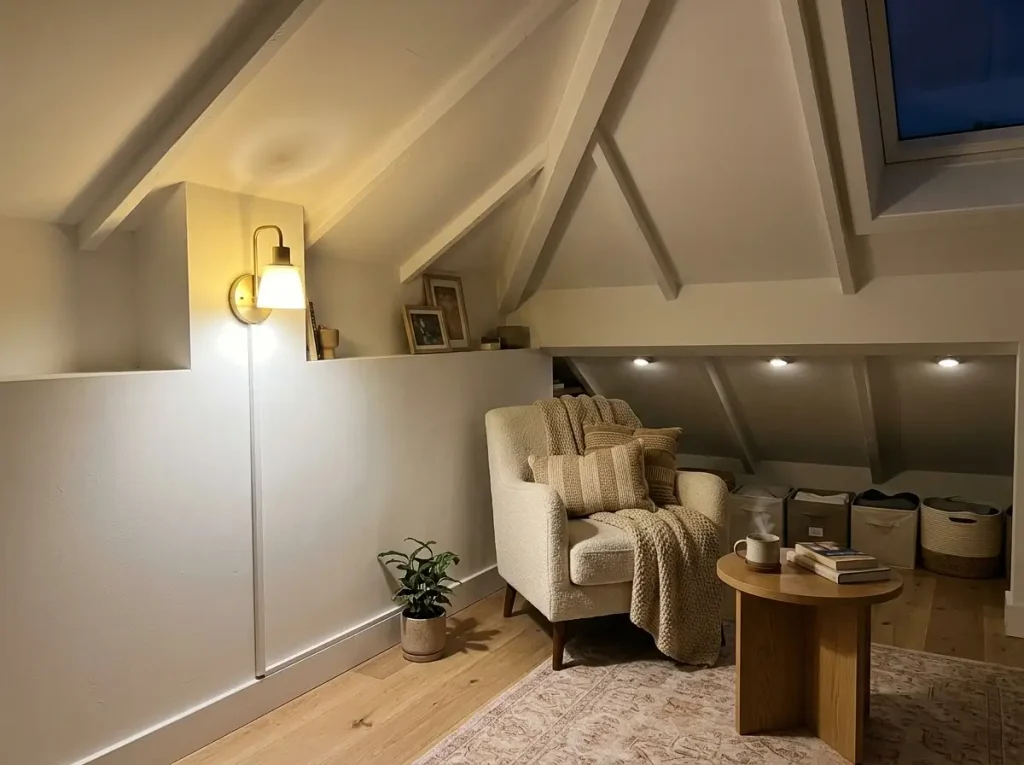
Attic apartments are infamous for their uneven lighting. While a central dormer window provides a beautiful wash of natural daytime light, the deep sloped eaves almost always fall into heavy shadow.
If you are looking for effective small attic apartment ideas, mastering your ambient lighting strategy is absolutely essential. A poorly lit space quickly feels cramped and uninviting, no matter how beautifully you arrange your furniture.
As a renter, you cannot simply call an electrician to hardwire new recessed ceiling lights into the angled roofline.
Furthermore, your landlord will likely not appreciate you drilling large holes into the drywall for junction boxes. Fortunately, there are plenty of drill-free ways to illuminate those dark corners and make your entire floor plan feel expansive.
Drill-Free Sconces and Arc Lamps
The most frustrating part of a slanted ceiling is that it severely limits your ability to use standard table lamps. If you place a tall lamp on a low side table near the knee wall, the lampshade will almost certainly scrape against the angled drywall.
One of the most popular small attic apartment ideas is to rely heavily on plug-in wall sconces. You can mount these stylish fixtures using heavy-duty adhesive strips directly onto the vertical knee walls or the flat gable ends of the room.
This gives you the sophisticated look of hardwired lighting without risking your security deposit or pulling out a drill.
To keep the setup looking clean, use adhesive cord channels painted to match your wall color. This safely hides the dangling wires as they travel down to the baseboard outlets.
Another excellent drill-free solution is the strategic placement of a large arc floor lamp. These tall, sweeping lamps can be placed in the highest-ceiling zones near the center of the room.
Their long, curved arms can then reach over your seating or dining area to cast warm, downward light right where you need it, effectively bypassing the awkward slopes entirely.
Safe LED Options for Deep Storage
Beyond the main living spaces, the deep, dark crevices under the lowest part of the roof are typically used for storage. Searching through tucked-away moving boxes or winter coats in the pitch black is incredibly frustrating.
To solve this problem, brilliant small attic apartment ideas often incorporate battery-operated LED puck lights.
These small, lightweight disks can be stuck directly underneath the slanted ceiling using removable double-sided tape. They instantly brighten your storage corridors with a simple tap, requiring zero cords or electrical outlets.
However, safety must be your absolute top priority when introducing temporary lighting to an attic space.
Heat naturally rises, and top-floor rentals are often constructed with old, dry wood framing just inches behind the drywall. You must take strict safety precautions regarding bulb heat near low, slanted ceilings.
Never use incandescent or halogen bulbs in tight attic spaces, as they generate dangerous amounts of ambient heat that can become trapped in the tight eaves. Always stick exclusively to cool-touch LED bulbs.
Furthermore, as a renter buying temporary plug-in fixtures online, it is vital to only purchase safety certified lighting products that have been rigorously tested to prevent electrical fires. A cheap, unverified plug-in cord tucked behind a sofa in a warm attic is a major hazard.
By prioritizing cool, safe, and drill-free illumination, these small attic apartment ideas will help you completely banish the shadows and create a warm, inviting top-floor home.
Clever Small Attic Apartment Ideas for Frequent Movers
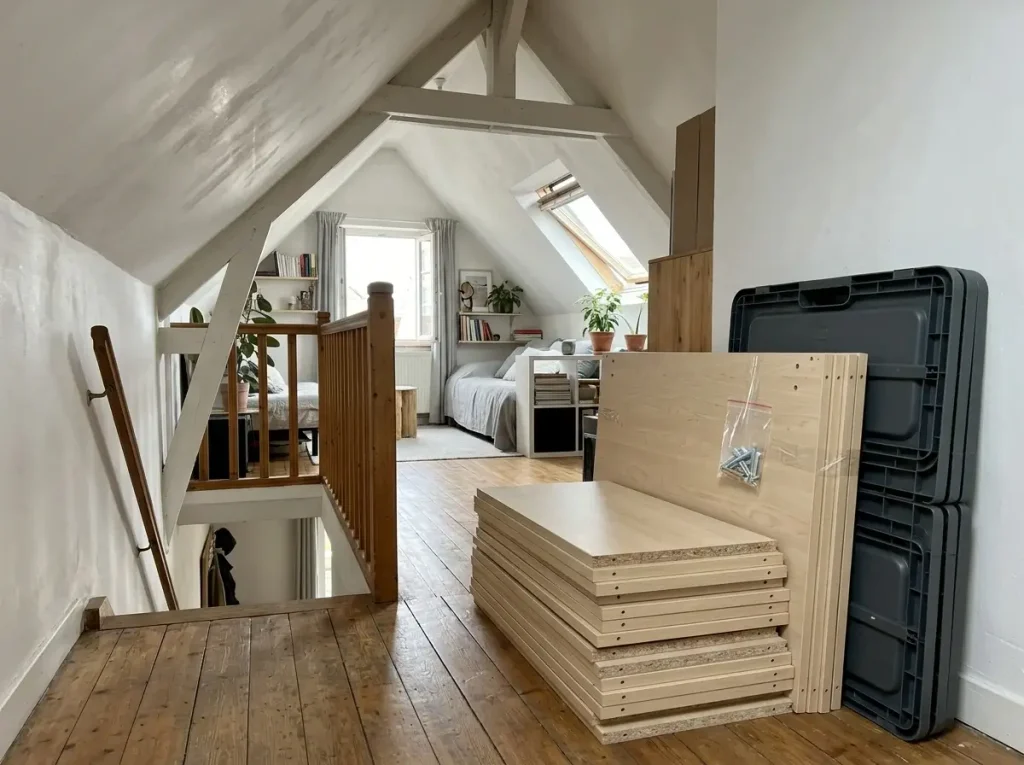
The reality of top-floor living is that getting your belongings into the space is often the hardest part of the entire tenancy. Attic stairwells are notoriously steep, narrow, and often feature tight turns or even spiral designs that make moving traditional furniture nearly impossible.
If you are a renter who relocates every year or two, the most valuable small attic apartment ideas start before you even pack your first box. By planning your furniture purchases around the logistics of moving day, you can save yourself hours of frustration and physical strain.
Stairwell Logistics and Safety
Trying to pivot a fully assembled solid oak dresser up a narrow flight of attic stairs is a classic moving day nightmare. It damages the drywall, ruins the furniture, and puts your physical safety at major risk.
Navigating steep, uneven steps while carrying unbalanced weight is incredibly dangerous.
Before you attempt to carry heavy boxes or awkwardly shaped items up to your top-floor rental, it is highly recommended to review proper safe lifting techniques and weight limits to prevent severe back injuries or dangerous falls.
Instead of fighting the architecture, your goal should be to break everything down into manageable, lightweight components before you ever approach the stairwell.
The Flat-Pack Advantage
When curating your space, prioritize flat-pack furniture that is specifically designed to be assembled and disassembled repeatedly. While solid, single-piece vintage furniture is beautiful, it simply does not belong in an attic rental.
The smartest small attic apartment ideas revolve around pieces that can be broken down completely flat. A bed frame that disassembles into four individual lightweight rails can easily be carried up a narrow spiral staircase by a single person.
To make frequent relocations seamless, use the “tape trick.” The moment you assemble a piece of flat-pack furniture, place the included Allen wrench and any spare hardware into a small zipper bag.
Use heavy-duty packing tape to secure this bag directly to the underside of the furniture. When it is time to move out, your tools are instantly accessible, preventing the frantic search for a specific hex key.
Rethinking Your Storage Containers
Another crucial logistics tip involves your moving boxes. Rigid plastic storage totes are incredibly popular, but they are a terrible choice for top-floor renters. They are bulky to carry up tight stairs and, worse, they take up massive amounts of premium floor space when they are empty.
Instead, the most efficient small attic apartment ideas utilize heavy-duty, collapsible storage bins or reinforced vacuum-sealed bags.
- Collapsible bins: When empty, these fabric or soft-sided bins fold completely flat and can be slid under a low-profile sofa or tucked behind a knee wall.
- Soft-sided moving bags: Large, heavy-duty zipper bags with backpack straps allow you to carry clothes and linens up steep stairs while keeping your hands free to grip the handrail.
By prioritizing lightweight, collapsible solutions, these practical small attic apartment ideas guarantee that moving in—and eventually moving out—is a smooth, stress-free experience.
Navigating Egress and Safety in an Attic Rental
When it comes to top-floor living, aesthetic design is only half of the equation. If you are researching small attic apartment ideas, it is absolutely critical to prioritize your physical safety.
Living directly under the roof presents unique challenges during an emergency, especially when your standard way out is a single, narrow stairwell. Because heat and smoke naturally rise, an attic unit is particularly vulnerable to incidents that start on the lower floors.
A common mistake renters make is assuming their landlord has perfectly optimized the space for safety. As a tenant, taking your emergency preparedness into your own hands is one of the most vital small attic apartment ideas you can implement.
Secondary Exits and Fire Escapes
Every living space requires a safe, accessible way to exit during an emergency. In many older home conversions, the attic apartment may only have one main door leading down to the rest of the house.
Understanding secondary egress requirements—meaning a second, alternative way out—is essential for your survival. If a fire blocks your main stairwell, you must have a backup plan ready to deploy immediately.
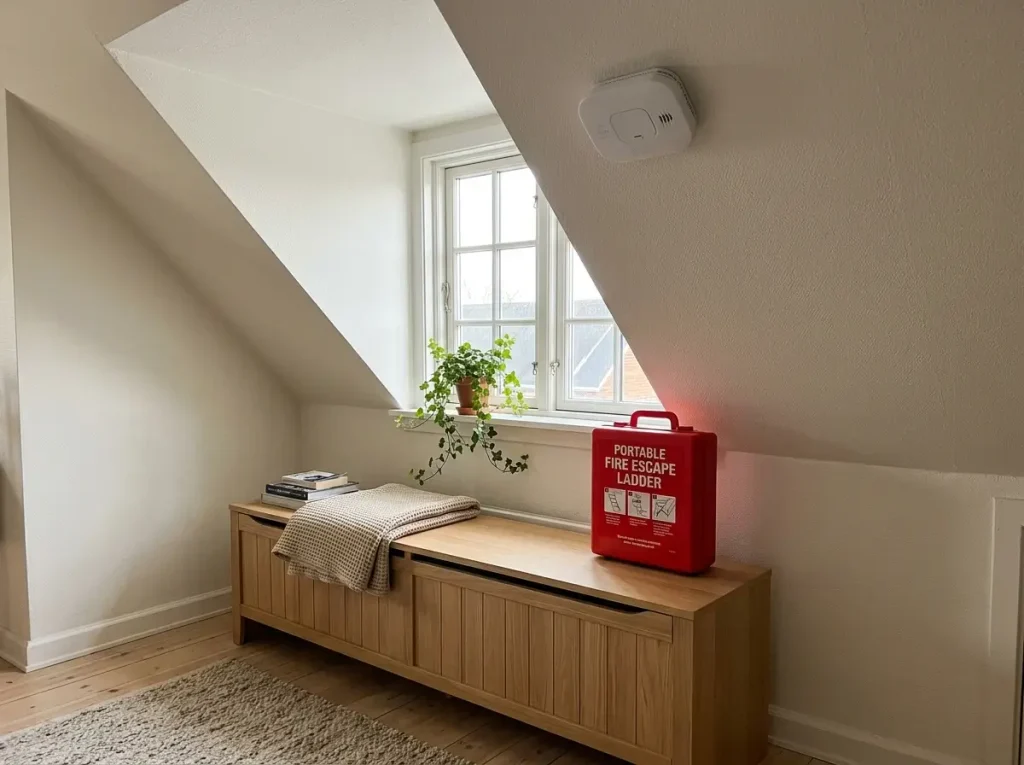
For top-floor renters, this backup plan usually involves utilizing a dormer window. However, jumping from a third-story window is incredibly dangerous and should never be Plan A. Investing in a heavy-duty, portable fire escape ladder is a non-negotiable addition to your home.
These collapsible metal ladders store easily beneath a bed or inside a storage ottoman. In the event of an emergency, they hook securely over the window sill, providing a safe climb down to the exterior ground.
When evaluating your space, we highly recommend reviewing official guidelines on fire escape planning and secondary egress to ensure your backup route is truly viable.
Air Quality and Clear Pathways
Because an attic sits at the very top of a building’s envelope, it catches all the rising heat, smoke, and airborne gases from the structure below. Relying solely on the smoke detectors installed out in the main downstairs hallway is simply not enough.
The smartest small attic apartment ideas include building a dedicated safety routine tailored to the unique architecture of your top-floor space.
- Install standalone detectors: Mount battery-operated smoke and carbon monoxide detectors high up on the angled ceiling, right where dangerous gases will accumulate first.
- Establish a strict “no-drop” zone: Never use the top of your stairwell as a temporary spot for shoes, incoming mail, or moving boxes.
- Test your alarms monthly: Ensure you always have an early warning system for any trouble brewing downstairs before it reaches your living area.
Keeping your primary egress pathway 100% clear of clutter at all times is the golden rule of top-floor living. In a dark, stressful emergency, tripping over a stray pair of boots at the top of steep stairs can be disastrous.
By combining smart, minimal organization with rigorous safety standards, these life-saving small attic apartment ideas ensure your cozy retreat is as secure as it is stylish.
Conclusion
Living under the eaves doesn’t mean you have to sacrifice comfort or risk your security deposit. By embracing these small attic apartment ideas, you can turn awkward slants and dark corners into a cozy, highly functional home.
Remember that the key to top-floor renting is flexibility. Focus on modular furniture, portable climate control, and lightweight setups that make navigating narrow stairwells a breeze when moving day arrives.
If you are looking for even more ways to optimize your floor plan, review our comprehensive guide on how to maximize space and storage in tricky layouts. Take a look at your current layout today and identify one dark eave or blocked pathway you can easily adjust this weekend.