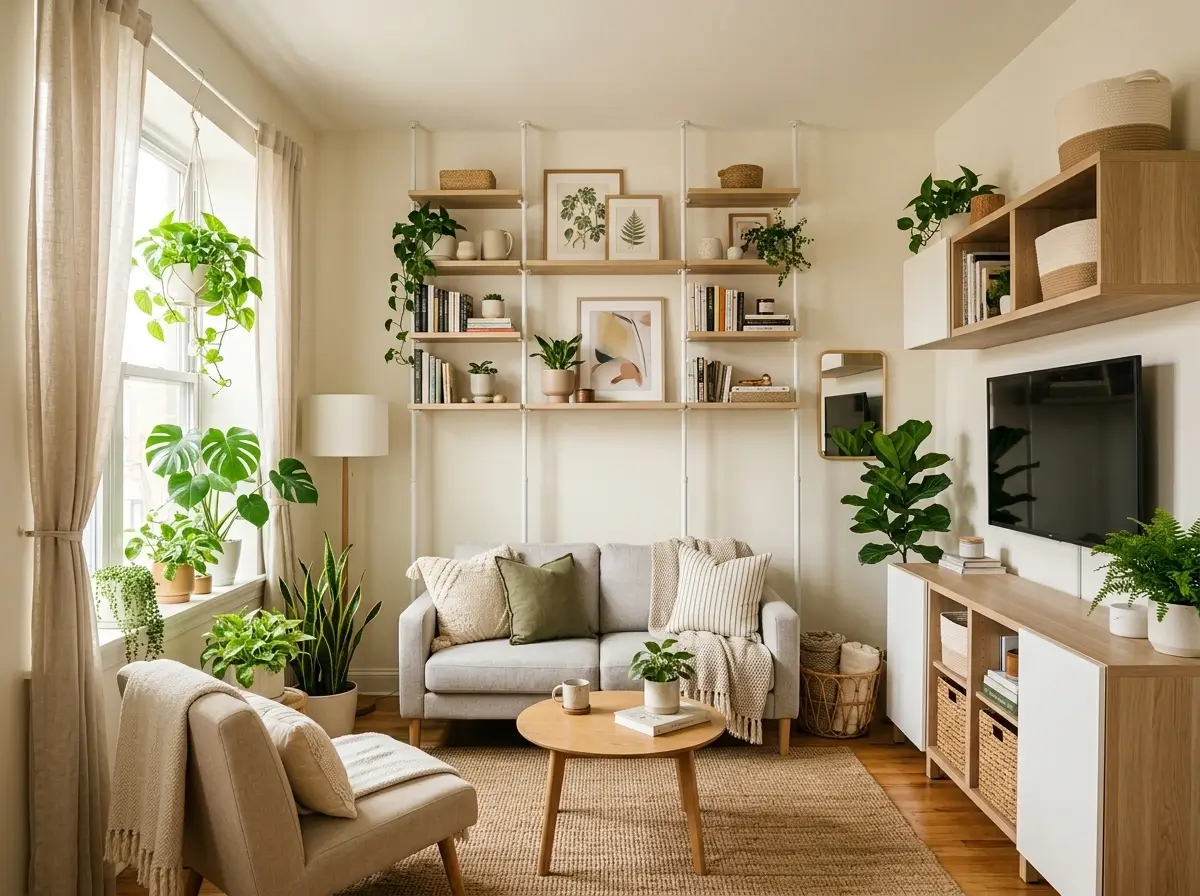
Living in a rental often means battling tiny closets, strict lease agreements, and zero built-in organization.
But a lack of square footage shouldn’t mean living in clutter.
Whether you are dealing with a 400-square-foot studio or planning your next big move across the country, finding the best apartment storage solutions is your ticket to a stress-free home.
In this master guide, we will walk you through the smartest drill-free hacks, modular furniture choices, and room-by-room strategies to maximize your space—without risking your security deposit or your sanity.
How can I effectively maximize vertical space in a room with standard ceiling heights?
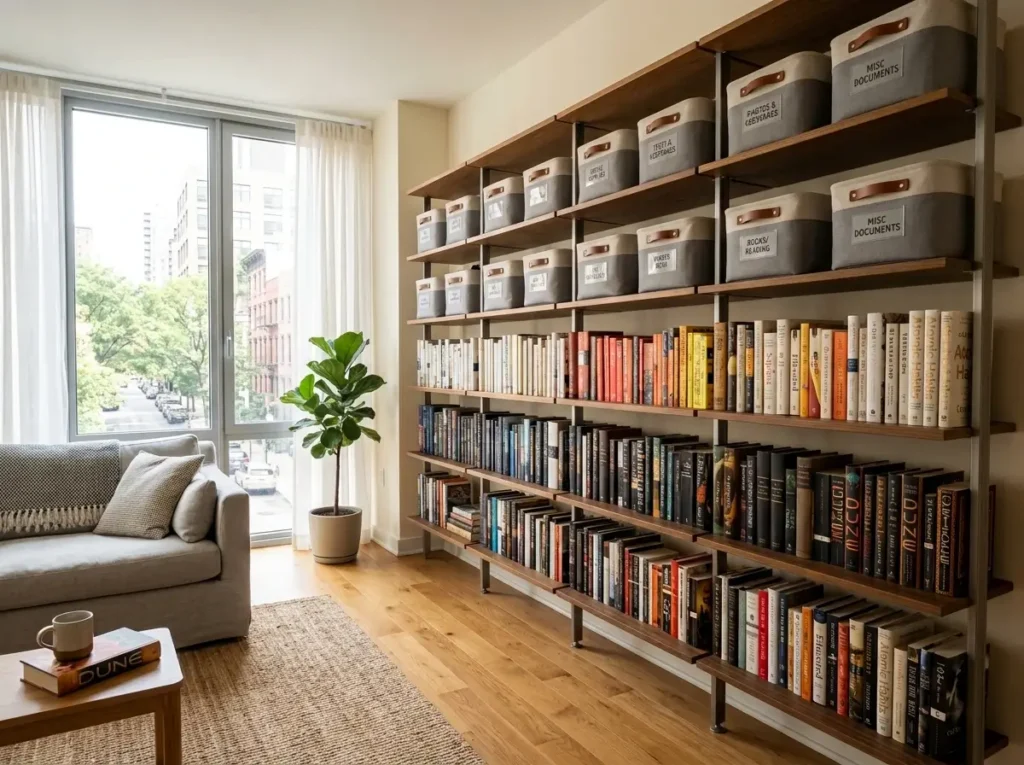
Maximizing vertical space in a room with standard ceiling heights requires utilizing the often-ignored top 24 inches of your walls.
By stacking modular bins, using tall bookcases, and adding over-the-door hanging racks, you can significantly increase capacity without eating into your limited square footage, keeping your walkways completely clutter-free.
Most standard apartments feature ceilings between 8 and 9 feet high. However, the average renter stops storing items at the 6-foot mark, which is standard eye level.
This leaves a massive 24 to 36 inches of completely unused vertical real estate. If you calculate the perimeter of a standard 12×12 bedroom, that empty upper boundary equals roughly 100 cubic feet of wasted potential.
Reclaiming this zone is the foundation for implementing the best apartment storage solutions without crowding your active living areas.
When you look upward, you unlock a completely new layer of square footage. But elevating your belongings safely requires strict adherence to safety principles. You cannot simply stack heavy boxes to the ceiling and hope they stay put.
Physics dictates that heavy items must remain anchored near the floor, while lightweight, seasonal items belong at the top.
Here is the exact numbered sequence to effectively and safely utilize that upper airspace:
- Assess Your Floor-to-Ceiling Ratio: Measure the exact distance from your floor to the ceiling. If you have 8-foot ceilings, you need shelving units that reach at least 84 inches high to minimize dead space. Avoid standard 72-inch bookcases, which leave an awkward, unusable gap at the top.
- Implement the “Weight Pyramid” Strategy: Always place your densest, heaviest items (like dense text books, small kitchen appliances, or toolboxes) in the bottom 30 inches of your storage unit. Never place items weighing more than 10 pounds above your shoulder height. If a unit becomes top-heavy, it poses a severe tipping hazard, especially in active households.
- Deploy Over-the-Door Organizers: Standard interior doors provide 80 inches of vertical space. Hanging a heavy-duty pocket organizer on the back of a bathroom, bedroom, or closet door transforms flat wood into high-capacity storage. This remains one of the absolute best apartment storage solutions because it requires zero drilling and leverages space that is otherwise completely ignored.
- Utilize Modular Stacking Bins: For the space directly above your kitchen cabinets or wardrobe, use uniformly sized modular bins. Ensure these bins have interlocking tracking lids to prevent sliding when stacked. Label them clearly, as you will likely need a step stool to reach them, and guessing what is inside wastes time and energy.
- Anchor Freestanding Units: Even if you do not drill into walls for floating shelves, you must secure tall freestanding bookcases. Many modern units come with damage-free anti-tip tethers that utilize heavy-duty adhesive or tension to secure the top of the shelf safely to the wall.
Furthermore, shifting your storage focus vertically changes the entire architectural feel of the room. When you use floor-to-ceiling shelving, you naturally draw the eye upward, which visually stretches the height of the space.
This optical illusion makes the room feel much grander. When selecting items to store in these upper zones, prioritize out-of-season clothing, lightweight holiday decorations, and extra bedding.
Do not store everyday essentials out of reach, as the daily friction of retrieving them will cause your organizational system to quickly fail.
What are the best drill-free storage solutions that won’t violate a landlord’s lease agreement?
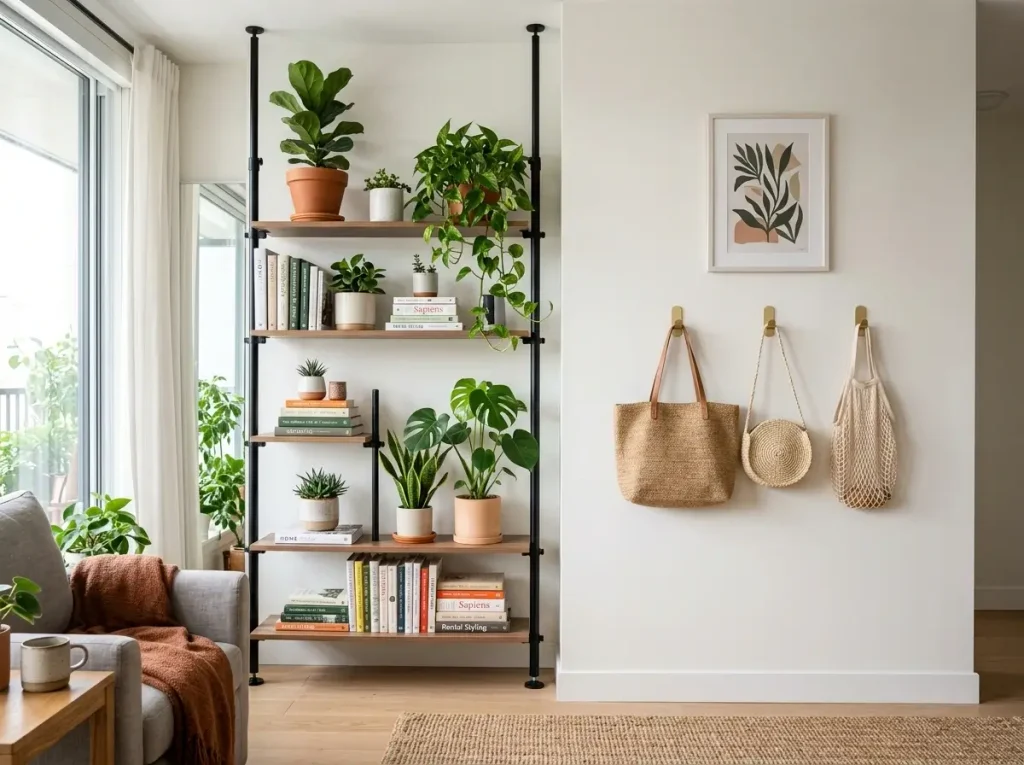
The best drill-free storage solutions that protect your lease agreement include heavy-duty tension rods, freestanding leaning shelves, and high-capacity adhesive hooks.
These temporary options provide the structural support of built-in shelving while ensuring your drywall remains completely undamaged when it is time to move, securing your deposit.
Navigating strict lease agreements is one of the most frustrating aspects of renting. Most landlords explicitly forbid drilling into studs or using large drywall anchors, meaning traditional floating shelves are off-limits.
To bypass this, you need to employ the best apartment storage solutions that rely on tension, gravity, and advanced adhesives rather than permanent hardware.
Heavy-duty tension systems are a game-changer for renters. Unlike the flimsy spring-loaded rods used for lightweight shower curtains, commercial-grade tension poles can span from floor to ceiling to support substantial weight.
These vertical systems press firmly against the structural framing of the room, allowing you to mount wire baskets or solid shelves between them.
A high-quality floor-to-ceiling tension shelf can safely hold between 15 to 30 pounds per tier, making them ideal for books, kitchenware, or decorative plants.
When vertical tension is not viable, you must turn to heavy-duty adhesives. However, there is a critical distinction to make: the adhesive’s maximum weight rating versus the drywall paint’s tensile strength.
While an adhesive hook might be rated for 15 pounds, standard flat builder-grade paint often peels away from the paper backing at just 5 to 7 pounds of shear force.
To utilize the best apartment storage solutions without forfeiting your deposit, you must respect the limitations of your wall’s surface.
Always clean the wall with rubbing alcohol before application, and never hang fragile or excessively heavy items on painted surfaces using adhesives alone.
For items that exceed these limits, freestanding leaning ladders and leaning bookshelves are the safest alternative.
Because they use gravity to wedge against the wall and the floor simultaneously, they offer the aesthetic of a mounted shelf with zero permanent damage.
To help you select the right damage-free apartment storage strategies, refer to the structural comparison table below:
| Drill-Free Method | Max Safe Weight (Painted Drywall) | Best Use Case | Risk to Property |
| Vertical Tension Poles | 20-30 lbs per tier | Pantries, heavy books, bathroom shelving | Low (may leave minor ceiling scuffs) |
| Horizontal Tension Rods | 10-20 lbs total | Closets, window treatments, light garments | Low (can dent weak drywall if over-tightened) |
| Heavy-Duty Adhesive Hooks | 5-7 lbs per hook | Coats, towels, keys, lightweight art | High (risk of peeling flat paint upon removal) |
| Leaning Freestanding Shelves | 30-50 lbs per tier | Display items, heavy electronics, bulky storage | Zero (no wall attachment required) |
Always double-check your lease agreement before testing new wall-attachment products.
If you are ever in doubt about an adhesive’s strength, test it in an inconspicuous area, such as the inside of a closet, before committing your most valuable items to it.
By understanding the physics of these temporary mounts, you can build a customized, highly functional space while remaining completely compliant with your rental terms.
What storage furniture is the absolute easiest to disassemble and reassemble when moving frequently?
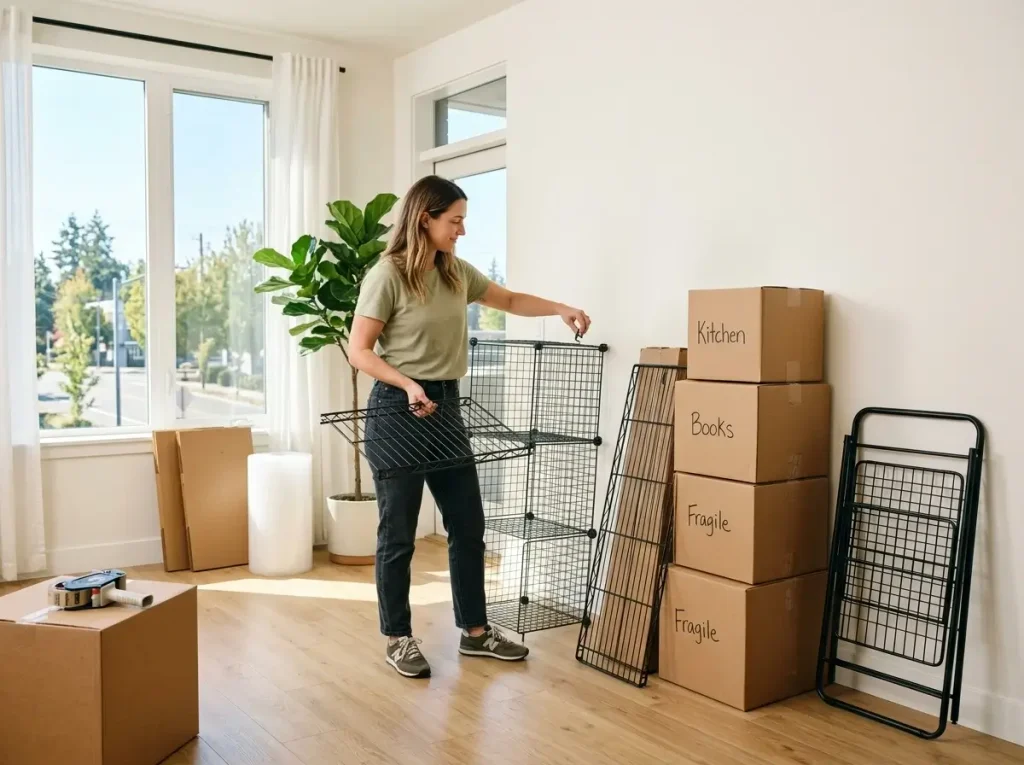
The absolute easiest storage furniture to disassemble and reassemble when moving frequently includes heavy-duty wire grid shelving, folding metal baker’s racks, and interlocking plastic modular cube systems.
Unlike traditional particleboard, these lightweight options can be repeatedly transported across the country without stripping delicate hardware or losing vital structural integrity over time.
For renters who relocate often—whether for military deployments, corporate relocations, or seeking better leases—moving bulky furniture is a massive logistical and financial drain.
The most common mistake renters make is investing heavily in cheap, flat-pack particleboard furniture. While affordable upfront, particleboard relies on cam locks and wooden dowels inserted into compressed wood dust.
Every time you unscrew a cam lock, the surrounding composite wood strips and weakens. By the second or third move, the structural joints are permanently compromised, rendering the piece dangerously wobbly or completely useless.
To build a truly mobile home setup, you must shift your focus toward materials designed for dynamic modularity.
Securing the best apartment storage solutions means prioritizing frameworks that utilize friction, heavy-duty hinges, and interlocking tension rather than threaded metal screws in weak wood.
Here are the most resilient categories of portable storage furniture and exactly why they survive frequent relocations:
- NSF-Certified Wire Shelving: These industrial-style racks use tapered plastic split sleeves that wedge into grooved metal poles. There are zero screws involved. As you place weight on the shelf, the friction connection actually tightens. They take fewer than 10 minutes to tear down with a rubber mallet, and the flat metal grates stack perfectly flush inside a moving truck.
- Folding Metal Baker’s Racks: Unlike standard wooden bookshelves, folding racks operate on heavy-duty, pre-riveted hinges. You simply remove the flat shelves, fold the side panels inward, and the entire unit collapses to a slim 3-inch profile. This is ideal for sliding between mattresses or into the narrow gaps of a moving van.
- Interlocking Modular Plastic Cubes: These systems use slotted ABS plastic connectors to hold rigid frosted-plastic or wire panels together. Not only do they break down into a highly portable, lightweight stack, but the assembled cubes themselves can often be configured to match standard moving box dimensions. This allows you to pack your belongings directly into them and tape them shut, skipping cardboard boxes entirely.
When you invest in portable storage furniture for frequent movers, you drastically reduce the physical friction of relocation.
You no longer have to hire professional movers just to carry a massive, 150-pound MDF wardrobe down a narrow three-story walk-up.
Furthermore, the best apartment storage solutions will constantly adapt to your new floor plan. A massive wooden bookshelf that fit perfectly along the expansive wall of your current living room might completely block a critical window or hallway in your next rental.
Modular systems, however, are shapeshifters. A tall 4×4 cube organizer in one apartment can easily be reassembled as a long, low-profile 2×8 entryway bench in the next, ensuring your initial financial investment never goes to waste regardless of where your lease takes you.
How do I fit bulky storage pieces into a tightly constrained 400-square-foot floor plan?
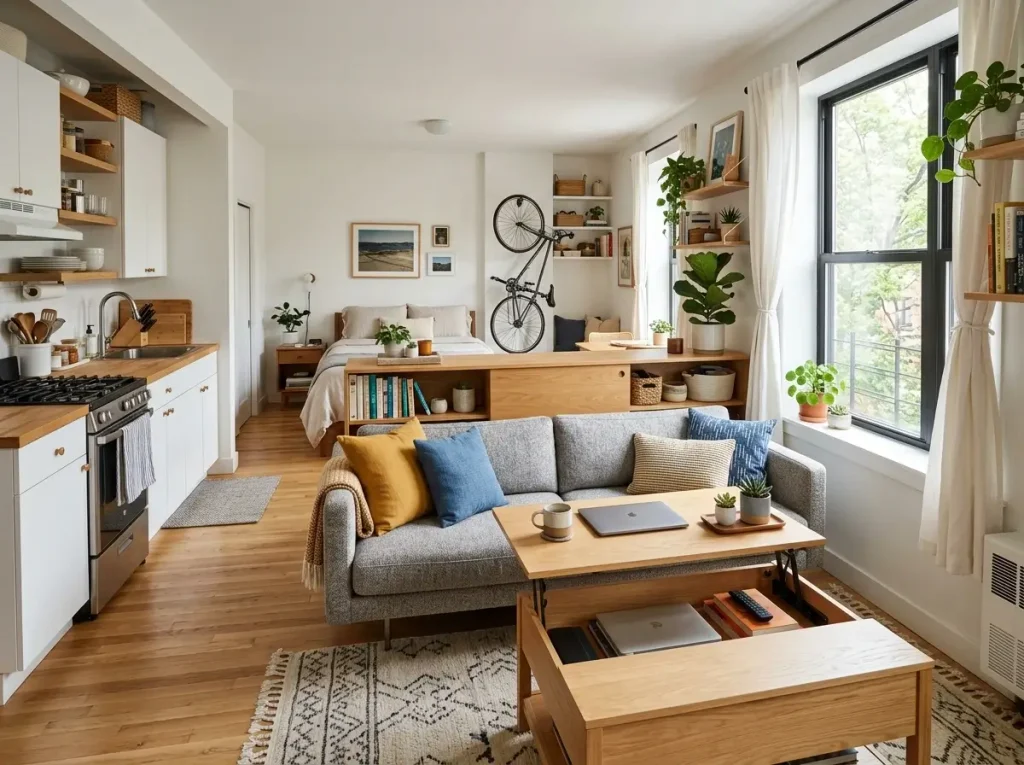
Fitting bulky storage pieces into a tightly constrained 400-square-foot floor plan requires strategically mapping the architectural dead zones of your apartment.
By placing narrow storage towers in awkward corners, using your sofa to conceal low-profile credenzas, and prioritizing multi-functional furniture, you can maximize capacity without suffocating your active living area.
When you are dealing with a micro-apartment, traditional furniture layouts simply will not work. A standard 36-inch deep dresser can instantly consume your entire walking path, making the room feel like a claustrophobic maze.
To successfully integrate high-capacity furniture into these footprints, you have to think like an architect rather than an interior decorator.
It is all about exploiting the negative space. Implementing the best apartment storage solutions requires you to hunt for the overlooked gaps that standard builders leave behind.
The key to micro-space optimization is realizing that “bulky” does not have to mean visually heavy. By hiding large storage footprints in plain sight and utilizing precise measurements, you can store an impressive amount of gear.
Here is the exact numbered sequence of small space planning principles for mapping and filling these tight constraints:
- Measure Your Architectural Dead Zones: Before buying anything, grab a tape measure and hunt for micro-gaps. The most common dead zones are the 6-to-8 inch gap between your refrigerator and the wall, the 9-inch gap beside your bathroom vanity, and the empty space directly behind an open interior door. These are prime locations for ultra-narrow, slide-out rolling pantries or vertical tiered shelves. Never leave a gap larger than 5 inches empty.
- Deploy Sofa Camouflage Storage: In a 400-square-foot studio, your sofa likely floats in the middle of the room to create a designated living zone. You can hide incredibly bulky pieces directly behind it. Place a low-profile, solid-door credenza or a heavy-duty trunk flush against the back of the sofa. This acts as a visual console table for your lamps while hiding bulky winter gear, electronics, or toolboxes completely out of standard sightlines.
- Capitalize on Under-Window Clearances: Standard apartment windows usually have 24 to 36 inches of vertical clearance beneath the sill. Tall bookcases cannot go here, but this is the perfect spot for deep, low-to-the-ground storage benches. You get a massive internal storage cavity for extra bedding, plus an additional window seating area that does not block critical natural light from entering the room.
- Swap Single-Use Items for Dual-Purpose Heavyweights: In a tightly constrained floor plan, you simply cannot afford furniture that only does one job. Never buy a standard open-leg coffee table with empty space underneath. Instead, invest in a solid lift-top coffee table or a large, hollow ottoman that serves as a dining table, a footrest, and a massive storage bin for everyday clutter all at once.
Ultimately, identifying the best apartment storage solutions for micro-units relies heavily on visual manipulation.
Keep your bulkiest, heaviest items below your natural eye level, match their finishes to your wall color so they visually recede into the background, and ensure that every large piece you bring through the front door serves at least two functional purposes.
Where should I store my clothing if my rental bedroom doesn’t have a built-in closet?
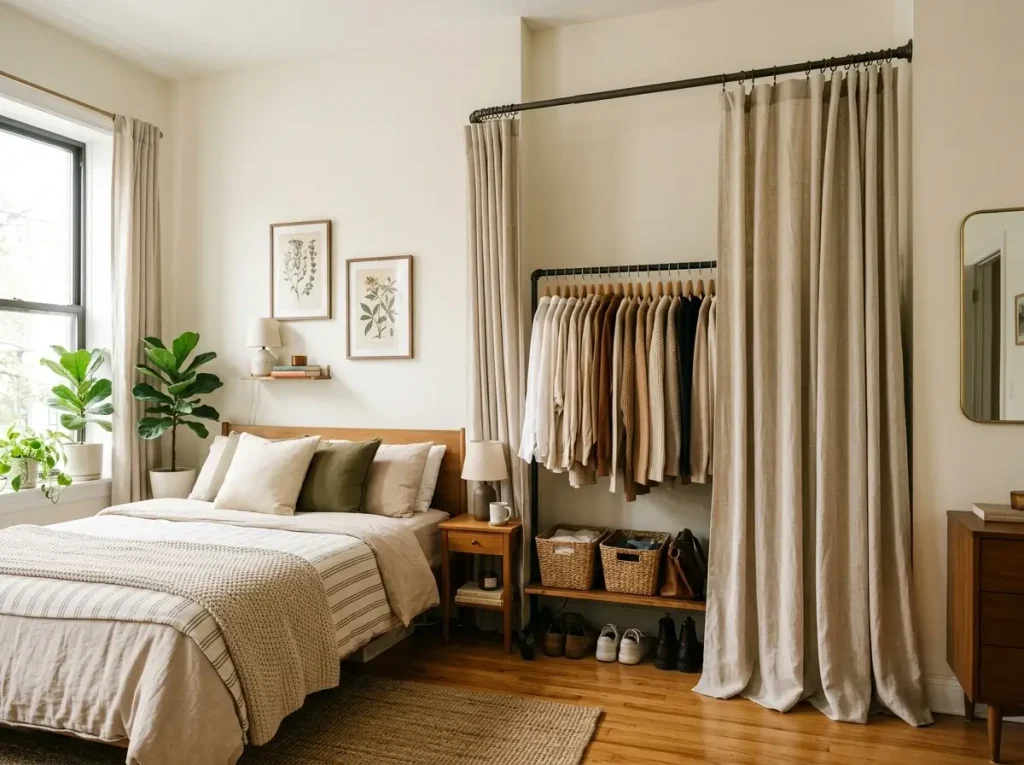
If your rental bedroom lacks a built-in closet, the most effective solution is a freestanding wardrobe rack combined with a heavy-duty tension rod system.
By utilizing the space behind a decorative room divider or blackout curtain, you can create a highly functional makeshift closet without drilling into the walls.
Moving into an apartment only to realize your bedroom lacks a closet is a startling reality for many renters, particularly in older historic buildings or modern micro-studios.
When the architectural structure fails you, implementing the best apartment storage solutions requires building your own freestanding infrastructure.
You cannot simply throw clothes over a chair or stuff everything into under-bed boxes; you need accessible, vertical hanging space to maintain your daily wardrobe and your sanity.
The biggest mistake renters make when building a makeshift closet is drastically underestimating the physical weight of their clothing.
A densely packed row of winter coats weighs significantly more than a row of summer t-shirts.
If you buy a cheap aluminum rolling rack with plastic joints, the central bar will bow under the weight of heavy wool coats within days, eventually snapping or causing the entire unit to violently tip over.
To safely suspend your wardrobe, you must focus entirely on the load-bearing limits of your chosen system.
Below is a structural capacity guide to help you choose the right setup for your specific wardrobe needs:
| Wardrobe System Type | Best For | Max Weight Capacity (Approx) | Tipping Risk |
| Single-Bar Rolling Rack (Plastic Joints) | Light summer shirts, linen, dresses | 30 – 40 lbs | High (if overloaded or moved) |
| Commercial-Grade Z-Rack (All Metal) | Winter coats, heavy denim, suits | 150 – 400 lbs | Low (features a wide, stabilizing base) |
| Freestanding Wardrobe Cabinet (MDF) | Folded sweaters, hidden storage | 50 – 75 lbs per rod | Moderate (requires an anti-tip wall anchor) |
| Wall-to-Wall Tension Rod System | Mixed wardrobes, long dresses | 20 – 45 lbs per rod | Low (if tension is correctly locked) |
Once you select a sturdy metal rack, the next step is concealing the visual clutter. Seeing all your clothing out in the open creates massive visual noise, making a small room feel intensely chaotic.
The most elegant workaround is creating a faux-wall using heavy-duty tension rod options spanning from wall to wall.
By hanging floor-to-ceiling blackout curtains across this rod, you instantly hide your freestanding wardrobe racks behind a clean, fabric barrier.
This strategy stands out as one of the best apartment storage solutions because it completely transforms the architecture of the room without driving a single screw into the drywall.
For renters needing deep-dive tactics specifically tailored to sleeping quarters, exploring strategies for [INTERNAL LINK: maximizing bedroom storage in small apartments | Bedroom Storage Hacks: What to Do When Your Apartment Has No Closet] will help you tackle issues like shoe organization and under-bed clearance.
Always leave at least 12 to 16 inches of clearance between the floor and the bottom of your hanging clothes.
This empty gap allows you to slide interlocking shoe boxes or rigid vacuum-sealed bins directly beneath your garments.
By combining a heavy-duty metal garment rack, a tension-rod curtain divider, and stackable shoe bins underneath, you effectively build a custom walk-in closet in a room that originally had zero storage.
How can I create functional storage in kitchens and bathrooms that lack basic cabinets?
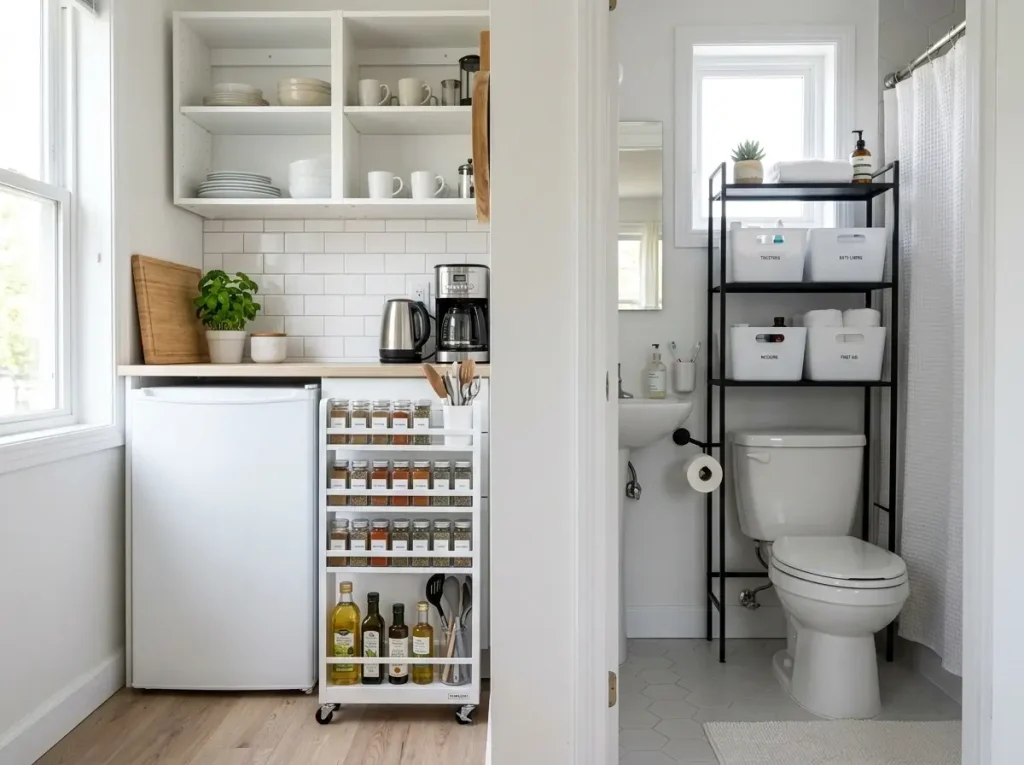
To create functional storage in kitchens and bathrooms lacking basic cabinets, you must utilize over-the-door organizers and narrow rolling utility carts.
These moisture-resistant, slim-profile additions slide into tight gaps beside appliances or toilets, giving you immediate pantry and toiletry space without requiring permanent installation or damaging the property.
The kitchen and the bathroom are the two hardest rooms to organize in any rental property. Because these are “wet rooms,” you cannot simply rely on standard cardboard moving boxes or cheap wood furniture.
When dealing with a severe lack of built-in cabinets, you have to create storage out of thin air while constantly fighting the elements of heat, steam, and daily water exposure.
Finding the best apartment storage solutions for these environments requires a heavy focus on material durability and maximum spatial efficiency.
In a tiny kitchen without a built-in pantry, your counter space usually becomes a dumping ground for groceries and appliances. Never sacrifice your active prep space for static storage. Instead, you must hunt for the micro-gaps.
The standard American kitchen layout almost always leaves a 5-to-8 inch gap between the refrigerator and the wall.
By inserting a narrow, slide-out rolling utility cart into this exact space, you instantly gain a hidden spice rack and canned goods pantry that tucks completely out of sight.
To safely maximize the awkward dead zones in your wet rooms, follow these critical material and placement strategies:
- Over-the-Door Wire Racks: Utilize the back of your bathroom or kitchen door for heavy-duty hanging pantry baskets. Ensure the metal brackets fit securely over standard 1.5-inch to 1.75-inch interior doors without preventing them from closing flush against the frame.
- Moisture-Resistant Materials: Always choose powder-coated steel, rust-proof aluminum, or high-density plastic for bathroom storage bins. Bare wood or untreated MDF will rapidly warp in unventilated spaces, making proper material selection essential for preventing mold on bathroom furniture.
- Magnetic Appliance Shelving: Leverage the bare side of your refrigerator or microwave. Heavy-duty magnetic spice racks can hold up to 10 pounds of glass jars, freeing up precious drawer space without the need for adhesives or screws.
- Under-Sink Tension Rods: Install a small, horizontal tension rod directly underneath the kitchen sink to hang chemical spray bottles by their triggers. This simple trick leaves the base of the cabinet completely free for stacking rigid, slide-out plastic drawers.
Bathrooms in small apartments often lack medicine cabinets or under-sink vanities, leaving you with nowhere to put daily toiletries.
Again, looking upward is key. An over-the-toilet storage étagère that utilizes freestanding legs can add three tiers of vertical shelving without drilling into the bathroom tile.
To maintain organization, group items in opaque plastic bins to reduce visual clutter and protect your cotton goods from ambient shower humidity.
If you are struggling with these specific environmental constraints and awkward layouts, dedicating time to mastering [INTERNAL LINK: rental kitchen and bathroom organization | Maximizing Kitchen & Bathroom Storage Without Cabinets or a Pantry] is crucial.
Remember, the best apartment storage solutions in wet rooms must be entirely waterproof and incredibly easy to wipe down.
By combining over-the-door racks, narrow rolling carts, and rust-proof shelving, you can completely overhaul your daily routines without ever needing a landlord’s permission to install real cabinetry.
What are the most cost-effective ways to increase apartment storage for under $100?
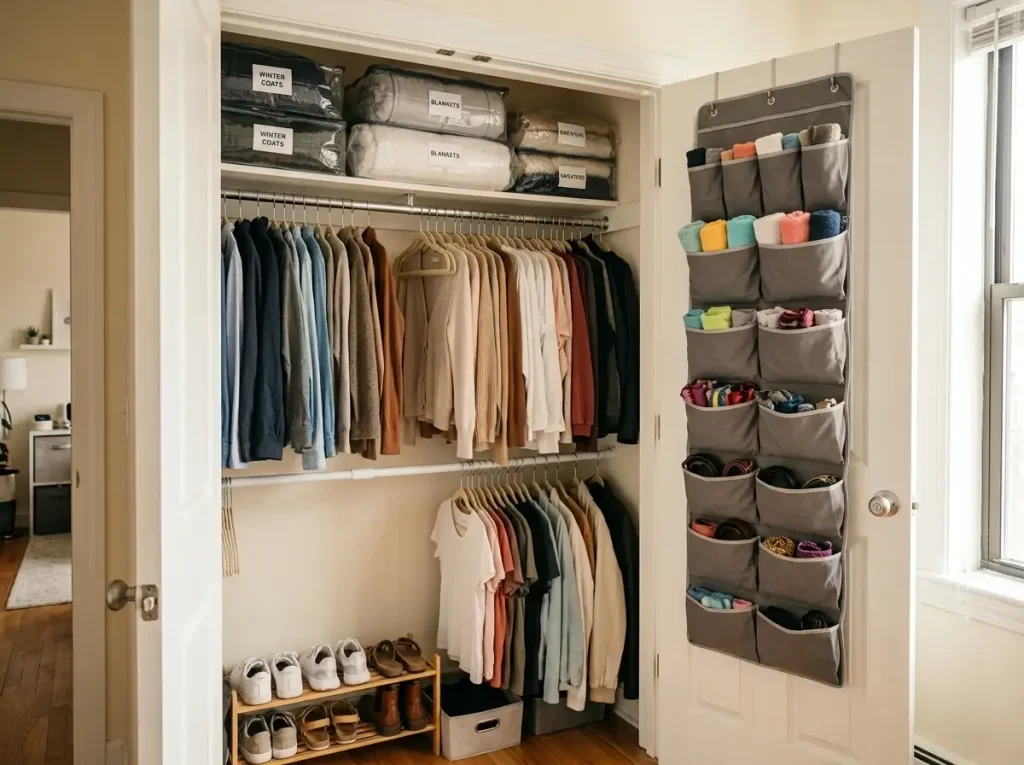
The most cost-effective ways to increase apartment storage for under $100 include investing in vacuum-sealed space bags, collapsible fabric bins, and over-the-door shoe organizers.
These highly affordable items instantly multiply your usable square footage, protecting your budget while transforming cluttered rooms into highly functional, stress-free living spaces.
Renting an apartment comes with significant upfront costs, from security deposits to first month’s rent and moving truck fees.
By the time you unpack your boxes, spending hundreds of dollars on custom shelving or large dressers simply is not a viable option.
Finding the best apartment storage solutions on a strict budget requires shifting your focus away from large wooden furniture and directing it entirely toward high-impact, low-cost spatial multipliers.
The single greatest mistake renters make when trying to organize on a budget is buying cheap, bulky plastic tubs.
A rigid plastic tub occupies the exact same physical footprint whether it is completely full or entirely empty. This is a terrible return on investment for tightly constrained spaces. Instead, your very first purchase should be heavy-duty vacuum compression bags.
Vacuum bags can compress soft goods by up to 80%. When you take four massive winter parkas or a king-sized duvet and compress them into a package the thickness of a folded towel, you instantly create physical space that did not exist before.
When evaluating vacuum storage bag durability, always look for double-zip seals and anti-microbial plastics to protect your off-season clothing from moisture and odors over the course of a long lease.
To truly maximize your financial investment, you need to understand the Spatial ROI (Return on Investment) of each item you purchase. Here is a breakdown of how to perfectly allocate a strict $100 budget to get the maximum amount of usable space across your apartment:
| Storage Item | Estimated Cost | Spatial ROI | Ideal Use Case |
| Heavy-Duty Vacuum Bags (12-Pack) | $25 | Extremely High | Winter clothing, thick duvets, extra pillows |
| Over-the-Door Pocket Organizer | $15 | High | Cleaning supplies, pantry snacks, toiletries |
| Collapsible Fabric Cubes (6-Pack) | $20 | Medium | Socks, cables, folded t-shirts, daily clutter |
| Commercial-Grade Tension Rod | $25 | High | Creating a secondary closet hanging tier |
| Slim Velvet Hangers (50-Pack) | $15 | Medium | Maximizing density on a single closet rod |
By strategically deploying these specific items, you can easily implement the [INTERNAL LINK: budget-friendly apartment storage solutions | Budget Apartment Storage: How to Maximize Space for Under $100] needed to overhaul an entire bedroom or kitchen without taking on debt.
Beyond vacuum bags, leveraging the hidden space behind your interior doors is incredibly lucrative.
An over-the-door shoe organizer is one of the absolute best apartment storage solutions available on the market for under $20.
Never limit these versatile organizers to just shoes. Hang one inside your bathroom door to securely hold hair styling tools, lotions, and rolled washcloths, or place one inside a kitchen pantry door to organize spices, snacks, and small condiment bottles.
Finally, always prioritize collapsible fabric bins over rigid structures. When your lease ends and it is time to pack up again, a set of six fabric cubes will fold entirely flat, taking up zero space in your moving vehicle.
Every dollar spent on these adaptable, space-saving tools is an investment that travels effortlessly with you to your next home.
How can I safely utilize the space under my bed without damaging the apartment’s carpet or flooring?
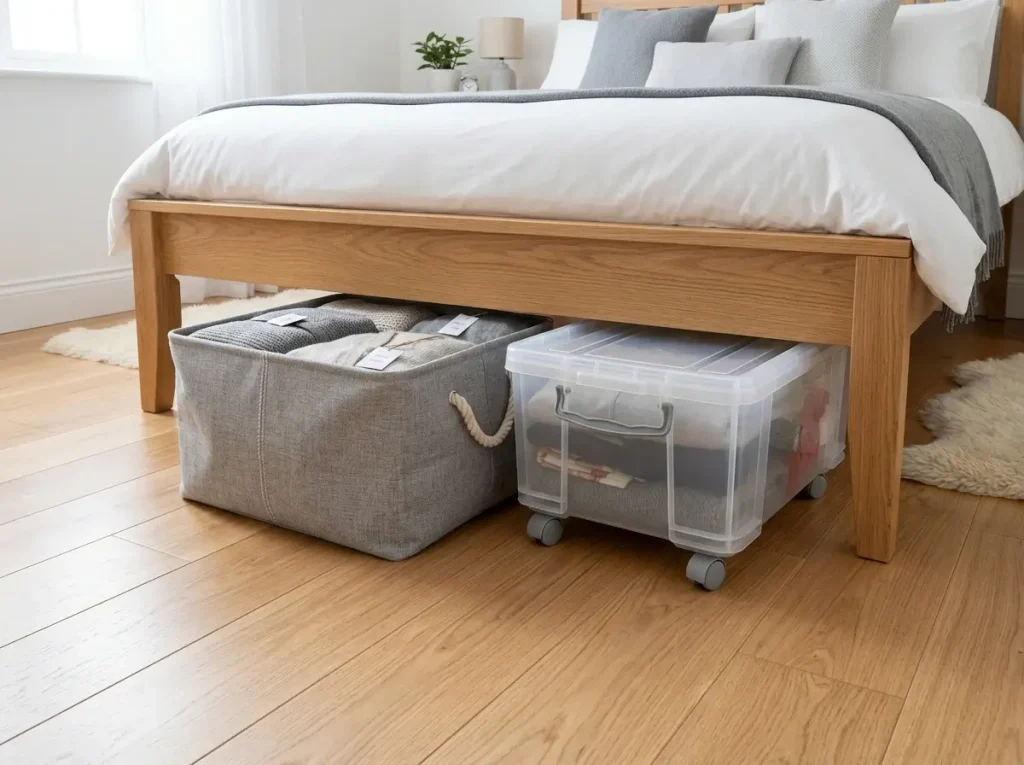
Utilizing the space under your bed safely requires choosing correct bin materials tailored to your specific flooring. Use soft fabric bins or add felt bottoms to containers on hardwood floors to prevent scratching.
Conversely, opt for smooth, hard-plastic bins on heavily carpeted floors to reduce friction and prevent fiber tearing.
The space underneath a traditional bed is one of the most lucrative storage zones in any rental property, often providing the exact equivalent volume of a large six-drawer dresser.
However, recklessly shoving cardboard boxes, heavy wooden crates, or cheap wire baskets underneath is a guaranteed way to lose your security deposit.
When landlords inspect apartments upon move-out, they routinely check for deep gouges in hardwood floors, permanent friction burns in wall-to-wall carpeting, and rust stains left behind by metal bins.
Before investing in the best apartment storage solutions for your bedroom, you must accurately measure your bed’s undercarriage clearance.
Most standard platform beds and basic metal frames only offer between 6 to 8 inches of vertical clearance.
Buying a standard 9-inch rigid plastic tub means you will constantly force and scrape it against the floorboards every single time you need to access your belongings.
Always measure from the floor to the lowest hanging structural component of the bed frame, not just the edge of the mattress.
Another critical rule is to strictly avoid cardboard. Cardboard boxes attract pests like silverfish, absorb ambient moisture from the air, and deteriorate quickly when dragged, leaving paper debris ground into your carpet.
Once you know your exact clearance height, you must match the storage container material directly to your flooring type to completely eliminate the risk of long-term property damage.
| Flooring Type | Approved Storage Material | Damage Risk to Avoid | Recommended Upgrade |
| Soft Hardwood / Laminate | Soft fabric bins, canvas zip bags | Rigid plastic dragging creates deep, permanent gouges | Heavy-duty felt strips applied to the bottom of all bins |
| Thick / Shag Carpet | Smooth, hard-plastic flat bins | Fabric or cardboard creates intense friction and fiber tearing | Large plastic rolling casters |
| Tile / Concrete Floors | Plastic bins with rubber wheels | Hard plastic scraping damages the bin itself over time | Rubberized or polyurethane caster wheels |
Adding casters (wheels) to your bins is a highly popular upgrade, but you must proceed carefully.
Hard plastic wheels will inevitably dent and scratch soft pine or engineered laminate floors if the bin is overloaded with heavy items like textbooks or bulky winter gear.
If you choose wheeled bins, ensure you purchase models exclusively with soft rubber wheels. Alternatively, you can apply heavy-duty floor protection pads to the flat bottom of un-wheeled storage boxes to create a smooth, scratch-free glide across sensitive wood grain.
If your bed sits too low to the ground to utilize any of these options safely, consider using heavy-duty bed risers.
These solid polymer blocks securely elevate your bed frame’s legs by an additional 3 to 5 inches, instantly unlocking the necessary volume for proper under-bed organization.
When combined with the right protective container materials, optimizing this hidden space is undoubtedly one of the best apartment storage solutions for keeping your daily environment pristine while keeping your security deposit fully protected.
What is the most efficient way to hide daily clutter in an open-concept studio apartment?
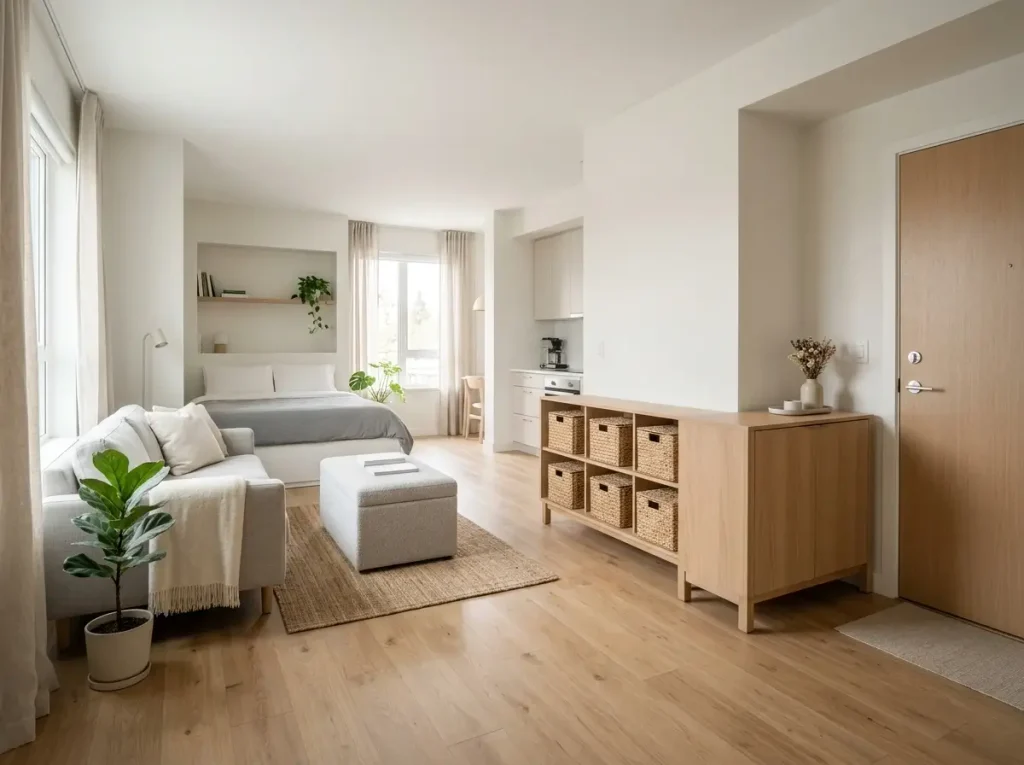
The most efficient way to hide daily clutter in an open-concept studio apartment is by incorporating closed-door storage furniture and opaque baskets.
By assigning specific drop zones near your entryway and utilizing multi-functional ottomans, you can instantly conceal everyday items, drastically reducing visual noise while maintaining a clean, minimalist aesthetic.
Living in a studio apartment means your bedroom, living room, and dining area all share the exact same visual footprint.
When you leave mail on the counter or toss a sweater on a chair, the entire apartment instantly feels messy. To combat this, you must rely on the best apartment storage solutions that prioritize concealment over display.
Open shelving might look stunning in architectural magazines, but in a 500-square-foot studio, displaying all of your possessions simultaneously creates an overwhelming and chaotic environment.
Understanding visual clutter psychology is critical for small-space dwellers. When your visual field is overloaded with varying colors, textures, and unorganized objects, your brain’s cognitive load significantly increases.
This constant processing leads to subconscious stress and fatigue. To truly relax in a micro-apartment, you must remove at least 70% of your daily use items from your direct line of sight.
Here is the exact numbered sequence for efficiently hiding clutter and creating designated organizational zones in an open-concept layout:
- Establish a Dedicated “Drop Zone”: The moment you walk through the door, you need a hidden place for your keys, mail, and bags. Never let entryway clutter travel further into the apartment. Use a slim, closed-drawer console table or a wall-mounted flip-down shoe cabinet positioned directly next to the front door to trap the mess immediately.
- Swap Clear Bins for Opaque Containers: Clear plastic bins are excellent for deep closet organization, but they are disastrous when placed out in the open. Seeing the chaotic shapes and colors inside a transparent box entirely defeats the purpose of putting things away. Always upgrade to solid-colored fabric cubes, woven rattan baskets, or frosted glass cabinets to instantly neutralize visual noise.
- Deploy the “Hollow Furniture” Rule: In an open-concept space, every piece of resting furniture must double as a storage vault. Implementing the best apartment storage solutions means replacing your standard seating with hollow storage ottomans and swapping a traditional bed frame for a lift-top bed. This allows you to stash bulky blankets, fitness gear, and electronics completely out of view within seconds.
- Digitize the Paper Trail: Paper clutter is the silent killer of studio apartments. Sort your mail immediately over a recycling bin, and invest in a small desktop scanner or use a mobile scanning app to digitize important documents. Keeping a physical filing cabinet in a tiny open-concept room wastes precious square footage that should be reserved for your active living space.
By strategically prioritizing closed-door furniture and establishing strict boundaries for incoming items, your open-concept studio will immediately feel larger, calmer, and significantly more organized.
Conclusion: Final Thoughts on Maximizing Your Rental Storage

Navigating strict rental constraints does not mean you must sacrifice living in a beautifully organized home.
By prioritizing modular designs, leveraging vertical real estate, and utilizing drill-free hacks, you can build a highly functional, easily movable living space. If you found these apartment storage strategies helpful, please share this guide with fellow renters!
Finding the best apartment storage solutions ultimately requires a fundamental mindset shift.
You are no longer just decorating a room; you are actively engineering a high-efficiency living space that must adapt to strict landlord rules, tight floor plans, and inevitable future relocations.
The days of hauling massive, fragile particleboard dressers up three flights of narrow stairs are over.
Instead, modern renting demands agility, structural durability, and a profound respect for the property’s physical boundaries.
Before you purchase a single tension rod, adhesive hook, or modular cube, the absolute most critical step is an extensive, line-by-line lease review.
Always verify your specific lease terms regarding wall attachments before buying heavy storage infrastructure.
Many well-meaning renters wrongly assume that filling small nail holes with white spackle upon move-out is perfectly acceptable.
They do this only to be hit with massive, unexpected deposit deductions because the property management contract explicitly stated “no wall punctures of any kind.”
Your security deposit is precious capital, and protecting it must remain the primary foundation of your entire organizational strategy.
To guarantee your long-term success and protect your wallet, always filter your potential furniture and organizational purchases through these final three foundational rules:
- Invest in Relocation Resilience: Only buy items that can be easily disassembled without power tools and packed completely flat. Heavy-duty wire grids, metal folding racks, and friction-based joints will outlast cheap wooden cam-locks and dowels every single time.
- Respect the Architectural Micro-Gaps: Never ignore the empty 6 inches next to your refrigerator, the awkward corner behind an open door, or the unused 24 inches directly above your wardrobe. The best apartment storage solutions ruthlessly exploit these architectural dead zones to keep your main living space and active walking paths completely wide open.
- Prioritize Damage-Free Tension and Adhesion: When in doubt, utilize heavy-duty vertical tension poles or freestanding gravity-leaning shelves. If you must use sticky adhesives, always calculate the object’s total weight limit against the fragile tensile strength of standard flat builder-grade paint, not just the plastic hook’s advertised rating.
Remember, a heavily organized apartment dramatically lowers daily subconscious stress and cognitive fatigue.
By deliberately controlling what enters your home, leveraging vertical airspace, and strategically hiding daily visual clutter behind opaque doors, you can seamlessly transform even the most cramped, awkward studio into a peaceful, highly functional oasis.
You hold the power to dictate exactly how your space functions, regardless of its original structural layout.
Thank you for exploring this ultimate master-guide. If you successfully transformed your rental using these drill-free hacks, budget-friendly layouts, and modular furniture concepts, we highly encourage you to pass this knowledge along.
Please share this article on your favorite social platforms or directly with friends to help other renters and frequent movers reclaim their limited square footage!