
Did you know that the average military family moves every two to three years?
That is a staggering amount of cardboard boxes to manage!
When I faced my first relocation, I thought I was prepared, but I quickly learned that hope is not a strategy.
I remember staring at a mountain of unorganized paperwork, missing forms, and thinking, “There has to be a better way to survive this process.”
That is exactly why I put together this guide to help you build an unbreakable system.
Here is what we are going to fix today:
- The endless paper trail
- The packing confusion
- The timeline panic
Let’s dive into the ultimate system to reclaim your sanity!
The Foundation: Essential PCS Move Organization Tips for 2026
Let me tell you about my very first Permanent Change of Station. It was a total disaster!
I thought I could just throw things in boxes and figure it out later. Boy, was I ever wrong about that.
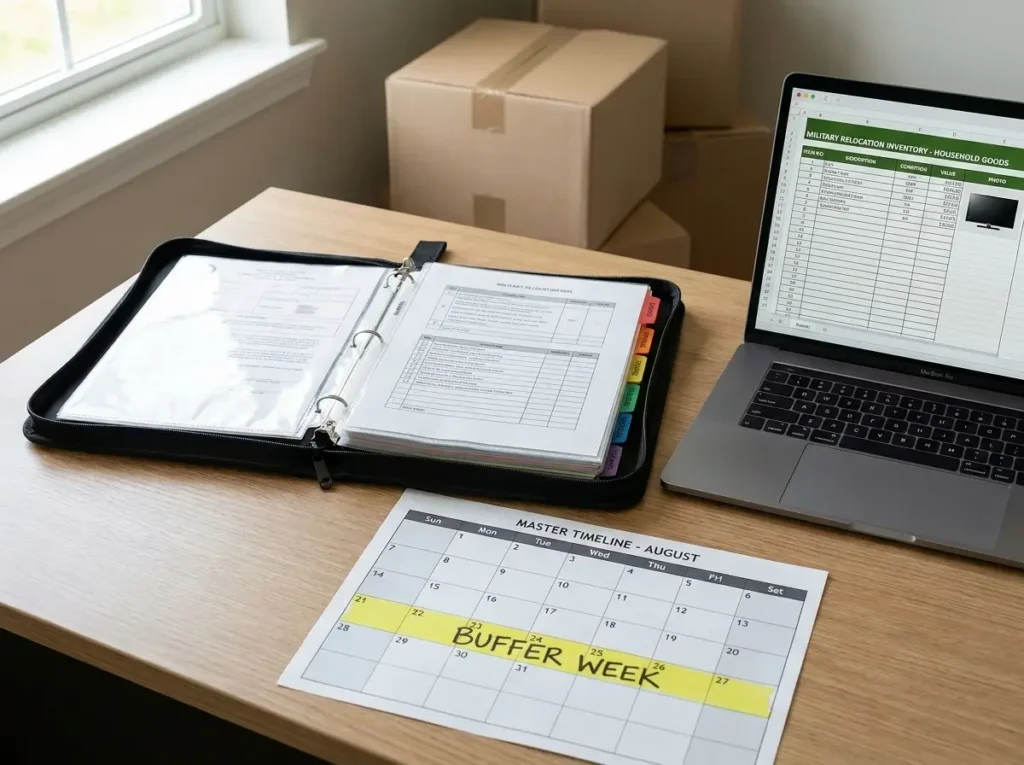
Building the Ultimate PCS Binder
The basic military moving guide they hand you is usually just a stack of confusing papers. You need an actual command center to survive this whole process.
During my second move, my husband’s orders was lost by the transportation office right before we left. Panic mode activated!
Since then, building a physical and digital PCS binder is my absolute number one rule for keeping my sanity.
To make a foolproof binder, you should buy a heavy-duty 2-inch D-ring binder with zipper closures. You don’t want important documents flying out in the wind on moving day.
Next, grab some plastic page protectors and dividers with tabs.
- Tab 1: Put your physical orders in the very front.
- Tab 2: Keep all medical and dental records here.
- Tab 3: Store school transcripts and birth certificates.
It is recommended by experts that you scan every single page into a secure cloud app. That way, if the moving truck catches on fire (yes, I have heard horror stories), your life isn’t totally ruined.
The Master Timeline with Buffer Weeks
You can’t just wing a military relocation checklist and hope for the best. You need a master timeline that works backwards from your moving day.
I used to just write the word “pack” on the calendar about a week before the movers came.
That silly mistake left me crying on the kitchen floor at 2 AM, completely surrounded by Tupperware and old receipts.
Now, I start my timeline exactly eight weeks out from the day the truck arrives.
Here is the secret trick: you gotta build in “buffer weeks” for when things inevitably go off the rails.
- Week 8 to 7: Focus on pre-move decluttering and scheduling your household goods shipment.
- Week 6 to 5: Tackle sorting the garage and attic, which are always the hardest parts!
- Week 4: Buffer week! Use this free time to catch up on whatever tasks you didn’t finish.
Having that cushion week makes a huge difference for your mental health.
Your Digital Inventory Spreadsheet
Before the packers even step foot in your house, drafting a digital inventory spreadsheet is a total game changer.
I learned this the hard way when our expensive flat-screen TV was broken by the movers.
Because an inventory wasn’t made by me beforehand, the PCS claims process took over six months to finish. Ugh.
Don’t be like me on that move! Create a simple spreadsheet to track your belongings before the chaos starts.
Make columns for the item name, serial number, estimated value, and which room it belongs in.
Take wide-angle photos of every single room, and then snap close-ups of your electronics, serial numbers, and valuables.
This military packing tip literally saved us thousands of dollars on our last OCONUS move.
Establishing a reliable foundation like this keeps you ahead of the military’s crazy, shifting timelines.
It ain’t rocket science, but it definitely takes some discipline to sit down and do it.
Once your command center is completely built, the rest of your DITY move guide just falls right into place.
Taming the Paperwork: A Military Moving Command Center
Let me tell you about the time my entire moving reimbursement was almost denied by the finance office.
It was an absolute nightmare.
I showed up with a disorganized folder of crumpled receipts, completely missing the empty weight ticket for my rental truck.
The clerk just looked at me and said, “No empty weight ticket, no payment.”
That one mistake cost me weeks of delays and so much unnecessary stress!
Since then, I have completely overhauled my paperwork system.
The Essential Documents You Cannot Lose
Gathering essential documents is the very first thing you need to do when those PCS orders drop.
You absolutely cannot trust the movers or the system to keep track of your family’s records.
Start by getting physical copies of your medical records, dental records, and school transcripts.
You should also print out at least ten copies of your official orders.
I know it sounds excessive, but literally every office on base will ask for a copy when your out-processing.
Keep all of these critical files tucked safely inside your PCS binder setup.
It goes with you in the car, never in the back of the moving truck!
Why Cloud Storage Will Save Your Bacon
While physical binders are great, utilizing secure cloud storage apps is how you actually survive a modern move.
I use to just stuff all my moving expenses into a random shoebox.
That was totally fine until my kid spilled a giant cup of juice all over my military travel vouchers.
Oops!
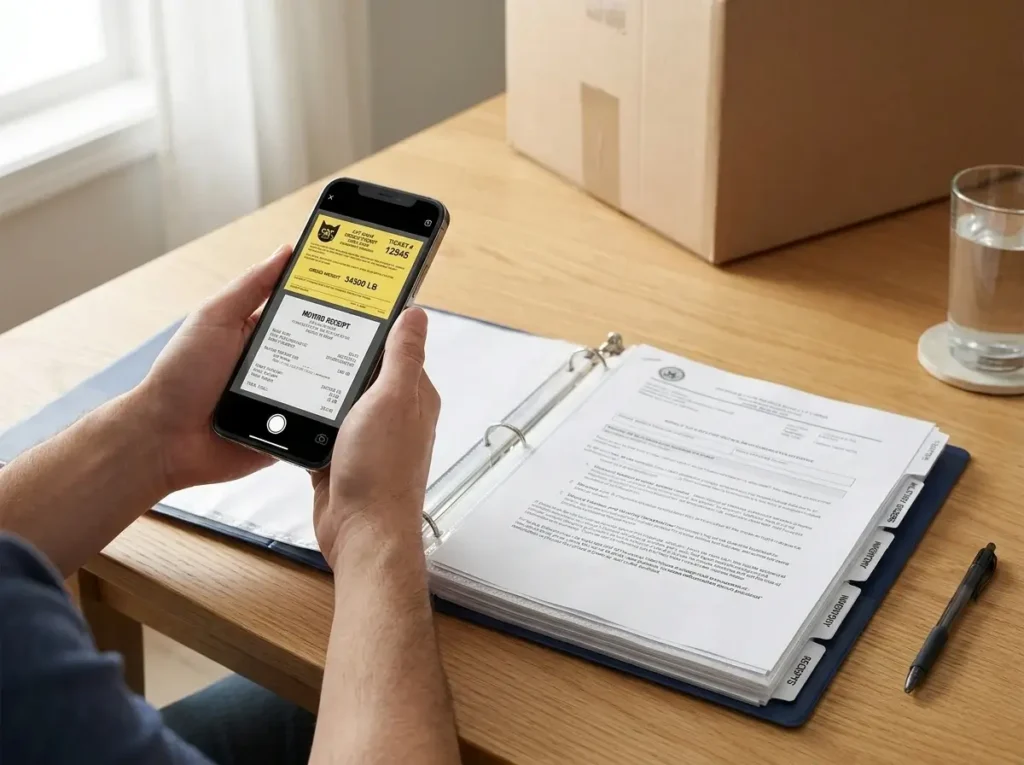
Now, every single time I buy packing tape, rent a truck, or stay in a hotel, a photo is snapped by me immediately.
Upload those pictures to an app like Google Drive or Dropbox.
Create specific folders for things like your “TLE reimbursement” and “dislocation allowance.”
If you ever need to file a claim later, having digital backups makes the PCS claims process a total breeze.
Mastering PPM Weight Tickets and Expense Logs
If you are doing a Personally Procured Move, your paperwork system literally translates to cash in your pocket.
To get your 100% reimbursement, managing your PPM weight tickets and expense logs has to be your top priority.
Here is the golden rule: you must get certified empty and full weight tickets from a place like a CAT Scale.
When you get weighed, make sure your gas tank is totally full and nobody is sitting in the vehicle.
If you mix those up, the transportation office can reject your DD Form 2278 and your travel voucher.
Also, track every single penny you spend on a moving inventory spreadsheet.
I always keep a running list of tolls, rental fees, and packing boxes.
By having my expense logs perfectly organized, my last DITY move payout hit my bank account in less than two weeks!
Taming the paperwork beast isn’t the most glamorous part of military life.
But when you get that massive reimbursement check, all that boring filing work feels totally worth it!
Packing Strategies: Next-Level PCS Move Organization Tips

I seen the government contractors pack a literal bag of garbage from my kitchen during my second move.
I opened a box marked “Kitchen Misc” at our new house, and the smell of rotting banana peels hit me like a truck. Gross!
You really cannot control the movers on a permanent change of station.
But you can absolutely control how your house is prepped before they even show up.
Applying some next-level military packing tips is the only way to survive the chaos.
Color Coding Your Way to Sanity
During my early moves, I just let the packers write on the boxes with a black marker.
That meant I was running around like a headless chicken trying to read sloppy handwriting on delivery day.
“Where does this box go, ma’am?”
I was asked that question about five hundred times, and it drove me absolutely bonkers!
Now, color coding moving boxes is my ultimate secret weapon for the delivery phase.
I buy thick rolls of brightly colored duct tape from the hardware store.
- Neon Pink: The master bedroom
- Bright Green: The kitchen
- Electric Blue: The kids’ rooms
Before the movers even start, a swatch of tape is placed by me on the doorframe of every single room.
When the truck gets unloaded, the movers just match the pink tape on the box to the pink tape on the door.
It speeds up the whole delivery process, and your unpacking strategies will thank you later!
The Lifesaving “Open First” Box
Have you ever arrived at an empty house after a three-day drive, only to realize you don’t have toilet paper?
I have, and let me tell you, using fast-food napkins is a total rookie mistake.
You need to pack a highly visible first day moving box.
This box travels in your personal car, never in the back of the moving truck!
What exactly goes in it?
- Two rolls of toilet paper and antibacterial hand soap.
- Basic tools like a box cutter, screwdrivers, and a hammer for reassembling beds.
- Paper plates, pet food, snacks, and some heavy-duty trash bags.
When you walk into your empty new duty station, this box is your instant survival kit.
Bulletproof Photo Inventories
Here is a hard truth about military relocations: things are going to get broken.
My favorite antique mirror was smashed into a million pieces by the movers back in 2020.
When I tried to file a claim, they said I had no proof of its condition beforehand.
I was so mad I could have spit fire!
Now, extensive photo inventories are taken by me the week before the packers arrive.
I walk through the house taking wide-angle shots of every single room to show the general condition.
Then, I get up close and personal with my high-value items, taking pictures of the serial numbers on TVs and computers.
Make sure you get clear shots of the corners of your wooden furniture, too.
If a scratch suddenly appears, those photos are your golden ticket to winning the PCS claims process.
Uploading everything to the Defense Personal Property System is so much easier when you have solid proof.
These packing strategies really do turn a chaotic mess into a manageable mission.
It takes some serious elbow grease up front, but future you will be so happy when unpacking is a breeze!
Pre-Move Purge: How to Lighten Your Household Goods (HHG) Load

Let me confess my biggest moving sin from back in the day.
During our third CONUS relocation, I just couldn’t let go of anything and packed literally every single item we owned.
I didn’t think about my husband’s HHG weight allowance for a single second!
We went 1,500 pounds over our limit, and a massive debt collection letter was sent to us by the military.
Ugh.
That one silly mistake cost us over twelve hundred dollars right out of our own pockets.
Since that disaster, I realized a permanent change of station is the absolute best time to ruthlessly edit your junk.
Why let the government pack items you don’t even use anymore?
The Keep, Sell, Donate, and Trash Method
You really gotta start your pre-move decluttering at least a solid month in advance.
If you wait until moving week, you will totally panic-pack a drawer full of broken phone chargers and loose screws.
To get organized, four giant cardboard boxes are set up by me right in the middle of the living room.
They are labeled in big black marker: Keep, Sell, Donate, and Trash.
You must be ruthless during this phase, my friends!
If you haven’t worn a sweater since your last OCONUS move checklist, it immediately goes in the donate pile.
A great military packing tip is to toss anything expired in your pantry, bathroom, and medicine cabinet.
You definitely do not need to ship half-empty bottles of cheap lotion across the country!
Knowing Your Exact Weight Limits
Before you start dreaming about your new house, you need to understand your specific rank limits for your household goods shipment.
Every single pay grade has a totally different cap, and whether you have dependents changes the math completely.
For example, an E-5 without dependents gets 7,000 pounds, but an O-3 with dependents gets up to 13,000 pounds!
If you don’t know your exact number, you are flying completely blind on this move.
A quick phone call to the military housing office can give you the exact charts for the current year.
Your military family transition will be way less stressful when you actually know your target weight limit.
I usually estimate our heavy furniture by looking up the exact models online.
A basic spreadsheet is used by me to add up our big ticket items so we don’t get a nasty surprise later.
Funding Your Trip with a Pre-PCS Garage Sale
Let’s be real, moving ain’t cheap even when Uncle Sam is paying the main bill.
There is always hidden costs on your out-processing checklist and random gas station meals to buy for the kids.
Hosting a massive garage sale is my absolute favorite way to lighten our load and stack some extra cash!
Military base yard sales are super legendary because everyone is always coming and going.
Take all the nice stuff from your “Sell” pile and price it to move fast.
Pro tip: Baby gear, lawnmowers, and extra tactical gear always sell like hotcakes!
Don’t be greedy with your pricing; making fifty cents is better than having to haul a heavy lamp to the dump.
The cash from my last yard sale was used by us to cover three extra hotel nights while we waited for our TLE reimbursement.
Doing a serious pre-move purge is literally the smartest thing you can do before the packing crew arrives.
By shedding all that unnecessary weight, you won’t be sweating bullets when those final personally procured move weight tickets are processed!
Arrival and Unpacking: Setting Up Your New Duty Station

I still get a massive knot in my stomach every time I see that giant moving truck pull up to our driveway.
During our third move, I honestly thought the hard part was totally over once the driver parked the rig.
Boy, was that a rookie mistake!
My brand new house quickly turned into a literal warehouse of brown boxes, and I couldn’t even find my own bed for three days.
I actually sobbed into a box of winter coats because I was so insanely overwhelmed by the mess.
That is why having a solid plan for delivery day is just as important as your packing plan!
Inspecting Everything Before the Driver Leaves
You have to stay super vigilant during the offloading phase, even when you are dead tired from driving cross country.
A huge, nasty gash on my antique dining table was completely missed by me because I was hiding in the bathroom to stay out of the way.
When you sign that final piece of delivery paper, you are basically telling the government that everything arrived perfectly.
- Check your numbers: Cross off every single inventory sticker as it physically comes off the truck.
- Inspect the big stuff: Look closely at the corners of your couches and the wooden legs of your tables.
- Document the damage: Take clear, well-lit photos of any broken items while the movers are standing right there.
If a box looks like it was crushed by an elephant, make the driver open it right then and there!
It feels a little awkward to be “that person,” but this is your hard-earned stuff we are talking about.
Mastering this part of the PCS claims process is one of my absolute top military spouse moving tips.
Filing a claim through the DPS moving portal is a massive headache if you don’t note the damage on the delivery day paperwork.
Unpacking Strategies for Your Sanity
Once the movers finally drive away, the sheer volume of cardboard in your house will make you want to pull your hair out.
Please don’t start unpacking your fancy china or your living room decorations first!
At my first duty station, the big flat-screen TV was set up by my husband right away, but we had zero sheets for our mattresses at midnight.
Talk about a massive fail!
Effective unpacking strategies always, always start with the bedrooms and the bathrooms.
You absolutely need a clean, cozy place to sleep and take a hot shower after a chaotic delivery day.
- Find the hardware: Locate the parts box first so you can rebuild the beds.
- Make the beds: Put fresh sheets on immediately so you can crash whenever you run out of steam.
- Set up the kitchen basics: Just get your coffee maker, some paper plates, and your basic pots out of the boxes.
The rest of the house can totally wait until you finish your in-processing new duty station tasks.
Finding Your People at the New Duty Station
Moving to a brand new base feels super lonely, especially if you are stuck living out of a suitcase on a base housing waitlist.
I used to just sit in my messy house and feel totally sorry for myself for the first two weeks.
But then I realized that leaning on the local military community resources is the quickest way to actually feel at home!
Before you even arrive, you should definitely connect with the sponsor program military office.
Your sponsor can tell you which grocery stores are the cheapest and which base gates get super backed up in the morning.
Don’t be afraid to ask random questions on the local spouse Facebook pages, either.
“Hey, who has the best pizza delivery in town?” is a great way to break the ice and feed your tired family!
A perfectly stress free military move doesn’t really exist in the real world.
But making a few local connections right away definitely softens the blow of starting over.
You got this, so take a deep breath, plug in that coffee maker, and start making this empty house your home!
Conclusion
Moving your entire life across the country—or the globe—is never going to be perfectly smooth.
But it doesn’t have to be a total nightmare, either!
By implementing these strategies, you are taking back control of the chaos.
You have the power to turn a highly stressful military transition into an efficient, manageable process.
Now, grab a heavy-duty binder, print out your orders, and start building your master plan.
Which of these organizational systems are you going to set up first? Let me know in the comments below!